The Unforgiving Mathematics of Reinforcement Learning Post-Training for Large Language Models and the Innovative Solution of Co-operative Time-Slicing

The intricate mathematical underpinnings of reinforcement learning (RL) post-training for large language models (LLMs) present a formidable challenge for AI researchers. As leading AI laboratories push the frontiers of model capabilities in reasoning and coding through sophisticated RL post-training algorithms like Group Relative Policy Optimization (GRPO), they frequently encounter significant architectural and infrastructural limitations. While the industry’s attention is often directed towards acquiring vast quantities of accelerator hardware, the efficiency of the underlying infrastructure is equally crucial for achieving the high velocity required to execute multiple RL jobs concurrently and elevate models to unprecedented levels of intelligence.
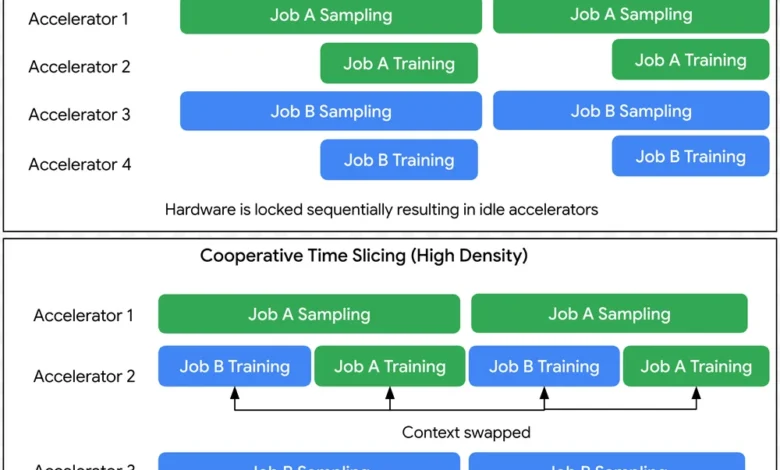
At scale, distributed RL training is plagued by severe resource bottlenecks. Traditional synchronous sampling and training methodologies operate in strictly sequential phases, leading to significant periods where trainer and sampler resources sit idle, alternating between states of inactivity. While asynchronous architectures attempt to overlap these phases, trainers still experience frequent idle gaps, waiting for specific trajectory batches to complete before initiating the next training cycle. This structural inefficiency represents a substantial waste of computational resources, directly impacting the pace of AI advancement and the cost-effectiveness of developing cutting-edge LLMs.
Addressing this pervasive problem, a novel solution has emerged: co-operative time-slicing, introduced through the groundbreaking llm-d project. This innovative approach redefines how discrete RL steps, such as sampling rollouts and gradient training, are managed. By treating these operations as dynamic, schedulable entities, the llm-d project enables the interleaving of independent RL jobs onto shared physical hardware. Initial benchmarks have demonstrated a remarkable improvement in aggregate accelerator duty cycles, boosting them from a baseline of approximately 40% to a substantial 70%, without compromising model convergence or accuracy. This breakthrough not only enhances price-performance but also significantly lowers the total cost of ownership (TCO) by mitigating the considerable waste of compute power incurred over time.
For synchronous RL setups, the platform intelligently interleaves both samplers and trainers, thereby minimizing alternating idle windows. Asynchronous workloads, on the other hand, leverage time-slicing to dynamically reclaim and utilize the fragmented idle gaps that occur between RL-trainer iterations. This represents a paradigm shift in how RL workloads are managed, moving from rigid sequential execution to a more fluid and efficient cooperative model.
The Challenge of RL Loops: Inefficiency at Scale
The fundamental structure of distributed RL post-training involves a fragmented, continuous cycle that alternates between generation (sampling rollouts) and optimization (gradient updates). Conventional cloud infrastructure, designed for stable, continuous workloads, struggles to adapt to this inherently alternating cadence. This mismatch means that standard Kubernetes clusters are ill-equipped to handle the dynamic demands of RL training.
At scale, this structural cadence manifests in two major systemic inefficiencies:
-
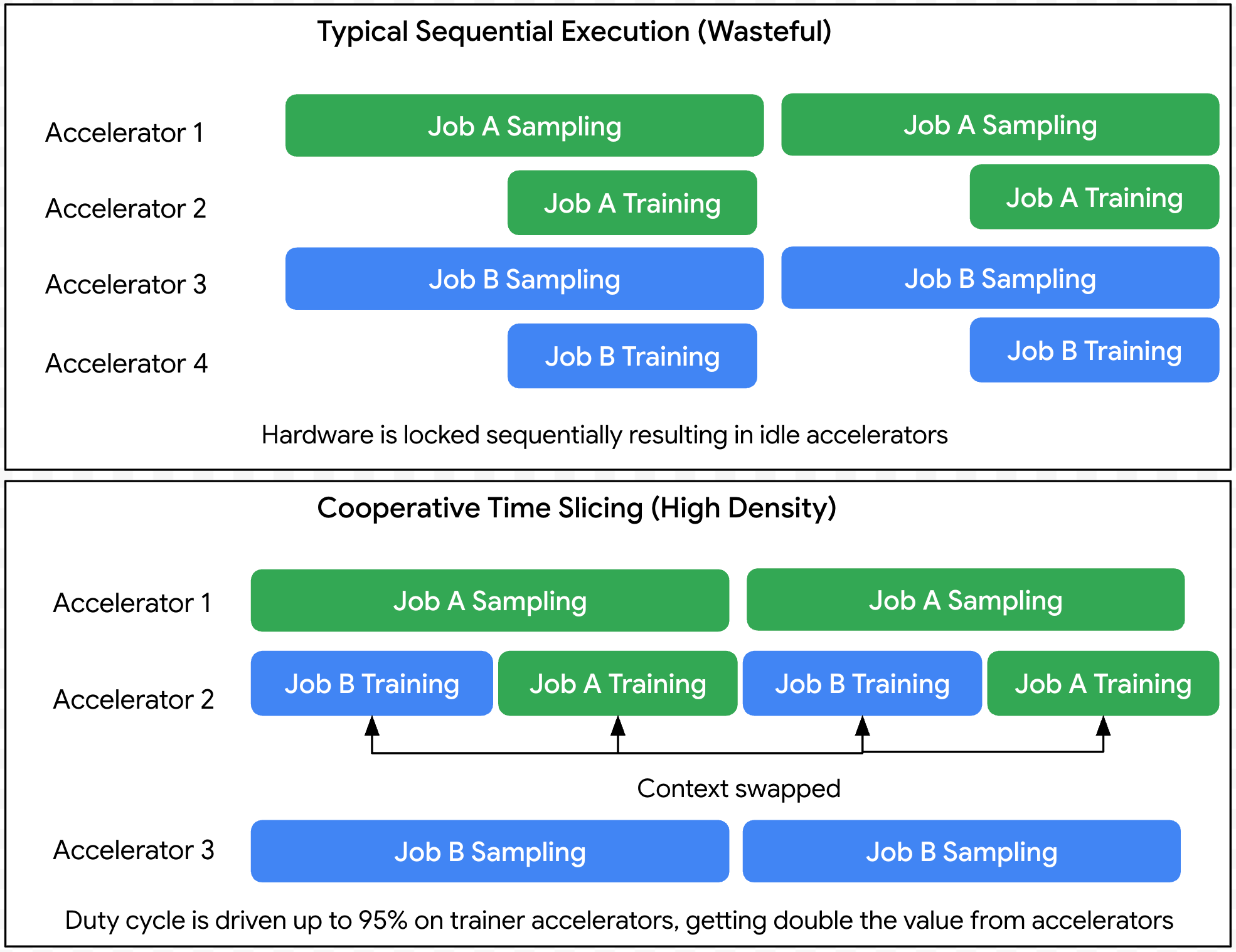
Resource Starvation and Idle Time: In synchronous RL, the sequential nature of sampling and training leads to significant idle periods. When the sampling phase is active, trainers are idle. Conversely, when training is underway, the samplers are idle, waiting for the training process to complete before they can generate new data. This back-and-forth results in a substantial underutilization of expensive accelerator resources. Even in asynchronous RL, where generation and training are overlapped, the generation phase often becomes the bottleneck. Trainer accelerators can still starve while waiting for sufficient rollout data to accumulate. The closer an asynchronous job runs to being "on-policy" (meaning the data used for training closely matches the current policy), the larger these idle windows become, as the pipeline stalls when fresh rollouts are not immediately available.
-
Synchronization Bottlenecks: The need for strict synchronization in traditional RL setups creates inherent bottlenecks. Any delay in one phase directly impacts the start time of the next, cascading throughout the training process. This rigid dependency amplifies the impact of even minor inefficiencies, leading to extended training times and increased costs.
The introduction of the llm-d project signifies a proactive effort to address these deeply entrenched inefficiencies. Recognizing the critical need for optimized infrastructure, the developers have engineered a highly composable stack designed to eliminate accelerator idle time across inference, agentic, and RL workloads. The llm-d stack for RL is built upon the principle of maximizing resource utilization through intelligent orchestration.
Co-operative Time-Slicing: A Paradigm Shift in RL Job Interleaving
The core innovation of the llm-d project lies in its co-operative time-slicing mechanism. This system allows the infrastructure to dynamically interleave independent RL jobs onto shared hardware blocks, effectively preventing accelerators from waiting idly for upstream phases. This approach is instrumental in driving up aggregate accelerator utilization without any adverse effects on model convergence or accuracy.
The operational principle is straightforward yet powerful. When one RL job, say Job A, becomes idle at a phase boundary in synchronous RL, or stalls waiting for fresh rollout data in asynchronous RL, the infrastructure intervenes. It time-slices the physical accelerators, seamlessly swapping in the active sampling or training phase of another independent job, Job B.
This "swap" is a sophisticated checkpoint and restore operation. Job A’s entire device state is meticulously checkpointed, moving from the accelerator’s memory into host DRAM. Subsequently, Job B’s previously saved state is restored in its place on the accelerator. Crucially, only one job’s state occupies the accelerator at any given moment, ensuring that these state transitions occur safely without any framework-level interference or the dreaded out-of-memory (OOM) faults. This method ensures that accelerators remain consistently engaged in productive computation, rather than sitting dormant.
High-Level Architecture of Time-Slicing
The time-slicing system is architecturally organized into three distinct, yet interconnected, layers:

-
Workload-Scoped Layer (Application Runtime): This layer is where the user’s code—including training loops, inference servers, and RL frameworks—executes. A critical new component here is the time-slice client library. This library exposes two essential gRPC APIs to the time-slice orchestrator:
acquire(), used to request exclusive accelerator access, andyield(), used to release that access. Users are guided to wrap any accelerator-intensive phase of their application with these calls. This effectively signals phase boundaries to the orchestrator, enabling the system to manage resource allocation dynamically. Importantly, the underlying ML framework (such as PyTorch FSDP or vLLM), the CUDA context, and accelerator memory allocations remain entirely unmodified, ensuring minimal disruption to existing workflows. -
Cluster-Scoped Layer (Control and Orchestration Plane): This layer is the brain of the operation, responsible for deciding which job gains accelerator access and when. Jobs that share the same physical accelerators—for instance, two RL jobs interleaving on a set of GPU nodes—are grouped together. For each such group, a time-slice orchestrator maintains a lock queue. This queue is an ordered list of jobs waiting for exclusive access to the group’s accelerators. Only the job at the head of the queue currently holds the lock and is permitted to run on the hardware. All other jobs remain blocked, waiting on their
acquire()calls. When the currently running job callsyield(), the orchestrator seamlessly transfers the lock to the next job in the queue and initiates a coordinated context switch across all nodes within the group. Future enhancements to this layer will include a workload placement optimizer. This optimizer will be capable of profiling workload phase patterns and automatically pairing jobs with complementary idle phases, thereby eliminating the need for users to explicitly define job groupings. -
Node-Scoped Layer (Hardware and Data Plane Isolation): This layer is responsible for executing the checkpoint/restore swap directly on each accelerator node. The snapshot agent, a privileged DaemonSet, receives directives from the orchestrator and translates them into low-level hardware operations. This includes pausing accelerator processes, serializing the device state to host DRAM, and restoring it when the job regains access. The agent is built upon a pluggable backend interface, with
cuda-checkpointserving as the initial implementation. Future backends are expected to introduce faster snapshot mechanisms and more selective offloading capabilities, such as offloading only specific memory addresses like LoRA adapters, rather than the entire device state. The snapshot agent is designed for standalone operation, capable of running outside Kubernetes in bare metal and Slurm environments, enhancing its versatility.
The Flow: A Seamless Transition
The entire process is orchestrated to ensure smooth and efficient transitions between RL jobs. When a workload completes its current accelerator phase, its time-slice client library invokes the yield() call to the time-slice orchestrator, signaling its release of accelerator access. The orchestrator then initiates the context switch by dispatching directives to the snapshot agent on each node within the affected group. The snapshot agent promptly freezes the yielding workload’s processes and meticulously moves its device state from the accelerator’s memory into host DRAM.
With the accelerators now vacant, the orchestrator grants the group lock to the next workload waiting in the queue. It then directs the Snapshot Agents on those nodes to restore that waiting workload’s previously saved state from host DRAM back into the accelerator’s memory. Following this restoration, the agent unblocks the workload’s pending acquire() call. The workload then resumes execution precisely from where it left off, without the need for any container restarts, framework reinitialization, or model reloads from storage.
The yielding workload’s state remains "warm" in host DRAM, ready for its next turn. When the orchestrator grants it the lock again, the Snapshot Agents perform the same swap operation, but in reverse, loading the state back onto the accelerator.
Developer Experience (Client-Side)
A key design consideration for the llm-d project is minimizing the impact on developers. Researchers and engineers are ideally positioned to focus on core modeling logic rather than grappling with the complexities of low-level CUDA context switching or custom scheduling loops. For those utilizing platforms like Ray or similar orchestrators for their RL jobs, integrating time-slicing is expected to have a minimal, if any, impact on the client side. In many scenarios, if training and sampling jobs are already being queued separately at the platform level, there may be no discernible client-side modifications required at all.

Current Release and Future Outlook
The llm-d project is marking a significant milestone with the release of its complete time-slicing stack. This includes the Snapshot Agent, the Accelerator Orchestrator, and comprehensive Python client libraries. A detailed user guide is available, providing clear instructions for integrating time-slicing into existing RL workflows.
Key highlights on the project’s future roadmap include:
-
Enhanced Snapshotting Mechanisms: Future developments will focus on optimizing snapshotting speed and efficiency. This includes exploring techniques like offloading only specific model components (e.g., LoRA adapters) rather than the entire device state, drastically reducing checkpointing and restoration times.
-
Advanced Workload Orchestration: The introduction of a sophisticated workload placement optimizer is a significant step towards automating resource allocation. This optimizer will intelligently pair jobs with complementary idle phases, further maximizing hardware utilization and simplifying the user experience.
-
Broader Framework and Hardware Support: The project aims to expand its compatibility with a wider range of ML frameworks and hardware accelerators, making its benefits accessible to a larger segment of the AI research community. This includes exploring support for specialized AI hardware and ensuring seamless integration with popular distributed training frameworks.
-
Performance Benchmarking and Optimization: Continuous benchmarking and performance tuning will be a core focus, ensuring that time-slicing continues to deliver state-of-the-art efficiency gains as LLMs and RL techniques evolve.
Getting Started with Time-Slicing
The development of robust and highly optimized RL infrastructure necessitates close collaboration between the engineers building these systems and the researchers deploying them at scale. The llm-d project embodies this collaborative spirit.
Organizations currently grappling with low GPU utilization, persistent synchronization stalls, or the complexities of custom scheduling logic in their post-training pipelines stand to benefit significantly from time-slicing. To begin leveraging this technology, interested parties are encouraged to explore the provided resources, including:
- The official GitHub repository: This serves as the central hub for the project’s code, documentation, and community discussions.
- The user guide: This comprehensive guide offers step-by-step instructions for integrating time-slicing into RL workloads.
- Community forums and channels: Engaging with the llm-d community is an excellent way to receive support, share insights, and stay updated on the latest developments.
Feedback from early adopters is crucial for the ongoing refinement and improvement of the time-slicing solution. By providing insights and reporting issues, users can directly contribute to shaping the future of efficient RL infrastructure.
The persistent challenge of optimizing computational resources for training advanced AI models, particularly in the demanding domain of RL for LLMs, has been a significant bottleneck. The introduction of co-operative time-slicing through the llm-d project represents a substantial leap forward, promising to unlock new levels of efficiency, accelerate research, and reduce the economic barriers to developing next-generation artificial intelligence.