Vercel Rolls Out Device Bound Session Credentials to Neutralize Info-Stealer Malware and Launches Automated Security Review


Cloud platform and development infrastructure provider Vercel has initiated a gradual rollout of Device Bound Session Credentials (DBSC) across its ecosystem, establishing a formidable new defense against the surging threat of information-stealing malware. Announced publicly by Vercel Chief Technology Officer Malte Ubl, the security enhancement cryptographically binds user authentication sessions to individual physical devices. This technical safeguard ensures that even if malicious actors manage to exfiltrate standard session cookies from a victim’s browser, those credentials remain entirely useless when deployed on an unauthorized machine.
The deployment of DBSC arrives at a critical juncture for software supply chains and cloud infrastructure. Vercel serves as a foundational ecosystem for millions of developers and enterprises worldwide, powering mission-critical websites, scalable web applications, and autonomous AI agents. Furthermore, the company maintains stewardship over Next.js, one of the most widely adopted React frameworks in the modern web development landscape. Because developers frequently store elevated API keys, repository connections, and sensitive environment variables within these platforms, compromise of a single developer account can lead to catastrophic downstream consequences for enterprise software.
Understanding Device Bound Session Credentials and TPM Integration
The core mechanism of DBSC relies on hardware-backed cryptographic security rather than purely software-based storage. Traditional authentication systems typically rely on session cookies stored in browser profile directories. When infostealer malware infects a workstation, it systematically vacuums these directories, harvesting active session tokens and allowing attackers to bypass multi-factor authentication (MFA) entirely through session hijacking.
DBSC fundamentally disrupts this attack vector. According to technical details shared by Ubl, the system generates a unique private key stored directly within the user device’s Trusted Platform Module (TPM)—a specialized secure crypto-processor built into modern motherboards or mobile hardware. This is the exact same hardware subsystem utilized by operating systems for biometric authentication, such as Windows Hello or Apple Touch ID.
When a user logs into vercel.com to manage projects, deployments, or configurations, the local TPM uses its embedded private key to sign the session cookie cryptographically. Because the private key is hardwired to the physical hardware chip, it is architecturally impossible to export, view, or steal. "The private key can never be retrieved ever again," Ubl emphasized in his public statements. "Not by us, not by you, not by the malware." Consequently, if an adversary steals the signed cookie file, they lack the corresponding private key housed inside the physical TPM of the victim’s machine, rendering the stolen token functionally inert.

Compatibility, Rollout Phases, and Complementary Defenses
Vercel’s implementation of DBSC is rolling out incrementally to guarantee seamless compatibility with complex OAuth applications and diverse developer workflows. At present, the capability functions natively within Google Chrome across both macOS and Windows operating environments.
This browser-level security measure does not operate in a vacuum; it directly complements recent advancements in client-side defense infrastructure. Most notably, DBSC works in tandem with Chrome’s App-Bound Encryption feature, which obfuscates and protects local browser data from unauthorized programmatic access by malware binaries. While App-Bound Encryption makes it significantly harder for infostealers to extract cookies in the first place, DBSC acts as an absolute safety net, nullifying the value of cookies even if extraction succeeds.
In parallel with the web platform rollout, Vercel is introducing a parallel security protocol known as DPoP (Demonstrating Proof-of-Possession) tailored specifically for the Vercel Command Line Interface (CLI). This ensures that developers interacting with the platform via terminal environments enjoy an equivalent tier of hardware-bound session protection.
Introduction of Automated Security Review for GitHub Repositories
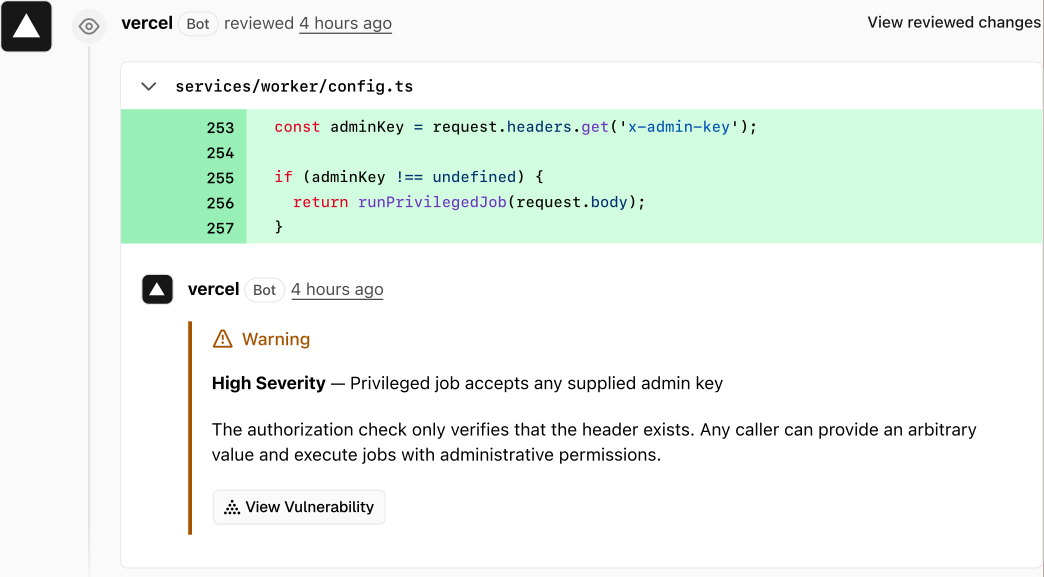
Beyond securing user logins at the perimeter, Vercel is expanding its defensive posture inward through the public beta launch of "Security Review" for Pro and Enterprise tiers. Integrated directly into the Vercel Agent ecosystem, this automated system monitors code changes on every incoming push to connected GitHub repositories once activated by development teams.
The automated scanner evaluates codebases against custom, team-defined security policies as well as baseline secure-coding standards. It is specifically engineered to flag common vulnerabilities that frequently evade manual code reviews, such as missing authorization checks on serverless functions, insecure data handling practices, and accidentally exposed API secrets or credentials.
Significantly, the Security Review system goes beyond mere passive detection. When granted appropriate permissions within the repository workflow, the Vercel Agent can independently validate identified vulnerabilities and automatically commit remediation patches. Vercel announced that scans under this program will be provided free of charge through November 10, 2026, while automated agent-generated fixes will be billed according to consumption metrics.
Ubl noted that Vercel’s internal security organization deployed this precise automated review tooling internally several months prior to its public release. Having proven its efficacy in catching vulnerabilities before they reached production environments, leadership elected to package the technology for external enterprise deployment.
Historical Context and the Escalating Threat Landscape
The aggressive modernization of Vercel’s security architecture follows a series of high-profile security incidents that underscored the vulnerability of cloud deployment pipelines. In April, Vercel confirmed a targeted security breach affecting a subset of its customer base. In that incident, threat actors successfully compromised an employee’s Google Workspace account hosted by a third-party partner, Context.ai.
Leveraging that initial foothold, the attackers navigated internal Vercel systems and accessed configuration parameters, including environment variables that had not been explicitly designated as sensitive by developers. Subsequently, a malicious actor operating under the persona of the notorious extortion collective ShinyHunters attempted to commercialize allegedly stolen source code, infrastructure access keys, and database extracts.
The incident served as a watershed moment for many platform-as-a-service (PaaS) providers, highlighting how identity federation, employee credential compromise, and exposed environment configurations represent critical attack surfaces. By implementing hardware-rooted authentication via DBSC and automated code auditing via Security Review, Vercel is aggressively closing the loop on both client-side malware threats and server-side authorization oversights.
Broader Industry Implications for Cloud Security
The deployment of Device Bound Session Credentials by major infrastructure players like Vercel marks a broader structural shift in web security. For decades, session cookies have remained the primary mechanism for maintaining authenticated web states, despite their well-documented vulnerability to theft via cross-site scripting (XSS) and infostealer malware.
As cybercriminal syndicates increasingly professionalize the distribution of commodity infostealers—such as RedLine, Lumma, and InfoStealer variants—traditional password and multi-factor authentication defenses have proven insufficient because they focus exclusively on the login event rather than the ongoing lifecycle of the session.
By tying session validity directly to physical hardware chips through standards like DBSC, the technology industry is moving toward a zero-trust model where possession of software artifacts is no longer sufficient for authenticated access. Analysts note that as browser vendors and cloud platforms standardize these mechanisms throughout 2026 and beyond, the economic viability of session-stealing malware operations will face severe headwinds.
For Vercel users, the immediate operational impact will be largely transparent, requiring minimal direct configuration while dramatically raising the barrier to account takeover. As enterprises continue migrating complex application architectures to cloud-native platforms, these hardware-anchored security controls are rapidly transitioning from experimental features to indispensable requirements for modern software development.