Wall Street Braces for a Historic Federal Reserve Rate Hike as Economic Pressures Mount

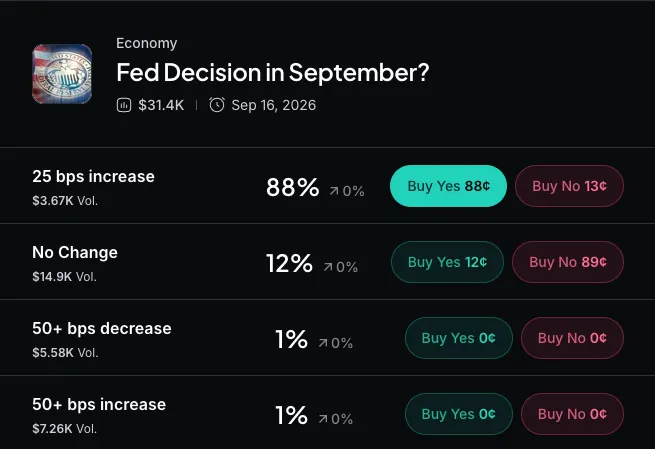
The financial markets are on high alert as the Federal Open Market Committee (FOMC) prepares to conclude its crucial two-day policy meeting on Wednesday. Wall Street is bracing for a monumental shift in monetary policy: an interest rate hike, a move the U.S. central bank has not executed since 2023. According to data from CME Group’s FedWatch tool, market expectations have shifted dramatically, pricing in a 94.5% probability of a quarter-percentage-point increase. This consensus represents a sharp escalation from sentiment just a month prior, when the likelihood of a hike was sitting below the 50% threshold.
This sudden repricing reflects a broader realization across global financial sectors that persistent inflationary pressures and geopolitical strains have left the central bank with very few alternatives. As traders, institutional investors, and digital asset markets position themselves for the outcome, the impending announcement threatens to reshape borrowing costs, sovereign bond yields, and risk assets worldwide.
The Rapid Shift in Market Expectations
The transition from monetary policy easing to renewed tightening happened with unexpected velocity. A comprehensive survey published by the Wall Street Journal revealed that nearly every major financial institution now expects the Federal Reserve to implement an upward adjustment to the federal funds rate on Wednesday. Most prominent Wall Street firms—including Barclays, Citigroup, JPMorgan Chase, Morgan Stanley, and UBS—are currently forecasting a cumulative 50 basis points of total monetary tightening by the conclusion of the calendar year.
More hawkish institutions, such as Bank of America, Deutsche Bank, and RBC, anticipate an even more aggressive trajectory, projecting a total of 75 basis points in rate hikes before the year ends. Conversely, Goldman Sachs occupies a more conservative stance among the forecasting community, penciling in only Wednesday’s anticipated quarter-point increase with no subsequent tightening expected in the near term. Outliers such as Jefferies and Oxford Economics remain entirely detached from the prevailing consensus, predicting a policy reversal and subsequent interest rate cuts by December and into 2027, respectively.
This aggressive repricing has not been confined to equity indices. Fixed-income markets have experienced significant volatility, with the benchmark 10-year U.S. Treasury yield touching 5.04%—its highest level since July 2007. Meanwhile, the two-year Treasury yield, which is traditionally more sensitive to near-term shifts in Federal Reserve policy, surged to its highest mark since July 2024. These surging yields underscore a market that is aggressively pricing in not only Wednesday’s hike, but also a prolonged period of elevated borrowing costs.
Underlying Economic Drivers and Inflationary Pressures
The primary catalyst forcing the Federal Reserve’s hand is stubborn, unyielding inflation that has consistently defied downward trends. The latest consumer price index (CPI) figures revealed headline inflation running at an annualized rate of 3.4% in August, while core inflation—which strips out volatile food and energy sectors—stood at 2.5%. Both metrics remain uncomfortably above the central bank’s steadfast 2% target.
Compounding these domestic pricing pressures are international supply chain disruptions and volatile commodity markets. Oil prices have faced renewed upward momentum, heavily influenced by escalating geopolitical tensions and the ongoing conflict involving Iran. These external shocks have injected fresh layers of price volatility into the global economy, rendering traditional monetary offsets—such as tariffs or sudden rate cuts—ineffective at containing broad-based price increases.
The internal dynamics of the FOMC have likewise shifted. During the Fed’s previous policy meeting in July, officials voted to hold the benchmark interest rate steady in a range of 3.50% to 3.75%. However, that decision was far from unanimous, passing by a contentious 9-3 vote. Notably, three regional Federal Reserve bank presidents dissented in favor of an immediate rate hike at that time. Combined with a surprisingly robust August jobs report that highlighted continued labor market resilience, this internal division effectively tilted the committee’s collective mindset toward renewed tightening heading into this week’s deliberations.
Political Friction and the Independence of the Central Bank
The looming rate decision places Federal Reserve Chair Kevin Warsh in an exceptionally delicate political environment. Appointed to lead the central bank by President Donald Trump in January, Warsh was publicly urged during his swearing-in ceremony in May to maintain absolute institutional independence while simultaneously receiving clear signals that the administration favored lower borrowing costs.
That delicate balance has since frayed. Over the preceding two weeks, President Trump, Vice President JD Vance, and Treasury Secretary Scott Bessent have publicly and repeatedly pressured the central bank to lower rates. President Trump’s rhetoric escalated notably when he raised the prospect of utilizing trade penalties against nations maintaining trade surpluses with the United States should borrowing costs fail to decline. Despite this intense political lobbying, Chair Warsh has maintained that executive branch commentary has had zero influence on the independent decision-making processes of the FOMC.
The optics of a rate hike arriving just two months prior to the November midterm elections present a complex public relations challenge for the administration. Voters have expressed consistent frustration over persistently high consumer prices and elevated financing expenses—economic conditions that critics argue are exacerbated by the very tariff and foreign policy measures championed by the White House.
Implications for Traditional Markets and Risk Assets
For traditional financial markets, the mechanics of a rate hike are straightforward: higher interest rates increase the cost of capital, which systematically restrains consumer spending, dampens corporate expansion, and pressures valuation multiples across equities. Furthermore, higher-yielding sovereign debt instruments become increasingly attractive relative to risk-on assets, triggering capital outflows from growth stocks, real estate, and digital currencies into safe-haven government bonds.
Beyond the immediate economic impact of the rate hike itself, market participants remain exceptionally sensitive to forward-looking guidance. Financial markets inherently abhor uncertainty; therefore, the ambiguity surrounding the exact trajectory of subsequent monetary tightening poses a greater risk than the twenty-five-basis-point adjustment itself.
Impact on Bitcoin and the Broader Cryptocurrency Ecosystem
Digital asset markets walked into the Federal Reserve’s policy meeting carrying considerable baggage. On Tuesday, Bitcoin traded near $75,700, marking a 3.2% daily decline following the legislative failure of the Clarity Act—a heavily anticipated market structure bill that failed to clear a Senate cloture vote. This contraction leaves the world’s largest cryptocurrency well below its September peak of approximately $82,000.
From a technical perspective, market analysts have identified $73,200 as a critical psychological line in the sand for Bitcoin. A confirmed daily close beneath this threshold could clear a path toward lower technical support levels at $71,000 and potentially $66,900, threatening to invalidate the broader bullish price structure that recently sparked a market-wide golden cross.
Nevertheless, opinion remains sharply divided on whether a quarter-point rate hike is universally bearish for the digital asset sector. Some market strategists argue that if the adjustment is perceived primarily as a technical measure designed to anchor long-term sovereign bond yields rather than an aggressive campaign to suffocate economic liquidity, the medium-term outlook for cryptocurrencies may remain relatively stable. In this scenario, market reaction will likely depend on whether the actual policy statement and Chair Warsh’s post-meeting press conference deliver unexpected hawkish surprises relative to current market expectations.
High-beta altcoins, characterized by lower liquidity profiles and heavier reliance on leverage, are widely anticipated to experience magnified percentage swings in either direction as the official announcements unfold.
Looking Ahead: The FOMC Schedule and Press Conference
The official Federal Open Market Committee policy statement, accompanied by the updated economic projections and the closely watched "dot plot," is scheduled for release at 2:00 p.m. Eastern Time on Wednesday. This release will be immediately followed by Federal Reserve Chair Kevin Warsh’s press conference at 2:30 p.m. ET.
Financial analysts, institutional investors, and macroeconomic traders will be parsing every word of the statement and press conference to determine whether the central bank intends to pause following Wednesday’s action or align with the more aggressive projections calling for multiple rate increases before the conclusion of the year.
Related posts: