Bridging the AI Development Chasm: YouTube’s Innovative Approach to Rapid Prototyping and Enterprise Deployment

The landscape of artificial intelligence development is undergoing a profound transformation, marked by an unprecedented acceleration in the ability to conceive and implement AI-driven projects. What once demanded months of dedicated engineering effort can now, in the realm of individual pursuits, be achieved within hours. This democratized power of AI, fueled by advancements in agentic engineering and large language models (LLMs), has ushered in what many are calling a “golden age of the weekend AI side project.” Developers can now translate complex, imaginative ideas into functional local applications with remarkable speed, often over a single weekend. However, this exhilarating pace of innovation encounters a significant barrier when scaled within the intricate and often rigid infrastructure of large enterprises.
The stark reality for AI development within established corporate ecosystems is that the agility of local prototyping often crumbles against the formidable walls of established networks, cascading error potentials, and the inherent caution of leadership wary of operational instability. The data paints a sobering picture: a staggering 95% of AI prototypes fail to transition into production environments, languishing in what can be termed the “validation abyss.” This widespread attrition rate is a source of frustration for developers, who witness the seemingly effortless deployment of AI solutions by peers on social media while grappling with protracted validation cycles.
To understand how this critical speed-versus-risk paradox is being addressed at the highest levels of AI implementation, an in-depth examination of practices at YouTube, a platform serving billions of users, was undertaken. The insights gleaned from this investigation are poised to fundamentally reshape the conventional understanding and design of the Artificial Intelligence Software Development Lifecycle (SDLC).
The Inherent Risk-Versus-Speed Paradox in AI Engineering
The fundamental difference in the AI development experience hinges on the cost of failure. In a solo development environment, experimenting with agentic code is akin to piloting a high-performance jet fighter. If an AI agent exhibits unintended behavior, the developer can swiftly adjust prompts, restart servers, and iterate with minimal consequence. The feedback loop is immediate and the financial or operational impact of a misstep is negligible.

However, as leading AI engineering expert Addy Osmani has articulated, the unconstrained orchestration of AI agents within an enterprise setting introduces a vastly amplified and unpredictable blast radius. Osmani himself has recounted instances in personal projects where running numerous parallel agents, rapidly context-switching and deploying code based on fleeting previews, led to significant technical debt. This accumulated debt ultimately resulted in the catastrophic failure of two applications due to inadequate isolation of modifications.
When this amplified risk is considered against the backdrop of a platform like YouTube, the stakes are exponentially higher. YouTube’s infrastructure is a marvel of engineering, supporting billions of users and built upon a robust, two-decade-old codebase. Functioning as a de facto public utility, the platform cannot afford to be burdened by experimental technical debt that could compromise its stability. Protecting such a vast and critical system necessitates the implementation of extensive and, by necessity, slow-acting guardrails. These guardrails, while essential for stability, create a bottleneck that can render AI prototypes obsolete by the time they navigate the labyrinthine approval processes. The underlying AI models themselves evolve at a pace far exceeding traditional development cycles, leaving even the most promising ideas outdated before they can be considered for deployment. This presents a critical question: How can organizations achieve the velocity demanded by AI innovation while meticulously mitigating systemic risk?
YouTube’s Groundbreaking AI Prototyping Stack
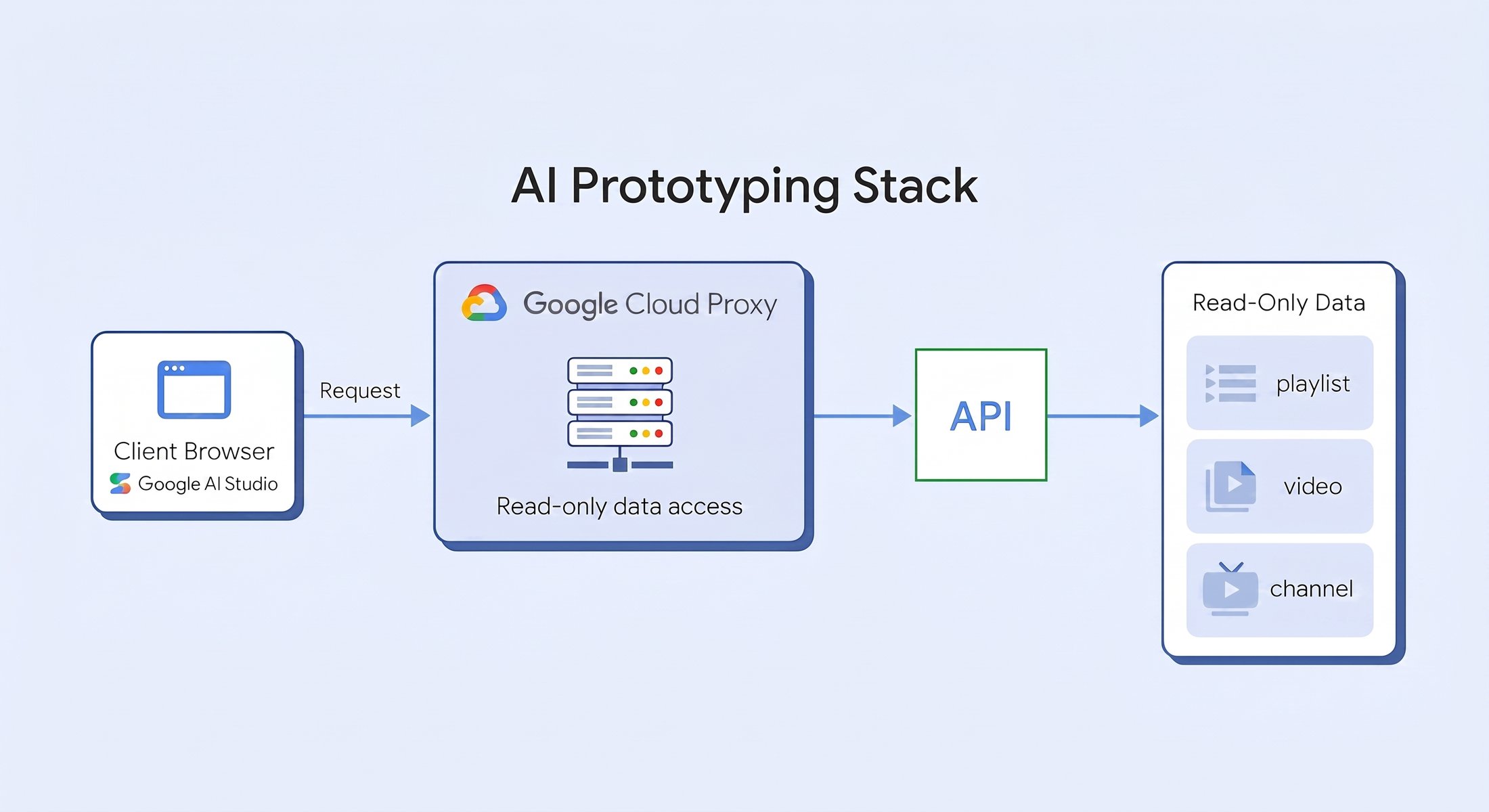
The challenge of harmonizing rapid AI experimentation with enterprise-grade stability was addressed by Benji Bear, a former software engineer at DeepMind and YouTube. Bear and his team approached this complex problem not by attempting to accelerate the review process, but by fundamentally rethinking the infrastructure philosophy. Their solution is the creation of a prototyping stack, a unified platform designed to govern the entire design-to-code lifecycle. Crucially, this stack completely decouples rapid experimentation from the core production servers, systematically dismantling the two primary friction points that impede developer velocity in large organizations.
Decoupling the Data Layer for Realistic Simulation
A significant hurdle in enterprise AI prototyping is the "blank canvas" problem. Developing a standalone application often means lacking the ability to test it under realistic, data-rich conditions. To overcome this, Bear’s team leverages pre-built templates from Google AI Studio. These templates serve as the foundation for new ideas and are integrated with a proxy server established on Google Cloud. This proxy server is configured to grant prototype applications read-only access to prototype-approved data.
This strategic setup provides immediate, pre-authenticated API access to live metadata bundles, such as playlists, videos, and channels. This access is facilitated through the use of strict tokens, ensuring that while developers gain the technical accuracy of real-world production parameters, they are entirely prevented from writing back to, polluting, or crashing core databases. This sophisticated data decoupling ensures that experimentation can occur with a high degree of fidelity to the production environment without introducing any risk to its integrity.
Seamless Live UI Injection for Real-World Validation
When a concept demands validation within the actual user experience, the prototyping stack offers a powerful solution: client-side YouTube Extension wrappers. These wrappers act as intelligent glue code, enabling developers to inject their experimental features directly into the live production web interface of YouTube. This is achieved through code-split chunk safeguards, a critical architectural component that isolates experimental code from the main production binaries. This isolation allows for rapid updates to prototypes, which can be deployed to a safe staging environment in a matter of minutes.
The impact of this integrated approach has been transformative. YouTube has seen its development cycle for vetting new ideas shrink dramatically, from multiple quarters to mere weeks. This accelerated timeline has facilitated the successful launch of several prototypes, including the highly anticipated YouTube Recap and the innovative Ask YouTube feature, directly into user research studies (UXR). This signifies a paradigm shift in how AI-powered features are conceived, tested, and brought to the attention of end-users.
Embracing the Philosophy of "Throw-Away Code"
Implementing such a forward-thinking prototyping stack necessitates a profound psychological adjustment for engineers. Traditionally, developers are trained to view code as a permanent fixture, meticulously polishing and refactoring it into a state of pristine permanence. However, Benji Bear’s core philosophy for enterprise AI development is elegantly simple: Embrace throw-away code.
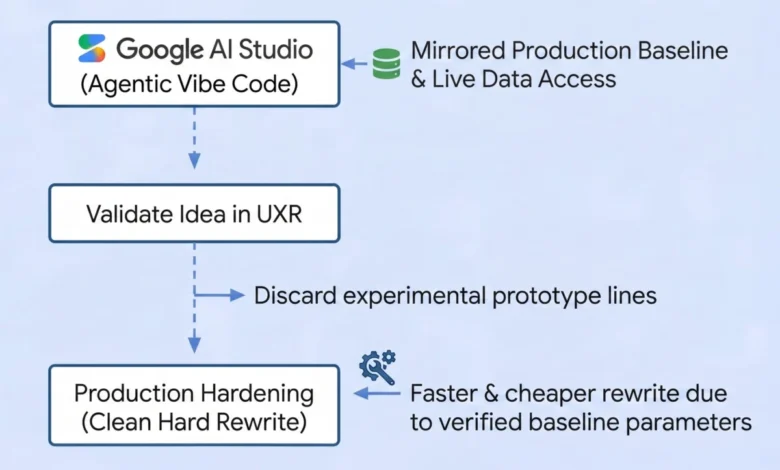
Prototypes developed using Google AI Studio are not intended for long-term maintenance or architectural purity. Their primary objective is to efficiently validate product-market fit through the collection of quantitative data. The attempt to refactor chaotic, AI-generated code directly into an established enterprise codebase is often an architectural trap that can introduce friction and delay.
However, because Google AI Studio builds prototypes directly onto a mirrored version of the production infrastructure, a highly accurate baseline is established from the outset. While the messy, AI-generated script is indeed discarded, the process of rewriting a successful idea for production becomes significantly faster, more cost-effective, and strategically positioned later in the development lifecycle. This approach provides a verified blueprint for subsequent development, rather than requiring engineers to start from a blank canvas.
Moving at Hyper-Speed Without Breaking Production Systems
The fundamental insight driving YouTube’s innovative approach is that the commonly observed 95% failure rate of AI prototypes is not a bug in the system, but rather an inherent characteristic of the strategy itself. The goal, therefore, should be to design environments that actively encourage teams to fail more frequently, but critically, to do so safely.
Artificial intelligence has drastically reduced the cost of code generation. Consequently, the role of developers is evolving from gatekeepers of syntax to system architects. Their paramount responsibility now lies in designing the crucial infrastructure components: the bridges, read-only sandboxes, and isolated pipelines that empower teams to rigorously test ambitious ideas without triggering catastrophic system failures.
The most significant risk in the current AI development landscape is not the potential for messy AI code to break a server, but rather the danger of missing a critical technological moment due to excessively slow validation loops. By implementing structural constraints that render failure a safe and manageable outcome, organizations can liberate their teams to innovate and execute at hyper-speed. This strategic reorientation promises to unlock the full potential of AI within enterprise settings, ensuring that innovation thrives without compromising the stability and reliability of mission-critical platforms.
For a comprehensive technical breakdown, including in-depth interview clips with YouTube’s core infrastructure engineers and a detailed exploration of the Google AI Studio Proto-Stack, interested parties are encouraged to view the premiere episode of "Emergent" on YouTube. This resource offers invaluable insights into the practical implementation and strategic underpinnings of this revolutionary approach to AI development.
Related posts: