Google Unveils Agent Substrate on Google Kubernetes Engine to Scale Autonomous AI Workloads to One Million Agents

The landscape of artificial intelligence is rapidly transitioning from passive chat-based large language models to autonomous, goal-oriented agents capable of generating code, executing terminal commands, manipulating tools, and executing complex, multi-step workflows. However, scaling these systems from local developer environments to robust production architectures has historically presented platform engineers with an intractable set of infrastructure dilemmas. In response to these architectural bottlenecks, Google has officially announced the availability of Agent Substrate on Google Kubernetes Engine (GKE). Designed specifically to meet the intensive demands of autonomous agent fleets, this open-source, secure-by-default execution runtime is engineered to support millions of sandboxed agents simultaneously, boasting a compute density up to ten times greater than traditional container runtimes.
The Evolution of Autonomous AI Agents and Infrastructure Bottlenecks
Over the past several years, the developer ecosystem has witnessed a proliferation of sophisticated local agent harnesses, including frameworks such as Claude Code, Codex, Antigravity, OpenClaw, and Nous Research’s Hermes. While these tools perform exceptionally well during local testing and development phases, translating them into enterprise-grade deployments operating at a massive scale exposes severe underlying limitations in conventional cloud infrastructure.
When organizations attempt to scale autonomous agent platforms from a handful of local prototypes to hundreds of thousands of concurrent, long-lived execution instances, they immediately encounter severe constraints. Traditional architectures generally force platform teams into an unacceptable compromise: they must either rely on standard virtual machines (VMs)—which offer strong isolation and full operating system control but suffer from prohibitive startup latencies, heavy resource overheads, and high costs—or use standard container runtimes, which are fast and lightweight but lack the robust kernel-level isolation and network security required when executing completely untrusted, AI-generated code.
Furthermore, autonomous agents do not consume compute resources in a linear or continuous fashion. By nature, an agent spends the vast majority of its operational lifecycle entirely idle, waiting for responses from underlying model inference APIs, parsing external tool outputs, or awaiting user inputs. Under legacy infrastructure models, maintaining dedicated physical CPU cores and random-access memory (RAM) allocated to dormant containers or VMs locks up scarce and expensive enterprise compute capacity, making large-scale agent operations economically unsustainable.
Core Architecture and Technical Specifications of Agent Substrate
To eliminate these compromises, Agent Substrate was engineered from the ground up to decouple agent execution workflows from underlying machine management. Built on top of cloud-native Kubernetes infrastructure, the runtime introduces a dedicated execution layer specifically tailored for agentic workloads. The technical architecture relies on four foundational pillars designed to achieve maximum security, minimal latency, and optimal compute efficiency:
-
Kernel and Network Security by Default
Because autonomous agents routinely generate and execute untrusted code, shell scripts, and terminal commands in real time, executing these tasks on shared infrastructure introduces critical security vulnerabilities, including potential container breakouts and unauthorized data exfiltration. Agent Substrate addresses this by implementing a zero-trust posture at both the host kernel and network levels. Administrators can select between hardware-isolated Cloud Hypervisor microVMs, which offer complete Linux kernel compatibility, or gVisor sandboxing for an even lighter kernel isolation footprint. Additionally, an integrated network gateway handles all inbound and outbound traffic requests, providing engineers with fine-grained, extensible control over network egress and ingress. -
A Specialized Control and Data Plane for Low-Latency Activation
Achieving high-density execution for isolated workloads requires an optimized control plane and data plane capable of executing rapid suspend and resume actions. Agent Substrate features a specialized control plane that manages data-aware scheduling with minimal delay. Simultaneously, its data plane handles hundreds of suspend and resume activations per second directly on pre-warmed worker nodes, eliminating the overhead associated with provisioning fresh environments. System state snapshots are written concurrently to local NVMe storage and Google Cloud Storage to guarantee durable state persistence. Consequently, a sandboxed agent environment can be fully restored to its exact previous operational state in under 500 milliseconds, and immediately re-suspended the moment it enters an idle state. -
High-Density and Active-Only Compute Economics
To solve the economic inefficiencies of idle compute, Agent Substrate implements an active-only resource model. The runtime immediately captures a snapshot of the guest hypervisor’s state and persists it to disk, freeing up physical CPU and RAM resources to run other active workloads while preserving the session state intact. When the next tool invocation or model response arrives, the session is restored in milliseconds. This zero-idle architecture enables a single host to pack over 1,000 dormant agents, achieving a tenfold increase in compute density compared to standard container platforms. For workloads requiring shared file system access across multiple execution turns, an optional Filestore agent volume controller provides persistent Network File System (NFS) storage. -
Kubernetes-Centric Scale and Reliability
Rather than forcing engineering teams to build custom, fragile orchestrators on top of raw VMs—which requires maintaining complex operational tooling for node recovery, multi-zone scheduling, and autoscaling—Agent Substrate leverages Kubernetes as its foundational control layer. High-frequency suspend and resume operations execute directly on local workers via the custom data plane, while Kubernetes manages the underlying physical fleet, ensuring self-healing nodes, automated cluster scaling, and robust infrastructure reliability. Furthermore, legacy workloads utilizing standard Kubernetes Pod semantics or kernel-isolated Pod primitives can continue to run side-by-side with the new substrate.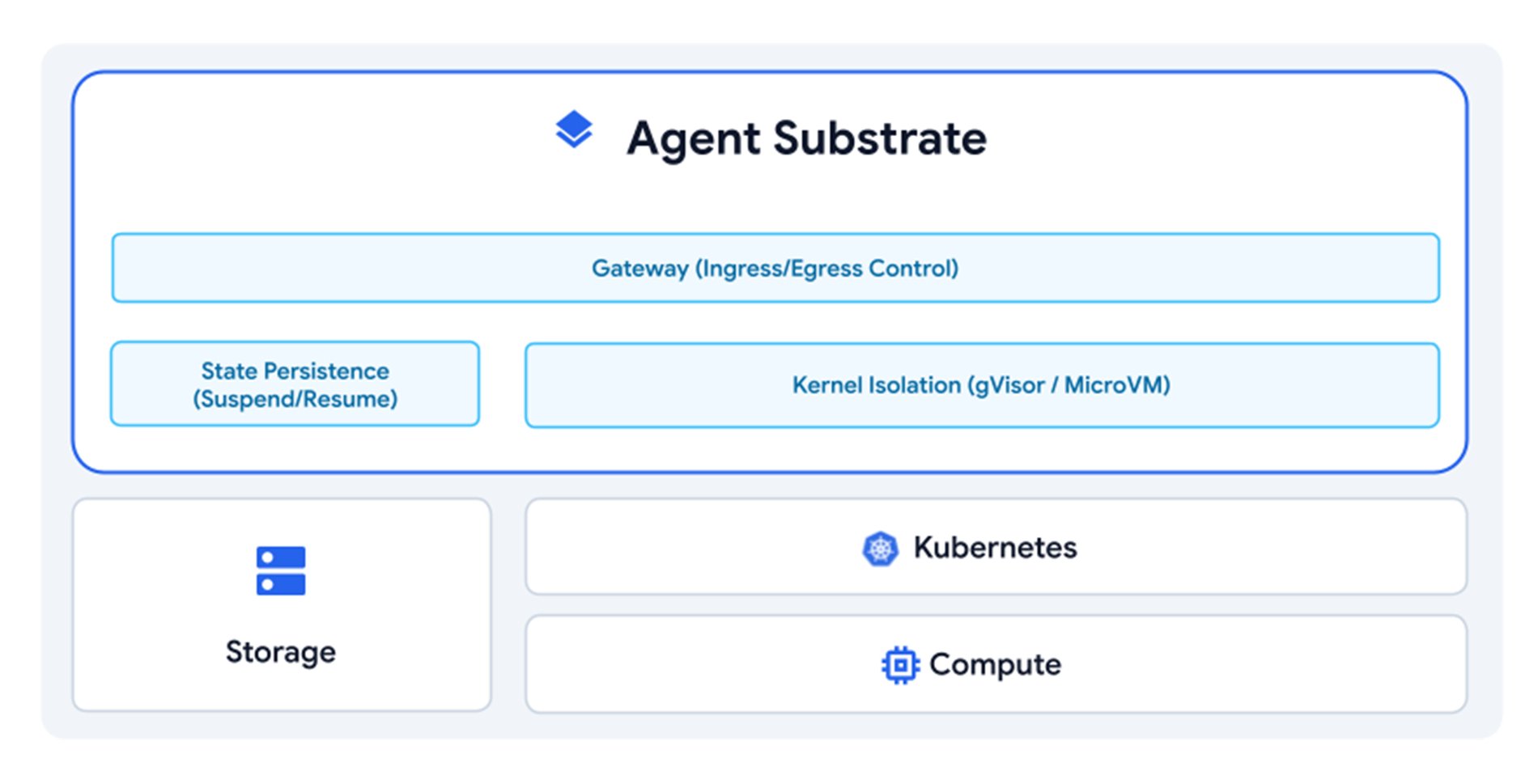
Deep Integration with Google Cloud Infrastructure
To successfully achieve a targeted scale of one million concurrent agents, Agent Substrate on Google Kubernetes Engine takes full advantage of specialized Google Cloud hardware and storage ecosystems. The platform integrates seamlessly with custom ComputeClasses, allowing system administrators to dynamically provision and manage heterogeneous machine pools across various instance families, balancing spot instances and on-demand capacity with ease.
Crucially, the runtime provides native support for Google Axion processors—Google’s custom, Arm-based silicon architecture. Benchmarks indicate that Axion processors deliver up to a 30 percent improvement in price-performance metrics for sandboxed agent workloads when compared to standard competitive cloud offerings. Furthermore, stateful workspaces benefit from deep integration with Filestore agent volumes. This specialized storage offering attaches and detaches NFS mounts in mere milliseconds, allowing agent environments to resume near-instantaneously while supporting Read-Write-Many (RWX) access and POSIX-compliant file locking. These features allow multiple autonomous agents to collaborate safely on shared project files without encountering catastrophic write collisions or data corruption.
Early Industry Adoption and Enterprise Validation
Even prior to its broader release, Agent Substrate has undergone rigorous real-world evaluation by leading artificial intelligence development teams. Among the most prominent early design partners is Nous Research, the engineering organization behind Hermes, an advanced AI agent system currently ranked as the number-one global AI agent by OpenRouter usage metrics across productivity, coding, command-line interface (CLI), and personal assistant categories.
Nous Research has actively integrated Agent Substrate to underpin its commercial and enterprise offerings. Hervé Bizira, Chief Business Officer at Nous Research, emphasized the critical nature of this architecture during early evaluations. "We built Hermes Enterprise to enable customers to deploy into their existing infrastructure, while handling per-agent isolation and extensible access control," Bizira stated. "Agent Substrate addresses both at the platform layer in a way that also preserves valuable compute resources. Our experience with Agent Substrate gives us confidence the architecture can scale efficiently as agent workloads grow."

Implications and Future Outlook for Enterprise AI Deployments
The release of Agent Substrate on GKE marks a significant inflection point in the operational maturity of enterprise artificial intelligence. Historically, organizations attempting to scale autonomous agent deployments have been severely hampered by the trilemma of security, latency, and cost. By providing a hardware-isolated, kernel-secured environment capable of sub-second state restorations and massive compute packing densities, Google has effectively removed the infrastructure barriers that previously restricted agentic workflows to localized prototypes or costly, over-provisioned cloud environments.
As enterprises increasingly transition from experimental generative AI pilots to fully automated, mission-critical autonomous agent fleets, the ability to manage millions of concurrent executions securely and economically will become a primary competitive differentiator. By marrying the declarative management, self-healing resilience, and expansive ecosystem of Kubernetes with a purpose-built, high-frequency execution layer, Google Kubernetes Engine provides a clear, scalable roadmap for the next generation of cloud-native, agentic applications.
Agent Substrate is currently available as an open-source project and is accessible to all GKE customers for non-production workloads. General Availability (GA) support for enterprise production deployments is being rolled out via an allowlist model. Engineering teams interested in deploying the runtime can access the official Agent Substrate on GKE documentation, review the core architecture guides, or explore the open-source code repositories directly.
Related posts: