Microsoft Azure Databricks Delivers Unprecedented Value, Independent Study Confirms 331% ROI

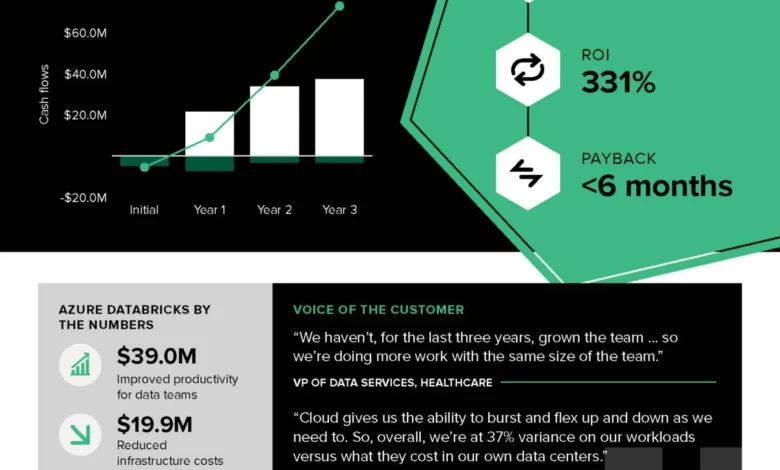
Microsoft Azure Databricks, a cornerstone of Microsoft’s data and artificial intelligence strategy, is demonstrating significant and measurable business value for its customers, according to a recent Total Economic Impact™ (TEI) study commissioned by Microsoft and conducted by Forrester Consulting. The report reveals that a composite organization leveraging Azure Databricks achieved a staggering 331% return on investment (ROI) over a three-year period, with a net present value (NPV) of $58.1 million and an investment payback period of less than six months. These findings underscore the platform’s ability to drive substantial cost savings and revenue generation, solidifying its position as a leading solution for modern data analytics and AI workloads.
The co-engineered nature of Azure Databricks, developed jointly by Microsoft and Databricks, is cited as a primary driver of its superior performance and economic benefits. This deep integration means Azure Databricks operates as a native Azure service, seamlessly fitting into existing Microsoft technology stacks, including identity management and governance frameworks. This "built-in, not bolted on" approach eliminates the complexities and costs associated with integrating disparate systems, leading to enhanced technical performance and streamlined operations for businesses.
Forrester’s comprehensive study analyzed the experiences of several Azure Databricks customers, constructing a composite organization representative of a $6 billion company operating within a regulated industry and managing approximately 10 petabytes of data. Prior to adopting Azure Databricks, this composite organization grappled with a fragmented, costly, and unreliable data estate that presented significant governance challenges. The implementation of Azure Databricks fundamentally transformed its data operations, yielding benefits totaling $75.6 million against costs of $17.5 million over three years, culminating in the impressive $58.1 million NPV.
The study meticulously identified four key areas where this substantial value was realized:
- Increased Productivity: Enhanced operational efficiency and accelerated project completion times for data teams.
- Reduced Infrastructure Costs: Optimization of data storage and processing, leading to significant savings.
- Improved Data Quality and Reliability: Greater trust in data leading to better decision-making and reduced errors.
- Faster Time to Market for Data-Driven Initiatives: Quicker deployment of AI and analytics solutions, enabling competitive advantages.
Beyond these quantifiable benefits, Forrester also highlighted a suite of qualitative advantages that contribute to Azure Databricks’ overall value proposition. These include native integration with other Azure services, faster generation of actionable insights, broader accessibility of data across the organization, and robust governance capabilities powered by Unity Catalog. These unpriced benefits, while harder to quantify directly, are crucial enablers of the cost savings and productivity gains documented in the study.
The Strategic Partnership: A Foundation for Accelerated Innovation
The strategic alliance between Microsoft and Databricks is central to the platform’s ongoing success. This partnership ensures a unified integration roadmap that aligns with the broader Microsoft data and AI ecosystem. This coordinated approach simplifies go-to-market strategies, offering customers a single point of contact for billing and support, a "one motion" experience that streamlines procurement and operational management. For technical teams, this translates to deeper native integrations and superior performance. For the business, it signifies reduced risk, lower costs, and a significantly accelerated path to realizing business value from data initiatives.
This collaborative engineering effort has continuously driven performance optimizations. The integration roadmap is actively managed, ensuring that Azure Databricks remains at the forefront of data and AI technology. This dedication to innovation is not merely theoretical; it is directly translated into tangible economic benefits for organizations.
Independent Benchmarks Validate Performance Claims
Complementing the economic impact study, independent performance benchmarks further bolster the claims of Azure Databricks’ superiority. Principled Technologies, a respected independent research firm, conducted a decision-support benchmark, akin to industry-standard TPC-DS tests, on a 10-terabyte dataset. The results demonstrated that Azure Databricks outperformed Databricks on AWS in key performance metrics. Specifically, Azure Databricks completed a single query stream up to 21.1% faster when autoscale was disabled. Furthermore, it executed four concurrent query streams more than nine minutes quicker than its counterpart on AWS. These performance advantages are critical for organizations dealing with large datasets and demanding query workloads, directly contributing to increased productivity and reduced processing costs.
The Role of Native Integration and Generative AI
A significant factor contributing to the economic value of Azure Databricks is its deep integration with the Microsoft ecosystem, particularly its embrace of generative AI. A prime example is the Azure Databricks Genie integration with Microsoft Copilot Cowork. This feature allows users to imbue Copilot with business context, building on existing intelligence within the tools they already use daily. Genie empowers users to query their lakehouse using natural language, with this capability now accessible within Microsoft Teams, Microsoft 365 Copilot, and Copilot Cowork.
The integration with Copilot Cowork, for instance, grounds tasks in trusted data through Genie Ontology. Critically, every response is meticulously scoped by Unity Catalog, ensuring that users only access information they are permitted to see. This intelligent data access mechanism facilitates the seamless flow of insights into daily workflows without compromising organizational governance standards. This ability to democratize data access while maintaining strict security and compliance is a key differentiator for Azure Databricks.
The platform’s depth of integration extends across its entire suite of services. These include:
- Seamless integration with Azure AI services: Enabling the development and deployment of sophisticated AI models.
- Data governance with Unity Catalog: Providing a unified platform for data discovery, access control, and auditing.
- Optimized performance for large-scale data processing: Leveraging the power of Azure’s infrastructure.
- Enhanced developer productivity: Through familiar tools and streamlined workflows.
These integrations, while not always directly priced in the Forrester study, represent crucial underlying factors that drive the quantified productivity and cost benefits. They empower organizations to extract maximum value from their data by making it more accessible, usable, and secure.
Timeline and Evolution of the Azure Databricks Offering
The journey of Azure Databricks as a first-party service reflects a strategic commitment from both Microsoft and Databricks to delivering a unified and powerful data analytics platform. The initial partnership, established to bring Databricks’ capabilities to the Azure cloud, has evolved significantly. The co-engineering approach has been a consistent theme since its inception, with both companies investing heavily in aligning their product roadmaps.
The integration with Microsoft’s broader data and AI portfolio, including Azure Synapse Analytics, Azure Machine Learning, and Power BI, has been a gradual but deliberate process. This evolution has been marked by key announcements and feature releases that progressively deepen the synergy between the platforms. For instance, the introduction of Unity Catalog, a unified data governance solution, marked a significant milestone, providing a centralized and secure way to manage data across the lakehouse.
The increasing integration of generative AI, exemplified by the Genie and Microsoft Copilot Cowork collaboration, represents the latest phase in this evolution. This focus on intelligent assistance and natural language interaction is designed to make advanced data analytics and AI more accessible to a wider range of users, further accelerating the adoption and impact of data-driven strategies. The ongoing commitment to innovation suggests a continued trajectory of enhanced capabilities and deeper integration, promising even greater value for customers in the future.
Broader Implications for the Data and AI Landscape
The findings of the Forrester TEI study have significant implications for businesses navigating the complex landscape of data and AI. In an era where data is often described as the "new oil," the ability to efficiently and effectively leverage this resource is paramount for competitive advantage. Azure Databricks’ proven ability to deliver substantial ROI and rapid payback suggests that organizations can achieve their data and AI objectives without incurring prohibitive costs or facing lengthy implementation cycles.
The emphasis on native integration within the Azure ecosystem also points to a broader trend in cloud computing: the desire for consolidated, end-to-end solutions. By offering a deeply integrated platform that spans data ingestion, processing, analytics, and AI, Microsoft is enabling organizations to simplify their technology stacks, reduce vendor sprawl, and foster greater collaboration between IT and business units.
The success of Azure Databricks also highlights the growing importance of governance and security in data initiatives. As organizations become more data-mature, the need for robust control over data access, lineage, and quality becomes critical. Unity Catalog’s role in providing this comprehensive governance framework is a key factor that builds trust and confidence in the platform, especially for companies operating in regulated industries.
Furthermore, the integration of generative AI capabilities signals a shift towards more intelligent and user-friendly data platforms. By empowering users to interact with data through natural language and leveraging AI to automate tasks and provide insights, Azure Databricks is democratizing access to advanced analytics and accelerating the adoption of AI across organizations. This not only drives efficiency but also fosters a culture of data-informed decision-making.
What This Means for Businesses Today
For organizations contemplating their data and AI strategy, the choice of a platform is a critical, long-term decision. Azure Databricks, with its inherent strengths as a first-party Azure service, offers a compelling proposition. The synergistic reinforcement between its integrated components drives the cost savings identified by Forrester. The platform’s robust performance ensures these gains are sustained even as data volumes and usage scale.
At its core, the value of Azure Databricks rests on a foundational partnership that aligns engineering efforts, product roadmaps, and support structures from both Microsoft and Databricks. This unified approach ensures that customers benefit from a cohesive and forward-looking platform. The measured results – a 331% three-year ROI and a payback period under six months – are not theoretical claims but concrete indicators of the tangible business value that Azure Databricks delivers. This compelling economic case is a primary reason why numerous teams are choosing to build and manage their lakehouse architectures on Azure Databricks, positioning themselves for future success in the data-driven economy.
Explore Further
Organizations interested in understanding the full scope of Azure Databricks’ capabilities and economic impact are encouraged to explore the following resources:
- The full Forrester Total Economic Impact™ study on Microsoft Azure Databricks.
- Detailed information on Microsoft Azure Databricks services and features.
- Case studies and customer success stories highlighting real-world applications and results.
- Information on integrating Azure Databricks with other Microsoft data and AI services.
- Resources for learning more about Unity Catalog and data governance best practices.
Related posts: