Amazon Web Services Integrates Anthropic Claude Fable 5 1 Bringing Long Running Frontier Intelligence to Enterprise Workflows

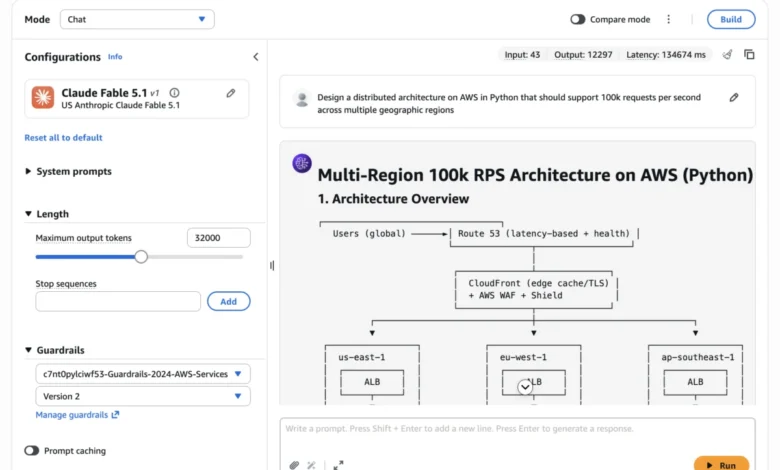
The rapid evolution of artificial intelligence in enterprise environments reached a significant milestone last week with the official arrival of Anthropic’s Claude Fable 5.1 on Amazon Web Services (AWS). Designed to tackle complex, long-running computational and creative tasks, the advanced model represents a major leap forward in how organizations manage large-scale software development, deep scientific research, and intricate multi-application workflows. As businesses increasingly demand autonomous systems capable of maintaining context and executing multi-step operations over extended periods, the deployment of Claude Fable 5.1 via AWS infrastructure and Amazon Bedrock provides a robust, scalable pathway for enterprise adoption.
Main Facts and Technical Capabilities
Claude Fable 5.1 is engineered specifically for high-stakes, time-intensive operations that span multiple applications and demand continuous reasoning over hours or even days. Unlike smaller, transactional models that excel at rapid question-and-answer exchanges or short-form code generation, Fable 5.1 is optimized to function as an independent collaborator. According to technical documentation provided by Anthropic and AWS, the model possesses the capability to take ownership of entire software engineering projects. This includes managing feature development across an expansive codebase, conducting thorough code reviews, and performing advanced performance optimizations over extended operational sessions.
In scientific research fields, the model’s frontier intelligence allows teams to process massive datasets, cross-reference complex literature, and model experimental parameters with unprecedented depth. By sustaining context across vast quantities of input data, Claude Fable 5.1 minimizes the degradation of reasoning quality often observed in standard large language models during prolonged processing tasks. Its integration into AWS means that developers and enterprise architects can harness these capabilities directly within their existing cloud ecosystems, leveraging the security, scalability, and performance standards associated with Amazon’s cloud architecture.
Chronology of the Partnership and Release
The introduction of Claude Fable 5.1 builds upon a rapidly accelerating timeline of strategic collaboration between Anthropic and Amazon Web Services. The partnership, which has deepened significantly over the past two years, began with foundational integrations of earlier Claude iterations into Amazon Bedrock. This managed service allowed AWS customers to experiment with and deploy frontier models without managing underlying hardware infrastructure.
Throughout successive releases, Anthropic and AWS have focused heavily on bridging the gap between cutting-edge AI research and the stringent compliance requirements of corporate and government entities. The development of specialized frameworks for data governance and safety governance has been a core priority leading up to the Fable 5.1 deployment. By introducing the model through both Amazon Bedrock and the specialized Claude Platform on AWS last week, the partners have established a streamlined deployment pipeline, ensuring that enterprise clients gain immediate access to the latest frontier capabilities shortly after their public announcement.
Data Retention, Security Policies, and the aws_review Mode
Because models possessing advanced autonomous capabilities handle sensitive codebases, proprietary algorithms, and confidential corporate data, security and governance remain paramount. Anthropic has designated Claude Fable 5.1 as a "Covered Model," a specific classification reserved for advanced iterations that necessitate specialized data retention parameters, rigorous safety reviews, and stringent access controls regardless of where they are hosted or offered.
To accommodate these requirements while maintaining enterprise trust, AWS introduced a dedicated data retention configuration known as the aws_review mode. Under this operational mode, AWS retains user prompts and model outputs strictly within defined security boundaries to facilitate human safety reviews conducted by authorized Amazon personnel. This mechanism ensures that potential safety violations, hallucination risks, or security vulnerabilities can be identified and mitigated.
Crucially, this framework distinguishes itself from legacy configurations such as provider_data_share, reinforcing the privacy architecture of Amazon Bedrock. Under current Bedrock standards, AWS does not share customer input and output data with third-party model providers, ensuring that proprietary enterprise information remains insulated from external model training pipelines.
Furthermore, the launch is accompanied by Enterprise Frontier Safeguards (EFS), a specialized framework built through a joint engineering effort between AWS and Anthropic. EFS is designed to empower eligible enterprise organizations to utilize Covered Models while ensuring their data remains strictly confined within a cloud environment under their direct control. This balances the necessity of robust safety oversight with the uncompromising data sovereignty demands of regulated industries such as finance, healthcare, and defense.
Access Models and Deployment Pathways

Enterprise customers seeking to integrate Claude Fable 5.1 into their production environments are provided with two primary access pathways within the AWS ecosystem. The first and most widely utilized method is through Amazon Bedrock, AWS’s fully managed service that offers a choice of high-performing foundation models via a single API. Through Bedrock, developers can incorporate Fable 5.1 into existing serverless architectures, apply fine-tuning techniques, and manage security policies using AWS Identity and Access Management (IAM) controls.
The second pathway is the Claude Platform on AWS, tailored for organizations requiring specialized tooling and direct interaction environments optimized explicitly for Anthropic’s model architecture. Documentation and model cards for both pathways have been published by AWS to assist developers in evaluating performance benchmarks, latency metrics, and quota management. These resources provide granular insight into how Fable 5.1 handles extended context windows and complex multi-tool execution.
Broader Impact and Industry Implications
The arrival of Claude Fable 5.1 on AWS signifies a broader maturation trend within the generative artificial intelligence sector. The industry is shifting its primary focus from superficial benchmarks—such as simple text generation speed or basic conversational fluency—toward deep operational utility. Models capable of autonomous, multi-hour execution are poised to fundamentally alter software development lifecycles, reducing the manual overhead required for routine code maintenance, regression testing, and architectural refactoring.
For enterprise IT departments, the availability of such models within a secured cloud perimeter alleviates many of the compliance hurdles that previously slowed AI adoption. Organizations that operate under strict regulatory frameworks can now leverage frontier intelligence without compromising data privacy or exposing intellectual property to public training sets. As competitors in the cloud computing and artificial intelligence space race to offer similar long-horizon capabilities, the collaborative safeguards established by AWS and Anthropic may well serve as a baseline standard for enterprise AI governance moving forward.
Related posts: