Mastering Feature Engineering in Scikit-Learn: The Definitive Guide to Building Robust Machine Learning Pipelines

The transition from a functional prototype to a reliable production-grade machine learning system represents one of the steepest learning curves for data practitioners. In the early stages of experimentation, data scientists frequently encounter a silent and insidious issue: data leakage. This phenomenon occurs when information from outside the training dataset is inadvertently used to create the model, leading to overly optimistic cross-validation scores that plummet when the model encounters unseen, real-world data. Industry analyses suggest that a significant percentage of deployed machine learning models fail to meet performance expectations not due to deficient algorithms, but because of flawed preprocessing methodologies. Recognizing this vulnerability, the data science community has increasingly standardized around the use of encapsulation tools like Scikit-Learn pipelines, shifting the focus from isolated data transformations to cohesive, end-to-end data processing workflows.
Data Leakage and the Evolution of Preprocessing
Historically, data preprocessing was treated as an ad-hoc, sequential manual procedure. Practitioners would routinely execute data scaling in one script block, apply categorical encoding in another, and subsequently fit estimators further down the analytical pipeline. While this method appeared straightforward, it fundamentally violated a core tenet of statistical learning: the validation and test subsets must remain completely sequestered from the training process. When a data scientist normalizes an entire dataset before splitting it into training and validation folds, the mean and standard deviation of the validation set inadvertently inform the training parameters. Consequently, the model evaluates itself using data it has already partially observed.
The introduction and widespread adoption of the scikit-learn Pipeline architecture fundamentally altered this dynamic. By forcing data transformations and model fitting into a single, unified object, the framework ensures that operations such as imputation, scaling, and encoding are computed exclusively on the training fold during cross-validation. The validation fold is then transformed using those exact same learned parameters, mirroring the exact conditions the model will face in production.
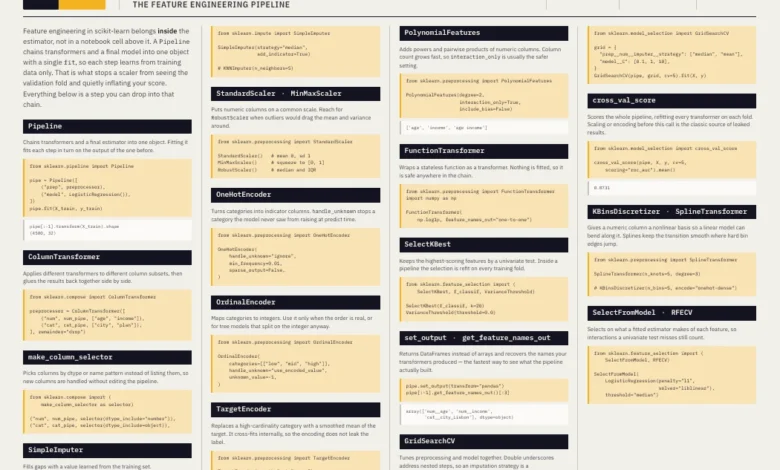
To assist practitioners in navigating these complexities, educational resources such as the newly released Feature Engineering in Scikit-Learn Cheat Sheet have gained traction across the industry. This reference material consolidates essential pipeline components, aiming to eliminate the cognitive overhead associated with remembering specific syntax arguments and class parameters.
Structural Pipeline Components: The Foundation of Clean Code
Building a maintainable machine learning architecture relies heavily on structural components that automate data routing and column management. Manually splitting dataframes to apply different transformations to numerical and categorical features is a frequent source of human error and script brittleness.
The ColumnTransformer class addresses this challenge directly by allowing data scientists to apply distinct sets of transformers to specific subsets of the data columns simultaneously. Coupled with the make_column_selector utility, developers can dynamically select columns based on their data types rather than hardcoding column names. This architectural choice ensures that if a downstream data ingestion pipeline introduces a new numerical feature, the scikit-learn pipeline ingests and scales it automatically without requiring manual code modifications.
Handling missing data is another critical phase where structural tooling prevents systemic bias. The SimpleImputer class, particularly when configured with the add_indicator=True parameter, provides a sophisticated approach to missingness. Rather than simply replacing a missing value with a median or a constant, the imputer creates an accompanying binary feature indicating whether a value was originally missing. In many operational datasets—such as medical records or financial transactions—the absence of data is a predictive signal in its own right.
Furthermore, categorical encoding presents persistent deployment challenges. Unseen categories encountered during inference routinely trigger exceptions that crash production systems. By configuring the OneHotEncoder with the handle_unknown="ignore" parameter, pipelines gracefully absorb novel categories by mapping them to all-zero rows rather than halting execution. For high-cardinality categorical variables—such as postal codes or product identifiers—where one-hot encoding creates an unmanageable matrix of sparse features, TargetEncoder has emerged as a statistically sound default, encoding categories based on a smoothed estimate of the target variable.
Transparency and Hyperparameter Optimization
A common critique of heavily abstracted pipelines is the black-box nature of their transformations. When multiple transformers—such as a ColumnTransformer combined with PolynomialFeatures—manipulate a dataset, tracking the provenance of individual features becomes difficult.
To combat this opacity, modern scikit-learn workflows emphasize the use of set_output(transform="pandas") and get_feature_names_out(). These methods allow developers to inspect intermediate states, translating anonymous NumPy arrays back into labeled Pandas dataframes. This visibility is essential not only for debugging and feature importance analysis but also for maintaining compliance with regulatory standards that demand model interpretability.
The true culmination of pipeline-based architecture, however, is realized during hyperparameter tuning. When data preprocessing steps are encapsulated within an estimator object, preprocessing strategies cease to be static choices made at the beginning of a notebook. Instead, elements like imputation strategies, scaling methods, and polynomial degrees become hyperparameters, just like a neural network’s learning rate or a support vector machine’s regularization strength.
Through GridSearchCV or RandomizedSearchCV, a data scientist can simultaneously optimize the feature engineering process and the model architecture in a single, comprehensive search. This prevents the common pitfall of tuning a model on sub-optimally preprocessed data, ensuring that the final configuration represents a globally optimal pipeline rather than a series of disconnected local optima.
Industry Implications and Future Directions
The formalization of feature engineering through standardized cheat sheets and pipeline frameworks reflects a broader industry maturation. As artificial intelligence and machine learning transition from experimental research projects into core enterprise infrastructure, the demand for reproducibility, scalability, and code hygiene has never been higher.
Engineering teams across financial services, healthcare, e-commerce, and logistics are increasingly auditing their machine learning operations to eliminate technical debt. By adopting modular pipeline components, organizations reduce the risk of deployment discrepancies between research environments and production servers. The standardization of these practices democratizes access to robust machine learning engineering, enabling junior and intermediate practitioners to build systems that adhere to software engineering best practices by default.
Ultimately, the mastery of feature engineering within frameworks like Scikit-Learn is less about memorizing complex algorithms and more about disciplined structural design. As data volumes grow and pipelines become increasingly intricate, the ability to encapsulate, inspect, and optimize data transformations will remain a foundational skill for the modern data practitioner.