Optimizing Small Language Models for Narrow Automation: Reusing Prompt Prefixes with Key-Value Caches

The deployment of Small Language Models (SLMs) in production environments has increasingly shifted from broad, general-purpose conversational agents to highly specialized, domain-specific narrow automation tasks. Organizations seeking efficient, cost-effective artificial intelligence solutions are turning to sub-billion-parameter architectures capable of performing repetitive text classification, data extraction, and routing operations. However, naive implementation paradigms—such as re-encoding identical system instructions and few-shot examples for every incoming request—introduce severe computational bottlenecks, undermining the inherent speed advantages of compact models. Building upon previous methodologies concerning output space constraints, recent technical developments demonstrate that leveraging prompt prefix caching can dramatically reduce inference latency and computational overhead without altering model accuracy.
Background and Evolution of SLM Optimization
In enterprise settings, narrow automation workloads—such as automated customer support ticket routing—rely heavily on structured, static instructions. A typical prompt used to categorize customer inquiries consists of an extensive system prompt defining a taxonomy, followed by a set of static few-shot examples, and finally concluding with a dynamic prompt tail containing the specific user input. In practical implementations, the static instruction block often accounts for upwards of 80 to 90 percent of the total token count.
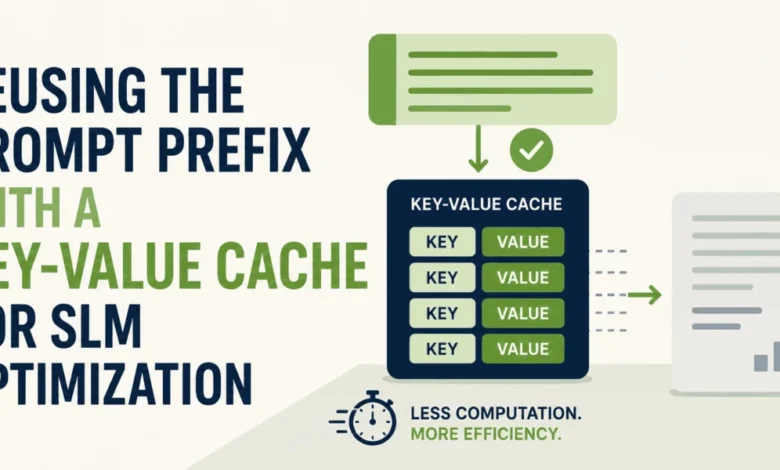
Historically, transformer-based architectures process these inputs by computing key and value vectors for every token across all attention layers during the pre-fill phase. Because the transformer’s self-attention mechanism ensures that tokens depend exclusively on preceding context, the key-value (KV) pairs generated for a fixed, unchanging system prompt remain identical across thousands of sequential API calls or inference loops. Repeatedly recomputing these identical tensors for every incoming item represents a significant waste of computational resources, particularly in central processing unit (CPU) constrained environments or edge deployments.
To quantify this inefficiency, baseline evaluations utilizing the Qwen2.5-0.5B-Instruct model running in float16 precision via Hugging Face Transformers on consumer-grade hardware demonstrate substantial performance degradation when standard inference loops are employed. Operating on a standardized dataset of 600 customer support tickets, a traditional full-prompt re-encoding approach requires an average of approximately 308.1 milliseconds per inference cycle, accumulating a total processing time of 184.85 seconds. With static instruction blocks comprising roughly 145 tokens out of a total 167-token prompt length, the redundant computation of these static elements constitutes an avoidable drag on system throughput.
Technical Mechanics of Prefix Caching
Prefix caching addresses this inefficiency by shifting the processing paradigm from stateless execution to a stateful caching model. Instead of treating every inference call as an isolated event, the system processes the static instruction prefix exactly once during initialization. The resulting key and value tensors are captured and stored within a dynamic cache structure (such as Hugging Face’s DynamicCache).
When subsequent individual data items—such as distinct customer support tickets—are processed, only the dynamic suffix containing the unique user input is passed through the model. The attention mechanism is explicitly configured via customized attention masks and cache positions to reference the pre-computed KV pairs residing in memory, while seamlessly appending the new token representations. Once the model completes its forward pass and generates the necessary logits for classification, the cache is programmatically rolled back to its initial baseline state, preserving the static prefix for the next iteration.
Comparative Performance Benchmarks and Computational Efficiency
Implementing prefix caching yields quantifiable efficiency gains. Under identical testing conditions—utilizing the Qwen2.5-0.5B-Instruct model on an Apple M2 architecture equipped with 24GB of RAM—the prefix-cached inference pipeline processes the same 600-record dataset in 80.07 seconds. This reduces the average per-ticket processing latency from 308.1 milliseconds down to 133.5 milliseconds.
Crucially, these performance enhancements are achieved without sacrificing predictive accuracy. Because prefix caching is a pure computational optimization rather than a model quantization or pruning technique, the output logits remain mathematically identical to those produced by full prompt re-encoding. Verification scripts comparing cached versus uncached execution paths across distinct record sets confirm a 100 percent match in classification outputs.
The scalability of this optimization technique is directly proportional to the ratio of static to dynamic content within the prompt architecture. As organizations design more robust, detailed system instructions containing comprehensive taxonomies and extensive few-shot training examples, the relative performance dividend of prefix caching increases. Rather than penalizing developers for utilizing detailed prompt engineering, prefix caching rewards comprehensive instruction sets by amortizing their computational cost across entire batch operations.
Industry Implications and Production Readiness
The transition toward stateful prompt handling marks a critical maturation point for the deployment of small language models in enterprise automation. Historically, organizations encountered a difficult trade-off: deploying massive foundational models yielded high accuracy but introduced prohibitive infrastructure costs and latency, while deploying smaller models often sacrificed contextual nuance and instruction-following capability.
By neutralizing the computational penalty associated with detailed system prompts, prefix caching elevates sub-billion-parameter models—such as 0.5-parameter architectures—into viable, high-throughput production assets. Engineering teams can now embed rich operational logic, strict output constraints, and extensive formatting guidelines directly into system prompts without incurring cumulative latency penalties during batch inference runs.
Furthermore, these optimization strategies align with broader industry movements toward edge AI and local inference execution. As hardware constraints on local devices and edge servers necessitate maximum efficiency, software-level optimizations that minimize redundant floating-point operations become essential. Techniques that isolate static structural components from dynamic input payloads allow lightweight models to operate at speeds competitive with traditional rule-based software, all while retaining the semantic flexibility of generative neural networks.
Future Outlook for Narrow Automation Architectures
As the machine learning community continues to refine inference engines and attention mechanisms, caching strategies are expected to become deeply integrated into standard transformer serving libraries. Current implementations require explicit management of cache positions, attention masks, and state rollbacks. However, emerging systems-level abstractions aim to automate KV-cache management entirely, abstracting memory lifecycle operations away from application developers.
For practitioners specializing in automated workflows, document processing, and customer service infrastructure, mastering prefix caching represents an immediate pathway to enhancing system scalability. By rethinking inference pipelines to treat instruction prompts as persistent state rather than transient input data, developers can unlock the full performance potential of compact language models, establishing a sustainable foundation for scalable, cost-effective enterprise automation.