Abacus AI Unveils Smaug Open-Weight Model Family to Overcome Long-Horizon AI Agent Bottlenecks


Artificial intelligence development has increasingly shifted away from simple single-turn prompts toward autonomous AI agents capable of multi-step reasoning, dynamic tool invocation, and extended context retention. However, this evolution has exposed fundamental limitations in foundational large language models. When general-purpose models attempt to execute long-horizon workflows—such as complex software engineering tasks, multi-document analysis, or sustained API interactions—they frequently deviate from their initial objectives, suffer from context degradation, and experience exponential cost inflation. Addressing these operational vulnerabilities, enterprise AI platform Abacus.AI has officially introduced the Smaug family, a collection of three open-weight models specifically fine-tuned for agentic workloads and publicly released on Hugging Face.
Background Context of the Agentic AI Shift

For years, the generative AI landscape was dominated by conversational chatbots designed to respond to isolated user prompts. While these systems excel at static text generation, translating their capabilities into autonomous agents operating in production environments has presented severe engineering hurdles. An effective AI agent must comprehend user intent, select appropriate external tools, parse complex outputs, and iterate through multiple execution cycles without human intervention.
Abacus.AI encountered these exact failure modes during its internal operations, where complex agentic workflows frequently required hours of continuous computation, massive context management across various stages, and frequent cross-referencing of external databases and APIs. General language models often ran out of steam, failed to complete tasks, or suffered from degraded prompt caching efficiency as context windows expanded. Recognizing that patching these deficiencies through prompt engineering or superficial weight adjustments was insufficient, Abacus.AI pursued a fundamental training-level intervention. According to company research notes, making a state-of-the-art model function as a reliable agent is fundamentally a training challenge rather than a prompting challenge, leading directly to the creation of the Smaug model line.
The Smaug Methodology and Model Architecture
The core innovation behind the Smaug series lies in a unified fine-tuning methodology applied across three distinct open-weight base architectures. Rather than attempting to maximize benchmark scores through format compliance—a common industry practice that often overwrites a model’s underlying reasoning capabilities—Abacus.AI utilized a curated mixture of human-demonstrated agentic trajectories and synthetically generated data derived from rigorous edge cases. This training corpus was intentionally filtered to eliminate instances that merely exploited benchmark scoring metrics, thereby prioritizing genuine, robust problem-solving behaviors.
The Smaug lineup comprises three distinct models, each engineered for specific operational scales and performance curves:
- Smaug Flash: Built upon the DeepSeek V4 Flash 0731 architecture with 304 billion parameters, this model is optimized as an always-on enterprise workhorse balancing speed and cost efficiency. It specifically targets the tendency of lightweight models to lose direction during extended tool use.
- Smaug Mini: Constructed from the Qwen3.8-27B base with 28 billion parameters, this compact, multimodal model is tailored for efficient deployment on localized hardware configurations, focusing on image and video interpretation, instruction following, and one-off execution tasks.
- Smaug Agentic: Operating at a frontier scale as a fine-tune of Moonshot AI’s Kimi K3 Mixture of Experts (MoE) model boasting 2.8 trillion parameters, this massive architecture is designed for long-horizon software engineering and complex enterprise automation.
Comprehensive Performance Data and Benchmark Analysis
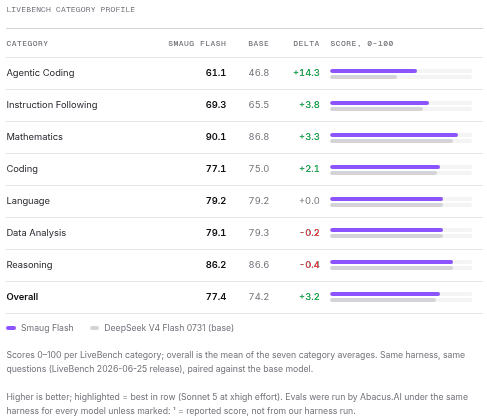
To evaluate the efficacy of the Smaug training regimen, Abacus.AI utilized rigorous benchmarking frameworks, most notably LiveBench—an evaluation suite designed to mitigate data contamination by regularly updating questions derived from current math competitions, academic preprints, and coding repositories, scored via deterministic ground truth rather than subjective LLM-as-a-judge protocols.
The performance gains across the three models demonstrate how fine-tuning impacts different base architectures where their gaps were widest:
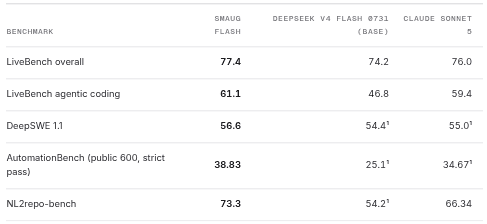
Smaug Flash demonstrated the most dramatic quantitative leaps in the entire series. On LiveBench agentic coding, it achieved a remarkable 14.3-point increase, rising from 46.8 to 61.1. Furthermore, it posted a 13.7-point improvement on AutomationBench (moving from 25.1 to 38.83) and a 19-point jump on NL2Repo-Bench (rising from 54.2 to 73.3). These metrics indicate that the fine-tuning successfully closed genuine capability gaps in automated code generation and long-context tool integration, outperforming several competing proprietary models in these specific domains.

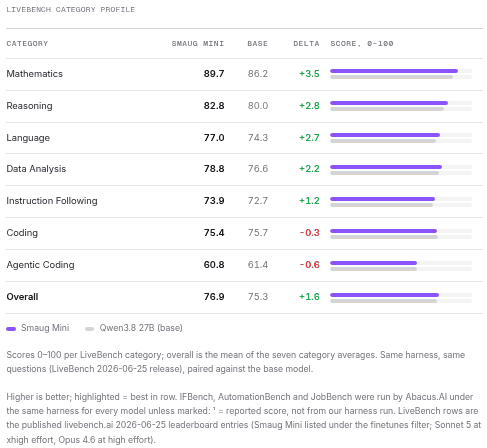
Smaug Mini presented a different trajectory. Because its Qwen base was already robust in coding tasks, its performance deltas concentrated heavily in mathematics (gaining 3.5 points) and reasoning (gaining 2.8 points). Notably, despite a marginal -0.6 variance in its LiveBench agentic coding score, Smaug Mini surpassed several prominent frontier closed-source models—including iterations from leading proprietary vendors—on specialized evaluations such as IFBench for instruction following, AutomationBench, and JobBench, where it recorded a 17.1-point gain over its base model. This divergence highlights the nuanced distinction between standardized benchmark categories and real-world operational capability.
Smaug Agentic focused less on raw benchmark delta maximization and more on operational reliability. Operating at a 2.8-trillion-parameter scale, its baseline capabilities left minimal room for score inflation. However, in rigorous stress tests involving long-horizon tasks, Smaug Agentic completed 113 complex agentic coding tasks running a median of 78 execution steps per task over more than seven continuous hours of operation, achieving zero infrastructure errors and zero timeouts. While its base model outperformed it on isolated benchmarks such as Terminal-Bench 2.1 and MMMU-Pro, the fine-tuned iteration eliminated runaway reasoning loops, demonstrating unprecedented behavioral stability.
Industry Implications and Practical Implementation
The public release of the Smaug model family on Hugging Face provides enterprise developers with significant flexibility, but industry analysts emphasize that open weights do not automatically equate to plug-and-play efficiency. Real-world deployment requires careful consideration of hardware configurations, inference latency, context window constraints, and specific task complexities.
For organizations building continuous, self-improving enterprise workflows, Smaug Flash offers an optimal balance of throughput and error reduction. For teams requiring localized deployment on restricted GPU setups without sacrificing advanced instruction-following capabilities, Smaug Mini provides a highly competitive alternative to proprietary closed-source APIs. Meanwhile, enterprises tackling multi-hour, multi-step computational pipelines can leverage Smaug Agentic to ensure infrastructural resilience and prevent the systemic timeouts that typically plague large-scale models during extended operational loops.
Ultimately, the introduction of the Smaug series marks a notable maturation in open-source AI development. By demonstrating that targeted, reasoning-preserving fine-tuning can systematically address the operational frailties of autonomous agents, Abacus.AI has provided the broader developer ecosystem with valuable empirical data and robust tools for scaling dependable artificial intelligence in production environments.