Accelerating Small Language Model Narrow Automation Through Key-Value Prompt Caching

In the rapidly evolving landscape of artificial intelligence, enterprises increasingly turn to Small Language Models (SLMs) to handle deterministic, narrow automation tasks. While parameters scaling traditionally dominated industry headlines, deployment realities in production environments demand efficiency, cost-effectiveness, and low latency. The second installment of KDnuggets’ specialized series on SLM optimization strategies addresses a critical computational bottleneck: redundant prompt processing. By implementing Key-Value (KV) cache reuse for static prompt prefixes, developers can slash computational overhead by more than half without sacrificing accuracy.
The Challenge of Redundancy in Narrow Automation Workloads
Narrow automation workflows—such as classifying customer support tickets, extracting structured entities, or validating form inputs—rely heavily on static instructional frameworks. A typical production prompt consists of a comprehensive system instruction, detailed taxonomy definitions, and several few-shot examples that establish the expected output format. In practical applications, this static instruction block often spans upwards of 150 tokens. Meanwhile, the dynamic element—the specific incoming ticket or data record—adds merely twenty to thirty tokens per execution.
In a standard naive inference loop, transformer-based architectures re-evaluate the entire prompt sequence from scratch for every single API call or local inference pass. Consequently, the system repeatedly computes key and value vectors for the identical instruction prefix across every layer of the neural network. For high-volume enterprise pipelines processing hundreds of thousands of transactions daily, this redundant mathematical computation represents a significant waste of processing time and energy resources.
Benchmarking the Baseline: The High Cost of Full Re-Encoding
To quantify the performance penalty of traditional inference approaches, engineers established a rigorous benchmark using the Qwen2.5-0.5B-Instruct model. Running in float16 precision via Hugging Face Transformers on consumer-grade hardware—specifically an M2 MacBook Air equipped with 24GB of RAM and a 16-core Neural Engine—the model processed a toy dataset of 600 customer support tickets.
The evaluation framework utilized a constrained scoring mechanism. By restricting the model’s output space at the final decoding layer, the system evaluates the logits of the first token corresponding to predefined classification labels ("billing," "technical," "account"). This single forward-pass strategy ensures deterministic classification while isolating the pre-fill phase as the primary optimization target.
During baseline testing, where the complete prompt containing both the 145-token static prefix and the dynamic ticket suffix was re-encoded for every record, the total execution time reached 184.85 seconds. This equated to an average latency of approximately 308.1 milliseconds per ticket. Although manageable for small batches, this computational drag scales linearly, rendering real-time or high-throughput batch automation inefficient on resource-constrained edge devices or cost-sensitive cloud instances.
Unlocking Efficiency via Prefix Caching
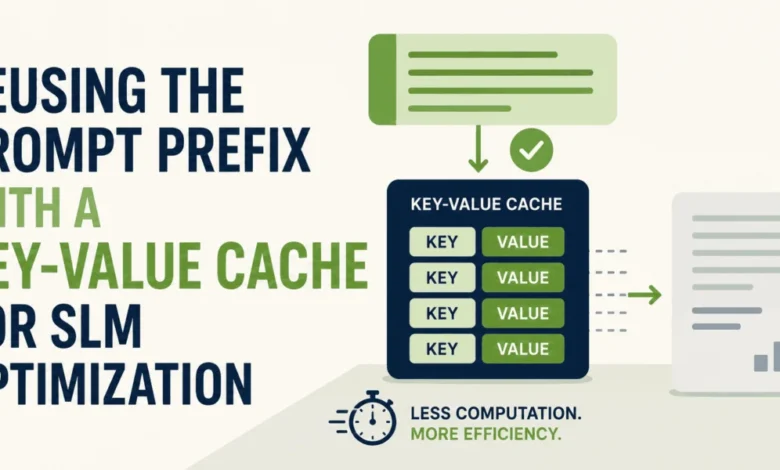
The architectural solution to this inefficiency lies in Key-Value caching. Within transformer models, the key and value vectors generated for any given token depend exclusively on the preceding context. Therefore, for a fixed system prompt and taxonomy definition, these internal vectors remain mathematically identical across every execution, provided the prefix boundary is cleanly maintained at the token level.
By feeding the static prefix through the model precisely once during initialization, developers can capture and store the resulting activation tensors inside a dynamic cache structure (such as PyTorch’s DynamicCache). Subsequent inference calls bypass the expensive pre-fill phase for the instructions, passing only the newly arrived dynamic tokens—the specific support ticket—while referencing the pre-computed keys and values stored in memory.
To execute this effectively, the runtime environment must carefully manage attention masks and cache positions. The attention mask must seamlessly bridge the cached prefix and the incoming suffix, while the cache position tensor explicitly informs the model where the new tokens append relative to the static baseline. Immediately following the forward pass for an individual item, the cache is rolled back to its original length, preparing the state for the next incoming record.
Quantifying Performance Gains and System Implications
When tested under identical hardware constraints using the same 600-record support ticket dataset, the prefix-cached architecture demonstrated dramatic performance improvements. The total runtime plummeted from 184.85 seconds down to 80.07 seconds. Average processing latency per ticket dropped from 308.1 milliseconds to 133.5 milliseconds, delivering an overall runtime reduction of approximately 57 percent.
Crucially, this optimization operates as a pure computational shortcut rather than an algorithmic approximation. Verification scripts confirmed that the cached execution path produced identical classification labels to the un-cached baseline across every single test case.
The implications of this performance leap extend far beyond a simple speed benchmark. As system designers draft increasingly sophisticated, detailed instruction blocks and expand few-shot examples to improve SLM accuracy, the proportion of static-to-dynamic tokens grows. Under traditional inference paradigms, more detailed instructions penalized system performance by increasing pre-fill length. With prefix caching, however, rich and expansive instruction sets become advantageous; because the prefix is computed only once, the marginal cost of adding detailed context approaches zero.
Industry Context and Production Readiness
The deployment of Small Language Models in production has accelerated dramatically throughout 2024 and 2025. Organizations increasingly favor sub-billion-parameter models like Qwen2.5-0.5B, Llama-3-8B variants, and specialized SLMs for edge computing, on-premise data privacy compliance, and cost-effective cloud scaling. However, realizing the economic potential of these models requires moving away from treating every inference call as an isolated, stateless event.
Software engineering paradigms surrounding generative AI are maturing to embrace stateful execution patterns. Techniques such as prompt prefix caching bridge the performance gap between monolithic, expensive frontier models and lightweight, highly specialized local models. By treating static instructions as cached system states, engineering teams can eliminate the computational overhead that previously made small models feel sluggish in production pipelines.
Broader Technical Impact on Edge AI and Enterprise Workflows
The successful implementation of KV cache reuse for SLMs signals a broader shift in how developers approach local and edge AI deployments. Hardware limitations—particularly on laptops, IoT gateways, and resource-capped server instances—frequently restrict the viability of continuous LLM inference. By optimizing memory access patterns and eradicating redundant tensor calculations, developers can run sophisticated classification, moderation, and extraction pipelines on standard hardware without relying on expensive GPU clusters.
Furthermore, as frameworks like Hugging Face Transformers, vLLM, and llama.cpp native support for prefix caching and automatic prefix sharing matures, these optimizations are transitioning from bespoke Python scripts to robust, out-of-the-box infrastructure features. For enterprises processing massive streams of structured textual data, adopting these strategies transforms small language models from an experimental compromise into an optimal, production-grade architectural choice.