Why Data Professionals Are Rethinking Browser AI: The Privacy Implications of Mainstream Assistants

Data professionals spend the vast majority of their working hours inside web browsers, navigating a dense digital ecosystem of technical documentation, academic research papers, open-source code repositories, model cards, and industry reports. Increasingly, this workflow is augmented by artificial intelligence assistants designed to summarize, parse, and generate text on the fly. However, as reliance on these tools deepens, a quiet trade-off has emerged between productivity and data privacy—one that is prompting a significant re-evaluation among engineers, data scientists, and analysts handling sensitive information.
The most widely adopted browser AI tools—such as Google Chrome integrated with Gemini, Perplexity, and OpenAI’s ChatGPT accessed via pinned tabs—are undeniably powerful. Yet, each carries a distinct privacy cost that is easily overlooked in the rush to meet project deadlines. Standard consumer implementations of Gemini often utilize user conversations to train and improve Google’s services, with select interactions subject to human review. Perplexity routes user queries and active webpage content through external cloud servers for processing. Similarly, unless explicitly opted out, ChatGPT leverages user inputs to refine future foundation models.
For general web browsing and casual inquiries, this data-sharing tradeoff is largely accepted by consumers. However, for data professionals dealing with proprietary corporate datasets, unreleased model architectures, sensitive client research, or confidential business intelligence, these default data-handling policies present compliance and security risks. Consequently, a growing segment of the technical community is turning its attention toward privacy-first alternatives integrated directly at the browser level, most notably the Brave browser’s native AI assistant, Brave Leo.
Understanding the Structural Privacy Deficit in Mainstream AI
To fully grasp the appeal of alternative architectures, it is necessary to examine how mainstream browser AI tools process user information. The differences are not merely cosmetic; they are structural.
When users interact with Gemini inside Chrome, Google’s terms of service advise against inputting sensitive data that users would not want reviewed by human eyes. While on-device models like Gemini Nano operate locally for specific tasks, broader cloud-based interactions default to data collection for model improvement. Perplexity functions as an exceptionally robust exploratory research engine backed by automated citations, but its cloud-first framework requires transmitting both user queries and live webpage contents away from the local machine. Even Apple Intelligence, widely praised for its heavy reliance on on-device processing via Private Cloud Compute, remains strictly siloed within Apple’s hardware ecosystem, leaving Windows and Linux data professionals without native support.
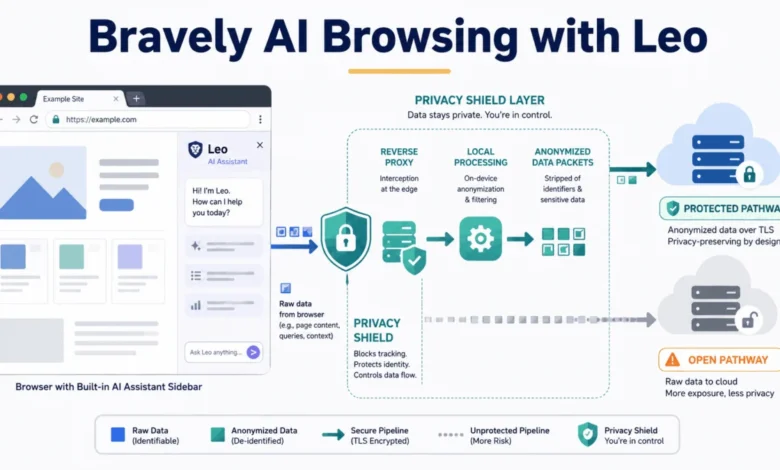
In contrast, privacy-centric tools like Brave Leo utilize an architectural model designed to sever the link between user identity and query processing. Queries are routed through an anonymous reverse proxy that strips originating IP addresses before requests reach the underlying large language models. Furthermore, conversation sessions are ephemeral, discarded immediately once a response is generated, ensuring that no logs are retained on company servers. User accounts are not tied to basic usage, and no inputs are utilized for model training. This zero-retention policy applies universally across both free and paid tiers, allowing professionals to parse proprietary documentation or analyze internal database schemas without leaving a persistent digital footprint.
Evolution and Feature Expansion of Privacy-First Assistants
Originally introduced to provide a native alternative to third-party extensions, Brave Leo has evolved significantly since its rollout. Built directly into the Chromium-based Brave browser—which facilitates seamless imports of bookmarks, extensions, and saved passwords from Chrome—Leo operates within the browser sidebar and address bar without requiring authentication.
The platform employs a tiered model structure designed to balance accessibility with advanced capabilities. The free tier grants users access to capable open-weight models suitable for day-to-day document summarization, code explanation, and general research. For advanced technical workloads, the Premium tier—priced at $14.99 monthly or approximately $12.50 monthly on an annual commitment—unlocks frontier models including Anthropic’s Claude Sonnet and DeepSeek R1, alongside higher rate limits and priority processing during peak network traffic.
Crucially, Brave maintains its strict privacy guarantees even for paying subscribers. Payment processing utilizes a credential-based token system that decouples financial identity from chat activity, ensuring that even premium accounts remain unlinkable to specific usage sessions. Furthermore, the introduction of local-first capabilities, such as the Brave Ocelot summarization model, allows users to execute inference directly on their own hardware, ensuring that sensitive documents never transit external networks. Advanced features like Bring Your Own Model (BYOM) further empower technical users to connect local instances or proprietary API keys directly to the browser interface.
Core Workflows and Practical Applications in Data Science
The primary utility of browser-integrated AI assistants lies in page-awareness. Unlike standalone conversational chatbots that require manual copy-pasting of text, sidebar assistants read active browser tabs in real time.
For data scientists reviewing academic literature on platforms like arXiv, Leo can parse complex model cards, extract evaluation metrics, and summarize technical methodologies instantly. Instead of manually reviewing lengthy documentation to identify training sets and known limitations, professionals can execute structured prompts to generate concise summaries. Similarly, the assistant natively processes PDFs, Google Docs, and Google Sheets opened within the browser, enabling targeted queries regarding data collection methods, sample sizes, and potential algorithmic biases without exposing proprietary data dictionaries to third-party model trainers.
Advanced operational workflows also benefit from multi-tab context and Tab Focus Mode. These features allow the assistant to draw information across several open documentation tabs simultaneously or anchor its focus to a single authoritative source—such as official framework documentation—while the user cross-references external tutorials. Additionally, the introduction of customizable prompt chains, known as "Skills," enables data professionals to automate repetitive auditing and extraction tasks across multiple technical papers, effectively transforming the browser sidebar into a specialized analytical co-pilot.
Comparative Analysis: Choosing the Right Tool for the Task
No single AI tool serves every requirement across a complex data workflow, and professionals must weigh capabilities against security constraints depending on the specific task at hand.
When conducting public-domain exploratory research, literature reviews, or tasks requiring live web citations and exhaustive synthesis, cloud-reliant platforms like Perplexity Pro remain industry leaders. Conversely, when examining internal codebases, client-restricted datasets, or proprietary technical documentation, privacy-first architectures like Brave Leo provide the necessary data isolation. For scenarios demanding absolute air-gapped security, running localized models via open-source interfaces remains the gold standard.
Industry analysts note that the artificial intelligence landscape of 2026 requires a nuanced approach to tool selection. Rather than relying on a single default assistant for all operational needs, data professionals are increasingly adopting a tiered workflow: utilizing browser-native privacy tools for day-to-day document reading and sensitive data handling, while reserving specialized cloud platforms strictly for public-domain research synthesis where data confidentiality is not a primary constraint.
Implications for the Future of Enterprise and Professional Browsing
The ongoing maturation of privacy-preserving browser assistants signals a broader shift in how technical professionals evaluate software tools. As regulatory scrutiny regarding data governance intensifies and organizations adopt stricter zero-trust policies, the convenience of cloud-based AI services is increasingly weighed against the hidden costs of data exposure.
While tools like Brave Leo still face limitations—such as a lack of autonomous web-crawling capabilities equivalent to dedicated research search engines or the absence of persistent memory across sessions by default—their architectural framework points toward a secure future for browser-based intelligence. For data professionals, engineers, and researchers operating at the intersection of productivity and security, the availability of high-performance models operating within a zero-retention privacy perimeter demonstrates that capability no longer requires compromising confidentiality.