Radaris.com Domain Seizure Marks a Major Escalation in the Legal Battle Over Data Broker Accountability


The landscape of online personal data brokering faced a historic disruption this week as the domain Radaris.com was forcibly transferred to the plaintiffs in a high-stakes legal battle centered on New Jersey’s Daniel’s Law. This judicial action represents a rare and aggressive enforcement measure against a sector long characterized by its opacity, systemic avoidance of removal requests, and complex corporate structures designed to evade liability. The seizure, which follows a protracted legal stalemate, serves as a litmus test for the enforceability of state-level privacy statutes in an era where personal information is traded as a global commodity.
The Genesis of the Conflict
At the heart of the dispute is Daniel’s Law, a New Jersey statute enacted to protect state law enforcement officers, judges, and government personnel—along with their families—from the risks associated with the public disclosure of their home addresses and personal information. The law mandates that data brokers must scrub such records upon request, with non-compliance triggering significant financial penalties of $1,000 per violation.
Atlas Data Privacy Corp, the plaintiff in this litigation, has positioned itself as a primary enforcer of this statute. In February 2024, the company initiated legal action against Radaris, an entity notorious for its massive repository of people-search databases. Throughout the proceedings, Atlas alleged that Radaris engaged in a sophisticated pattern of obstructionism, characterized by what company CEO Matt Adkisson described as a "shell game" of corporate identity.
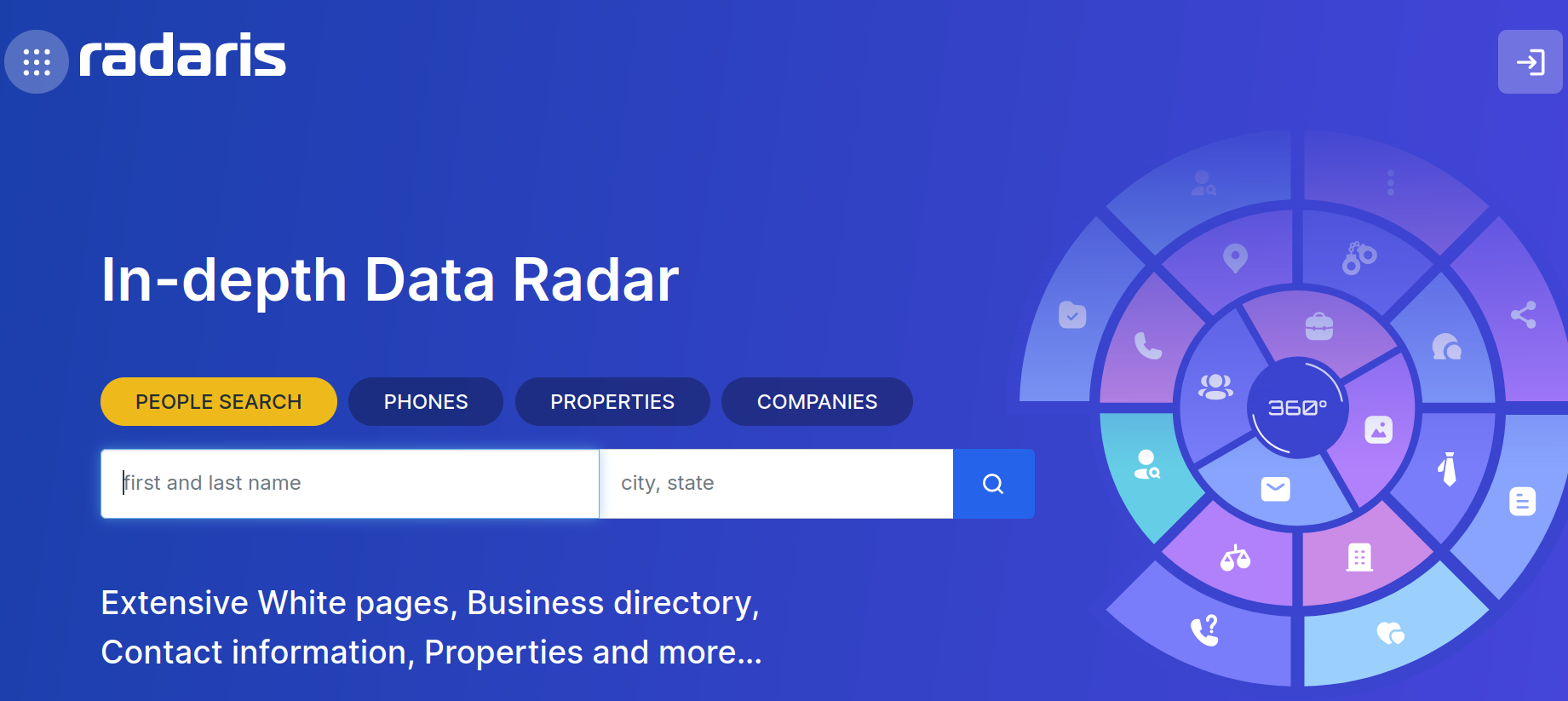
A Chronology of Evasion
The history of Radaris and its affiliates is defined by a decade-long strategy of procedural maneuvering. The legal timeline reveals a persistent pattern of behavior:
- 2017: Radaris faced a class-action lawsuit where a default judgment of $7.5 million was issued after the company failed to contest the claims. However, the company successfully appealed, arguing that the true legal owner—a Cyprus-based entity named Bitseller Expert Limited—had not been properly served, thereby halting the enforcement of the judgment.
- 2020: Following the 2017 case, the operational management of the domains shifted to Andtop Company, an entity incorporated in the Marshall Islands. This move was widely interpreted by legal observers as a deliberate attempt to place the company’s assets beyond the reach of U.S. courts.
- February 2024: Atlas Data Privacy Corp filed its initial complaint in New Jersey, citing recurring violations of Daniel’s Law.
- March 2024: Investigations by KrebsOnSecurity identified the co-founders of the operation as Igor and Dmitry Lubarsky, Russian-born brothers based in Massachusetts. The brothers’ legal team threatened defamation litigation, claiming the report was inaccurate and that the true owners were based in Ukraine—a claim that contradicted subsequent discovery evidence.
- June 2025: Facing continued non-compliance, Atlas refiled its lawsuit, expanding the scope to include a broader network of Radaris-affiliated data brokers.
- August 2026: A New Jersey judge ruled against the defendants, ordering the transfer of the Radaris.com domain and more than a dozen others to the plaintiffs after the operators failed to appear or provide a credible defense.
The Anatomy of a Data Broker Empire
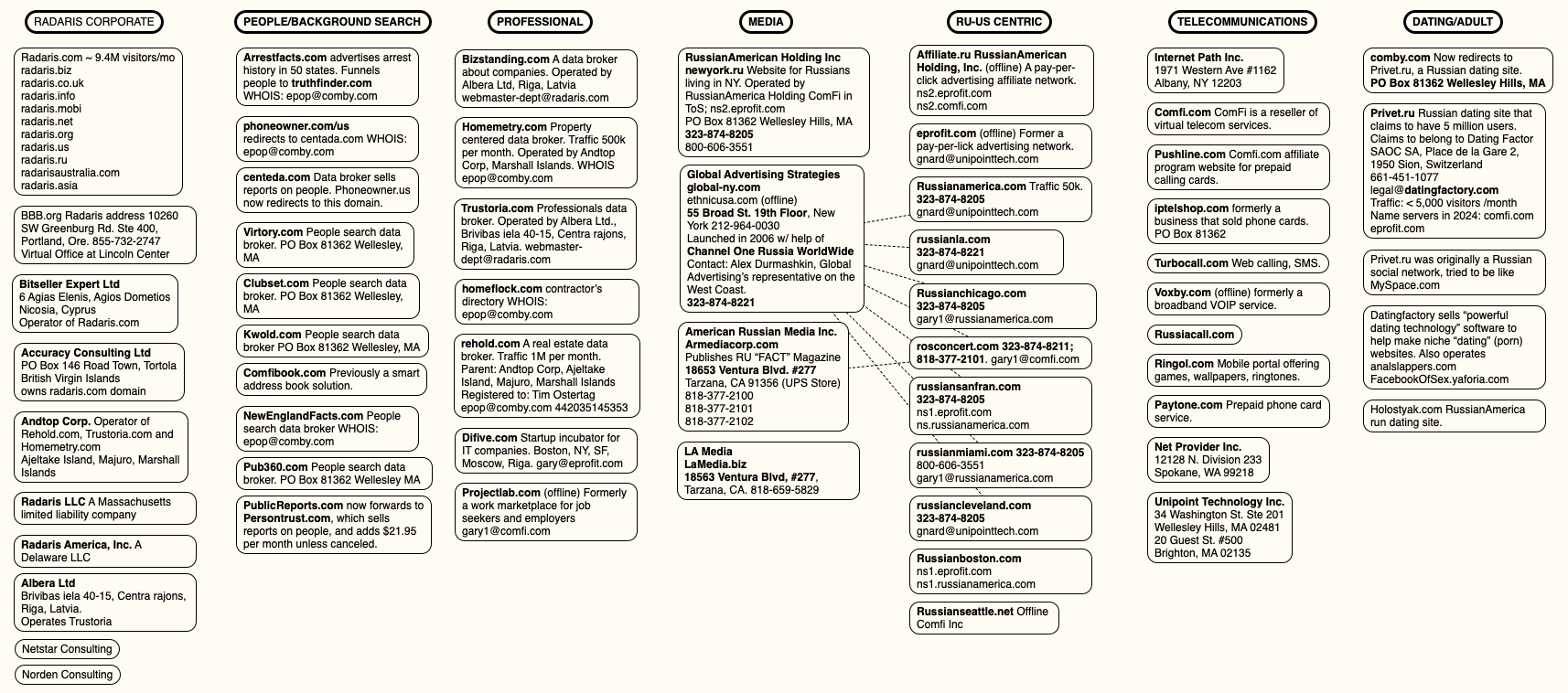
The litigation has provided unprecedented insight into how these firms operate. According to documents obtained by Atlas, the "Radaris family" is not a collection of independent entities, but a unified operation managed by a small group of individuals based in the Boston area.
Evidence secured through discovery includes over 10,000 internal emails and financial records. These documents indicate that entities such as Radaris America, Inc., Virtura Corp, Veripages Inc., and several others share centralized administrative functions, payment processing systems, and virtual office addresses. The internal communications revealed a cohesive technical infrastructure, with many of these sites routing administrative and financial traffic through shared email domains like "difive.com."
Financially, the operation is lucrative. The emails suggest that Radaris.com generates approximately $42,000 in monthly revenue, while its sister site, Veripages.com, nets roughly $45,000. These revenues are bolstered by partnerships with marketing firms and, ironically, by cross-promotional arrangements with "data removal" services like Onerep. This creates a circular business model where companies profit from both the aggregation of data and the desperate, paid attempts of consumers to remove it.

Legal Defenses and the Constitutional Challenge
Attorneys for the defendants have challenged the seizure on procedural grounds. Victor Worms, representing the interests involved, argued that the default judgment is void because "Radaris.com" is a domain name, not a legal entity, and therefore lacks the capacity to be sued. Furthermore, the defense contends that the domain transfer constitutes a violation of constitutional due process, signaling that an appeal to the U.S. Supreme Court is likely.
The case has also become a focal point for the broader data broker industry. Fearing that the New Jersey precedent could be replicated nationwide, approximately 150 data broker firms are currently challenging the constitutionality of Daniel’s Law. They argue that the statute is overly broad and infringes upon First Amendment protections regarding the dissemination of "publicly available information." The Third Circuit Court of Appeals is currently reviewing these constitutional arguments, and the outcome will likely dictate the future of privacy legislation in the United States.
Broader Implications for Privacy Law
The Radaris seizure underscores a fundamental disconnect between 20th-century definitions of "public records" and 21st-century digital surveillance. Privacy expert Justin Sherman notes that current state laws often fail to account for the ease with which aggregated public records—such as voting registries, property filings, and motor vehicle data—can be weaponized.
"The lack of a comprehensive federal privacy law is not for a lack of knowledge," Sherman stated. "We have had millions of wake-up calls regarding data exposure, yet the industry continues to lobby effectively against restrictive legislation by framing data scraping as essential to the U.S. economy."
The failure of the federal government to establish a unified standard has led to a patchwork of state-level regulations. While 14 states have adopted versions of Daniel’s Law, the effectiveness of these laws is being tested in real-time. For instance, in August 2025, a federal court ruled that West Virginia’s version of the law was facially unconstitutional, highlighting the legal vulnerability of state-led privacy initiatives when pitted against industry-backed constitutional challenges.
The Road Ahead
For now, Radaris.com displays a notice regarding the court-ordered transfer, serving as a symbolic victory for Atlas Data Privacy Corp. However, the broader war for data privacy remains in flux. The case has moved beyond a simple dispute over personal information and into a high-stakes legal battle over the rights of corporations to profit from the digital identities of private citizens.
As the litigation proceeds, the case will likely serve as a roadmap for future efforts to regulate the data broker industry. If the courts uphold the domain seizures, it could provide a template for plaintiffs to bypass the traditional hurdles of serving foreign-based shell companies. Conversely, a ruling in favor of the data brokers could effectively neutralize state-level privacy protections, leaving the task of regulation to an increasingly gridlocked Congress. For millions of Americans, the outcome of this case may determine whether their digital footprint remains a permanent, marketable asset for anonymous brokers or a private, protected aspect of their personal lives.
Related posts: