AWS Launches Enhanced Custom Event Bus in Amazon EventBridge to Simplify Multi-Account Serverless Architectures

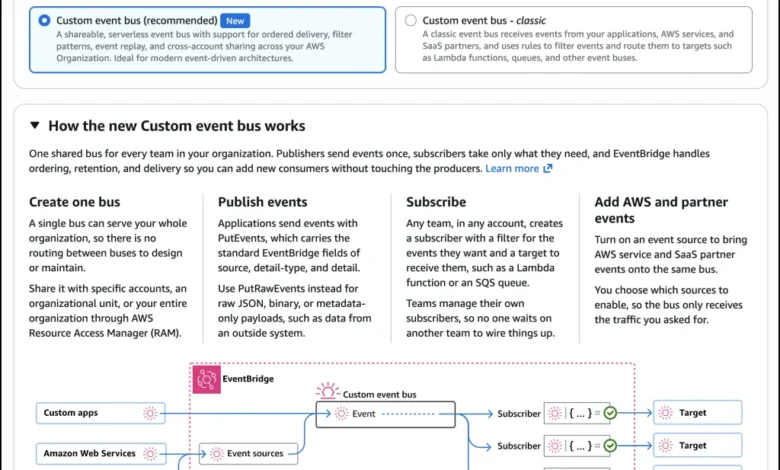
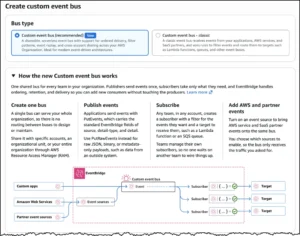
Amazon Web Services (AWS) has officially announced the launch of an enhanced custom event bus for Amazon EventBridge, marking a significant evolution in how organizations architect and scale event-driven applications across multiple cloud accounts. Designed to address the mounting operational complexities associated with managing distributed serverless systems, the newly released feature introduces organization-wide sharing, native event ordering, unified Subscriber resources, advanced event evaluation capabilities, and a decoupled throughput pricing model. This major update aims to eliminate the intricate web of cross-account rules and bus-to-bus routing architectures that have historically challenged enterprise platform engineering teams.
Background and Architectural Context
Event-driven architectures have long been celebrated for their ability to decouple software systems, enabling applications to communicate asynchronously through producers, routers, and consumers. In the early stages of cloud adoption, organizations typically establish a single custom event bus within a solitary AWS account. This streamlined setup functions efficiently when managed by a dedicated, centralized team. However, as cloud footprints expand and organizational growth accelerates, adherence to AWS well-architected multi-account best practices necessitates that distinct business units and engineering squads operate within their own isolated accounts.
To facilitate communication across these structural boundaries, engineering teams have traditionally relied on complex workarounds. These involved configuring multiple event buses interconnected via intricate cross-account resource policies and bus-to-bus routing rules. Over time, these practices re-introduced the very operational friction and administrative overhead that serverless computing was engineered to eradicate. Platform administrators frequently lost end-to-end visibility regarding who was subscribing to specific events. Furthermore, the compounding financial costs of multi-hop routing, coupled with the rigid constraints of legacy event ordering, forced developers to build cumbersome custom layers—such as inserting Amazon Simple Queue Service (SQS) queues between buses and compute layers—to maintain data integrity.
Recognizing these systemic enterprise challenges, AWS developed the enhanced custom event bus as a purpose-built solution for large-scale, multi-account environments. By centralizing the event backbone while preserving decentralized publishing and subscribing, the new architecture bridges the gap between organizational governance and developer agility.
Core Architectural Enhancements and Capabilities
The introduction of the enhanced custom event bus brings a suite of powerful technical capabilities directly into the Amazon EventBridge service layer, fundamentally transforming how publishers and subscribers interact.

Organization-Wide Sharing via AWS RAM
At the heart of the new offering is seamless resource sharing integrated directly with AWS Resource Access Manager (AWS RAM). Platform teams can now deploy a single, centralized event bus and share it across all AWS accounts within an entire AWS Organization, specific Organizational Units (OUs), or individual AWS Identity and Access Management (IAM) roles and users.
This mechanism removes the manual burden of configuring cross-account permissions. Publishers can broadcast events to the shared bus without needing prior knowledge of which downstream teams or services will consume them. Concurrently, application teams can independently establish their own subscriptions. To support sprawling enterprise structures, the enhanced event bus supports a default quota of 10,000 subscribers per bus—a threshold that can be increased upon request—drastically mitigating the bus fragmentation previously necessitated by strict subscriber limits.
Dual-Pattern Event Ordering and Synchronous Processing
While asynchronous event-driven models thrive on out-of-sequence execution, certain real-time workloads—such as logistics tracking, financial transactions, and inventory management—require strict chronological sequencing. Out-of-sequence events in a delivery routing system, for instance, can cause algorithms to process stale geographical data, resulting in erroneous routing decisions.
The enhanced custom event bus accommodates both asynchronous flexibility and strict ordering on the same shared bus. Publishers can attach an EventGroupId to payloads, instructing EventBridge to deliver events sharing the same identifier in precise sequence to subscribers configured for ordered delivery. Meanwhile, other non-sequential consumers on the same bus can process events asynchronously without performance degradation.
To support this ordered processing model seamlessly, the platform introduces synchronous invocation for targets such as AWS Lambda. In synchronous mode, EventBridge confirms successful target execution before acknowledging the event. This native capability eliminates the architectural pattern of interposing intermediary queues to guarantee reliable, sequential execution.
Streamlined Subscriber Resource Model
Managing event-filtering rules, target endpoints, retry policies, and dead-letter queues (DLQs) has historically required maintaining disparate resources scattered across an AWS environment. The enhanced custom event bus consolidates these functions into a unified Subscriber resource.

Each consumer utilizes a single, cohesive resource to define event filtering criteria, target delivery locations, and failure handling mechanisms. Additionally, the inclusion of variable start time options simplifies the onboarding of new consumer applications and streamlines event replay procedures required for disaster recovery or state rehydration.
Advanced Event Evaluation and Transformations
Data hygiene and transformation represent critical bottlenecks in large-scale event processing. The new event bus introduces content-based deduplication, enabling EventBridge to automatically evaluate payloads, compute cryptographic hashes of meaningful data, and collapse duplicate events arriving within a five-minute window. This provides exact-once delivery semantics for event sources that lack native idempotency tokens, relieving developers from writing custom deduplication logic.
Furthermore, subscribers can leverage JSONata expressions to reshape event payloads dynamically before they reach downstream targets. This allows consumers to extract specific fields, rename attributes, or compute derived values directly within the routing layer. For organizations utilizing complex serialization frameworks like Apache Avro or Protocol Buffers, EventBridge can now deserialize payloads into JSON format automatically, allowing for granular filtering across the entire event payload without requiring custom ingestion and deserialization code at the consumer level.
Economic Model and Pricing Restructuring
Financial predictability has historically been a complex variable in multi-bus topologies, where cross-account routing fees compounded rapidly. The enhanced custom event bus transitions to an ingress and egress throughput pricing model designed to align costs with actual data utilization.
Under this new structure, publishers incur charges based on the volume of events ingested, while subscribers pay for events delivered. This decoupling removes the financial penalties associated with complex multi-hop routing, delivering improved economic efficiency for enterprise-scale deployments. Legacy custom event buses remain fully supported under their existing pricing models, appearing as "Custom event bus — classic" in the management console to ensure uninterrupted operations for existing workloads.
Chronology and Immediate Availability
The development and deployment of the enhanced custom event bus followed a rigorous engineering roadmap focused on enterprise serverless readiness. The feature became generally available to global cloud customers, deployed across a broad spectrum of AWS Regions including US East (N. Virginia, Ohio), US West (Oregon), Europe (Ireland, Frankfurt, Stockholm, Spain), and Asia Pacific (Hong Kong, Malaysia, Mumbai, Singapore, Sydney, Thailand, Tokyo).
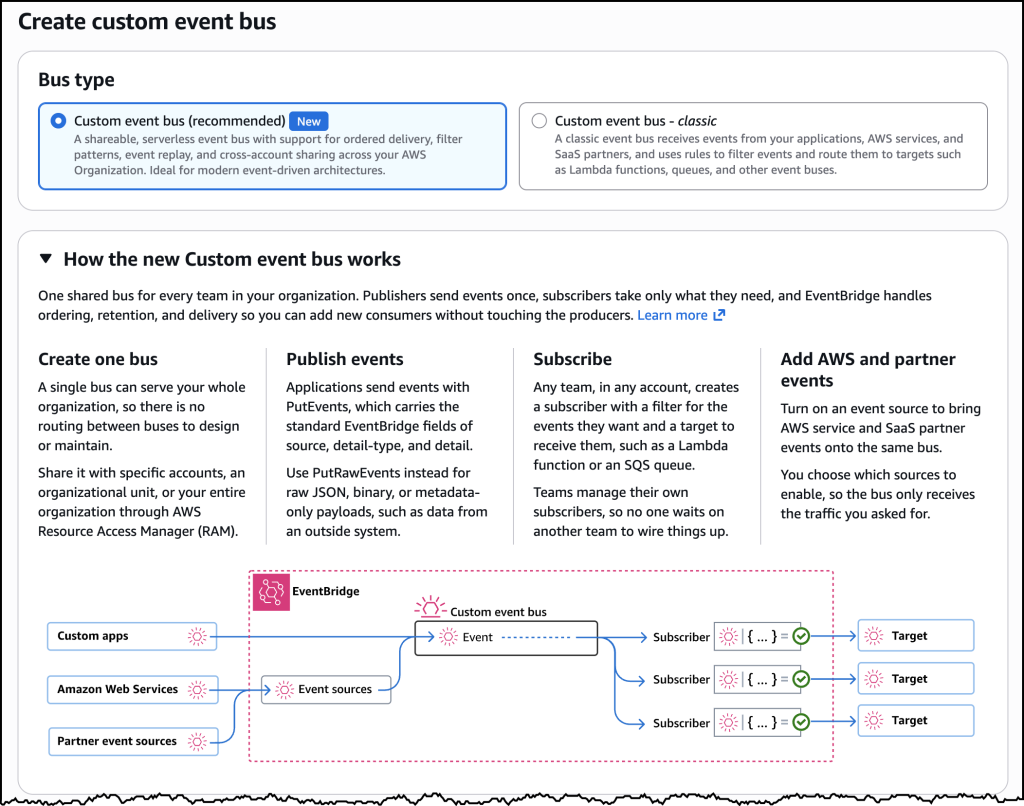
Organizations can provision and configure the new event bus immediately utilizing the AWS Management Console, the AWS Command Line Interface (AWSCLI), or programmatic EventBridge APIs. Existing workloads utilizing classic event buses are not subject to mandatory migration, allowing engineering organizations to adopt the enhanced architecture at their own operational pace.
Industry Implications and Technical Analysis
From an analytical standpoint, the release of the enhanced custom event bus signifies AWS’s continued commitment to maturing serverless ecosystems for enterprise-grade adoption. As enterprises migrate increasingly mission-critical workloads to cloud-native paradigms, operational governance, security isolation, and cost transparency have emerged as paramount concerns.
By collapsing multi-account routing complexity into a single, governed, and shareable resource, AWS reduces the cognitive load on platform engineering teams. The integration of native event ordering and JSONata transformations shifts responsibilities that previously required custom middleware back into the managed infrastructure layer. Consequently, organizations can expect reduced codebase complexity, improved auditability of event flows, and more predictable financial forecasting for large-scale distributed applications. As cloud architectures continue to scale, features of this nature establish a new benchmark for managed enterprise messaging and event brokerage systems.
Related posts: