Amazon Web Services Expands Elastic Block Store Capabilities with Cross-Account Volume Clones and Advanced Re-Encryption Controls

Amazon Web Services (AWS), a leading provider of cloud computing services, has announced a significant expansion of its Amazon Elastic Block Store (Amazon EBS) portfolio by introducing cross-account support for volume clones. This new capability allows organizations to create instant point-in-time copies of their EBS volumes and transfer them directly to separate AWS accounts within the same region. Coupled with the option to re-encrypt the transferred data using a targeted AWS Key Management Service (AWS KMS) key, the feature is designed to bridge the gap between production data utility and stringent multi-account security governance.
The release addresses a longstanding challenge in enterprise cloud architecture: how to effectively leverage production-grade datasets for downstream testing, quality assurance, and development without exposing production environments to security vulnerabilities or performance degradation. By integrating with AWS Resource Access Manager (RAM), the new functionality provides a secure, auditable, and streamlined mechanism for sharing storage assets across organizational boundaries.
Background Context and the Evolution of EBS Clones
To understand the significance of this cross-account release, it is necessary to examine the evolution of Amazon EBS data management. Historically, creating copies of block storage volumes involved taking traditional Amazon EBS snapshots. While snapshots remain vital for long-term backup, disaster recovery, and baseline data retention, they are point-in-time point-to-pointer representations that must be restored to new volumes before heavy read-write operations can occur at full performance. This restoration process can introduce latency and administrative overhead, particularly when dealing with terabytes of enterprise data.
To mitigate these challenges, AWS introduced Amazon EBS Volume Clones last year. Volume clones allowed users to generate instant, fully initialized copies of their EBS volumes within the same Availability Zone. Because these clones leverage underlying storage virtualization mechanisms, they are available for immediate use without the performance warm-up periods associated with standard snapshot restorations.
However, the initial iteration of volume clones was constrained by account boundaries. Development teams working in isolated sandbox accounts—a best practice in modern cloud financial management and security—could not directly instantiate a clone of a production volume residing in a separate administrative domain. Instead, administrators had to resort to complex, multi-step workflows involving snapshot sharing, manual AMI creation, or cross-account manual volume initialization. These workarounds frequently resulted in administrative friction, compliance hurdles, and delayed development cycles.

Technical Architecture and Workflow
The newly released cross-account volume clone capability integrates directly into the existing AWS management ecosystem, relying on AWS RAM and the Amazon EC2 console to govern permissions and execute transfers.
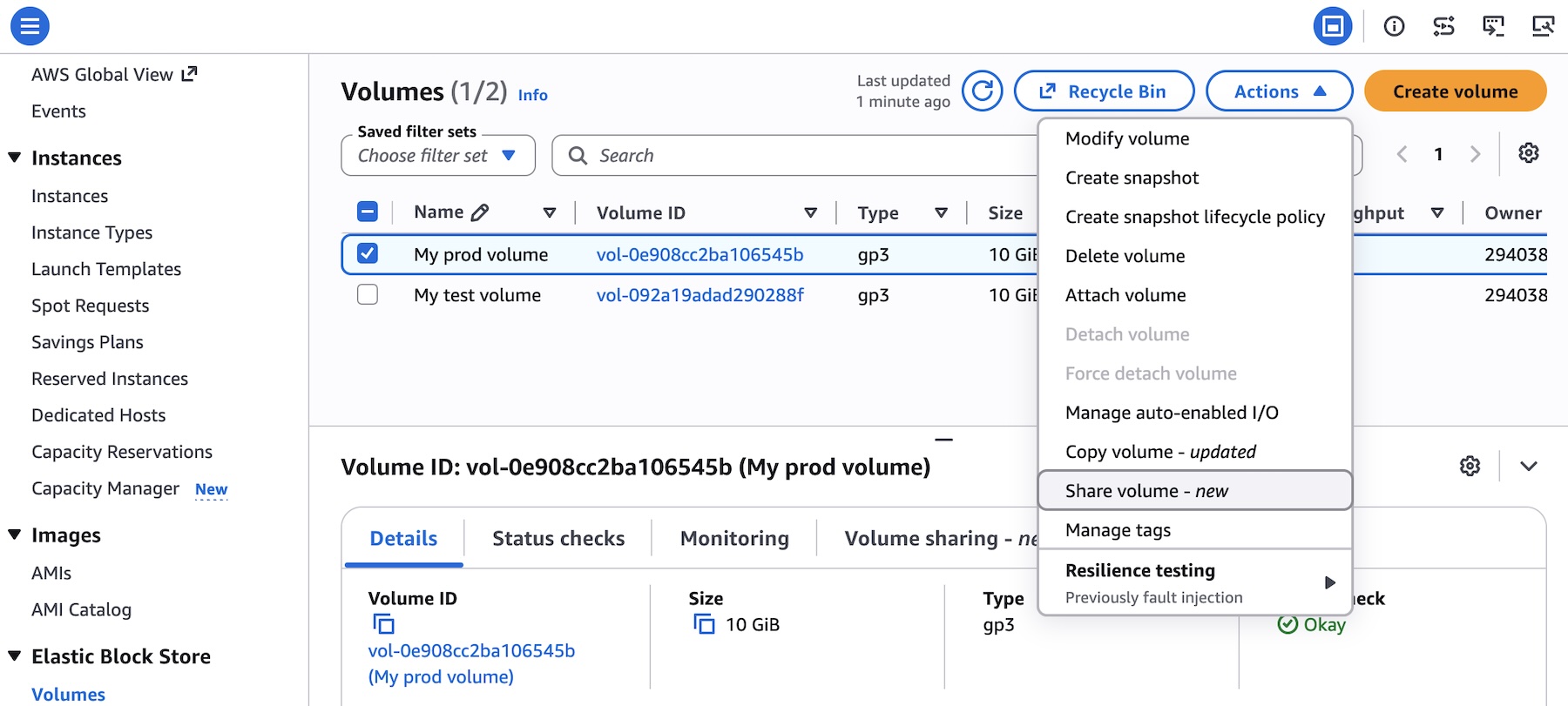
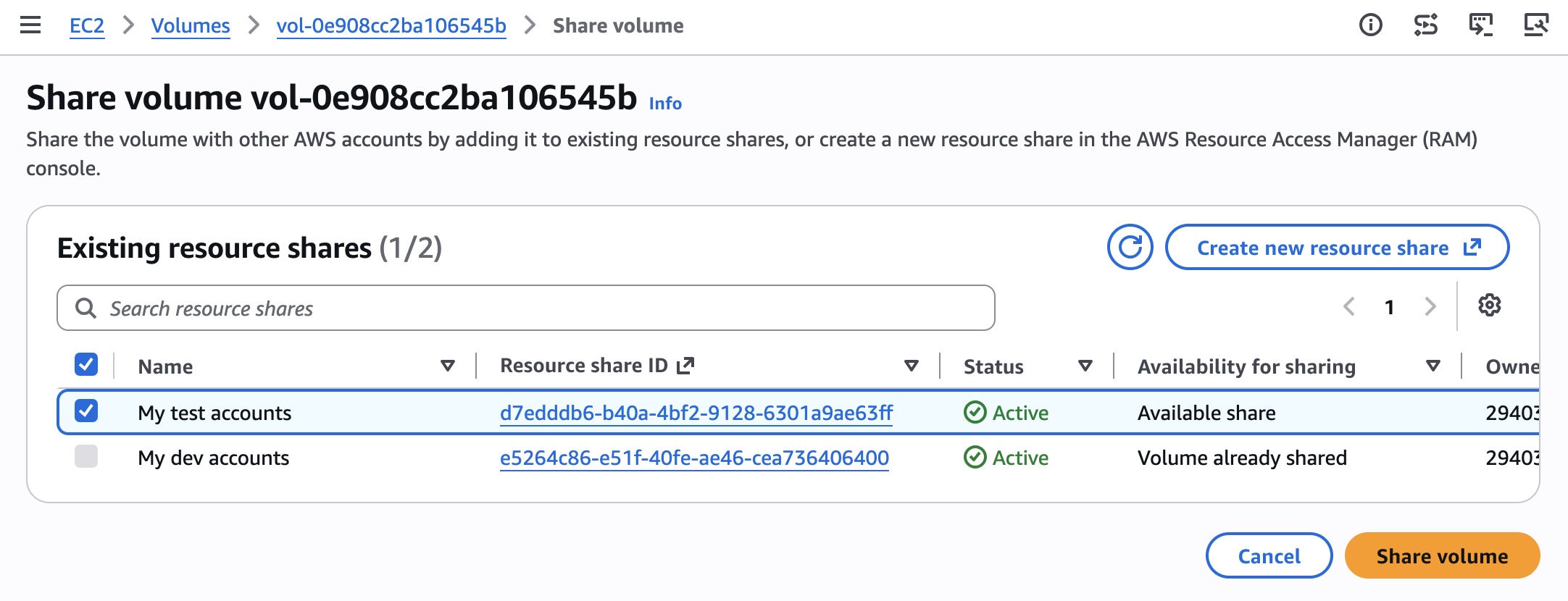
The workflow begins in the source account, where the volume owner navigates to the Amazon EBS console, selects the desired storage asset, and initiates the sharing process. By choosing to share the volume, the owner can add the asset to existing resource shares or formulate a new resource share via the AWS RAM console. AWS RAM acts as the central policy enforcement engine, allowing enterprises to share resources securely across AWS accounts within an organization or with explicitly trusted external accounts.
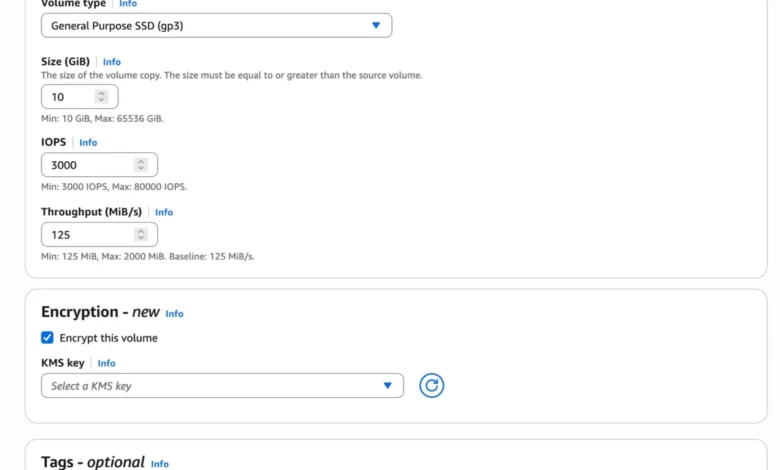
Once the resource share is established, the target account must formally accept the shared resource through its own RAM console. Upon acceptance, the shared volume becomes visible within the EBS volume management interface of the target account. Operators in the target environment can then invoke a dedicated "Copy volume" command. During this copy operation, the target account administrator can choose to re-encrypt the data utilizing a specific AWS KMS key managed within the target account’s cryptographic boundary. This ensures that even if data originates from a highly sensitive production tier, the receiving development or testing environment maintains absolute sovereignty over its encryption keys, satisfying internal compliance mandates and external regulatory frameworks such as HIPAA, PCI-DSS, and SOC 2.
Furthermore, AWS has ensured that these operations can be executed programmatically. Infrastructure-as-code practitioners and software development teams can integrate these tasks using the AWS MCP Server and associated plugins compatible with modern AI coding assistants and automation pipelines, thereby reducing manual intervention and human error.
Implications for Enterprise Development and Security
Industry analysts and cloud architects have noted several key implications stemming from the introduction of cross-account EBS volume clones.
First, the feature significantly enhances software development lifecycle (SDLC) velocity. Modern continuous integration and continuous deployment (CI/CD) pipelines rely heavily on realistic datasets to uncover integration bugs, performance bottlenecks, and database corruption issues before code reaches production. By enabling teams to instantly refresh development and staging environments with up-to-date production data—while maintaining strict account segregation—organizations can drastically reduce feedback loops. Developers no longer need to wait hours for snapshot restorations or rely on synthetic test data that fails to capture the complex anomalies inherent in live production databases.
Second, the capability reinforces security best practices through enforced data isolation and granular cryptographic control. In many traditional enterprise setups, granting developers access to production data meant provisioning permissions within the production account or sharing static snapshot identifiers across broad security groups. These practices expanded the blast radius of potential security incidents. With cross-account volume clones, the production environment remains strictly cordoned off. The data is copied out rather than accessed in place, and the application of target-account KMS encryption ensures that production keys are never exposed to secondary development teams.
Third, financial optimization and resource governance are improved. AWS environments often utilize multi-account strategies via AWS Organizations to allocate costs accurately to distinct business units or project codes. The ability to manage storage clones across accounts allows finance and cloud operations (FinOps) teams to track storage consumption more granularly, ensuring that exploratory workloads and heavy testing operations are billed to and managed by the appropriate departmental budgets rather than inflating core infrastructure expenditures.
Regional Availability and Getting Started
AWS has confirmed that cross-account volume clones for Amazon EBS are generally available immediately in all commercial AWS Regions that currently support standard Amazon EBS Volume Clones. Organizations looking to verify regional support can consult the official AWS Capabilities by Region documentation.

To begin utilizing the feature, administrators can access the Amazon EC2 console, navigate to the Elastic Block Store section, and follow the guided prompts for volume sharing and resource allocation. Feedback, feature requests, and technical inquiries regarding the rollout are being channeled through the official AWS re:Post community for Amazon EBS, as well as standard enterprise AWS Support channels.
As cloud infrastructures continue to scale in complexity, capabilities that harmonize operational agility with robust security architectures remain paramount. The rollout of cross-account EBS volume clones represents a measured, highly practical advancement in how enterprises manage, protect, and utilize their most valuable digital asset: operational data.
Related posts: