AWS Introduces Enhanced Custom Event Bus for Amazon EventBridge to Streamline Multi-Account Serverless Architectures

As organizations increasingly embrace serverless architectures and distributed cloud environments, managing event-driven applications across complex corporate structures has long presented significant friction. Historically, teams building applications on Amazon EventBridge initiated their workloads using a single custom event bus housed within a solitary AWS account. While this minimalist configuration proves efficient for isolated teams, the rapid pace of cloud adoption invariably necessitates a multi-account structure aligned with modern enterprise governance. To bridge the architectural gap between isolated environments, platform engineers have traditionally relied on complex webs of cross-account rules and interconnected bus-to-bus configurations. This workaround inadvertently reintroduced the operational overhead that serverless paradigms were fundamentally designed to eradicate.
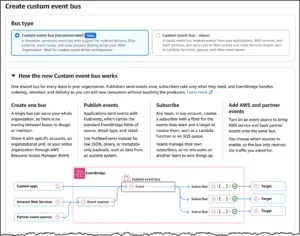
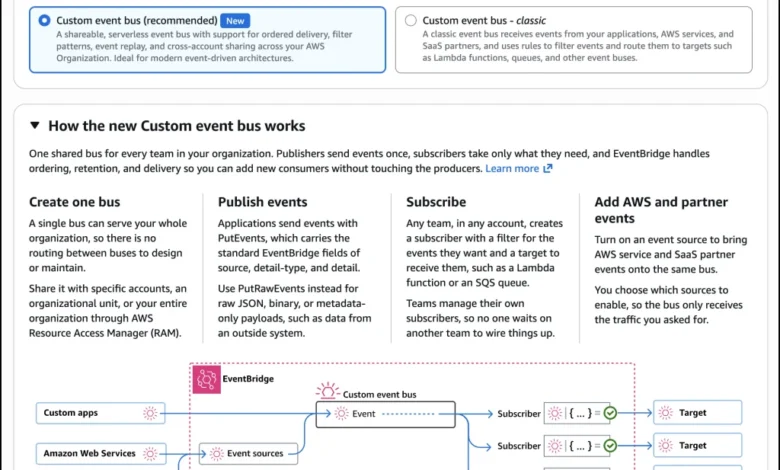
Addressing these pervasive scaling challenges, Amazon Web Services (AWS) has officially announced the launch of an enhanced custom event bus in Amazon EventBridge. Purpose-built to support the intricate demands of organizations scaling event-driven applications across multiple teams and accounts, the new infrastructure introduces a unified, centralized event bus shared seamlessly throughout an entire AWS organization. By integrating native ordering guarantees, a streamlined Subscriber resource, and an innovative pricing model optimized for large-scale operations, AWS aims to redefine how modern enterprises design, execute, and govern asynchronous cloud workloads.
The Evolution of Serverless Event Routing and Operational Friction
To understand the magnitude of this architectural shift, one must examine the operational bottlenecks inherent in legacy cloud configurations. As enterprise cloud footprints expand, individual business units typically operate within their own dedicated AWS accounts to maintain security boundaries, autonomous deployment cycles, and clear financial accountability. However, applications rarely operate in total isolation; data generated in one account frequently requires consumption by services residing in another.
Under previous iterations of Amazon EventBridge, fulfilling these cross-account communication requirements demanded intricate configurations. Platform teams were forced to establish multiple event buses connected via complex routing rules and resource policies. This fragmented approach triggered several cascading complications. First, platform operators rapidly lost centralized visibility regarding which downstream teams were subscribing to specific events, complicating security audits and data governance. Second, compounding routing charges associated with multi-bus architectures inflated monthly cloud expenditure. Finally, applications requiring strict event sequencing—such as financial transaction processors or real-time logistics trackers—were compelled to construct cumbersome programmatic workarounds or abandon serverless event routing entirely in favor of specialized, monolithic queuing technologies.
Industry analysts have long noted that while serverless computing dramatically reduces infrastructure maintenance, orchestration overhead often migrates from hardware management to event governance. The introduction of the enhanced custom event bus represents a decisive architectural response to these structural pain points, offering a unified spine for enterprise-wide event distribution.

Core Architectural Enhancements and Capabilities
The newly deployed enhanced custom event bus introduces several foundational capabilities designed to eliminate historical workarounds and streamline developer workflows across complex AWS organizations.
Organization-Wide Resource Sharing via AWS RAM
At the heart of the new architecture is native, organization-wide resource sharing powered by AWS Resource Access Manager (AWS RAM). Platform teams can now deploy a single, centralized event bus and instantly share it across all AWS accounts within an enterprise organization without manually configuring cumbersome cross-account IAM permissions or bus-to-bus routing paths.
Application teams can publish events and establish independent subscriptions on this shared backbone without waiting for infrastructure provisioning cycles from central IT departments. Publishers dispatch data payloads without needing prior knowledge of downstream consumers, while subscribers independently curate their ingestion parameters. Furthermore, platform administrators retain comprehensive visibility into all enterprise event flows, backed by a default quota scaling up to 10,000 subscribers per bus, which substantially minimizes architectural fragmentation.
Granular Event Ordering and Synchronous Processing
While asynchronous decoupling remains the gold standard for resilient distributed systems, specific operational domains—such as fleet management, order fulfillment, and telecommunications—demand strict chronological event sequencing. Out-of-sequence payloads in these contexts can cause downstream routing algorithms to process stale data, yielding catastrophic business logic errors.
The enhanced custom event bus resolves this tension by natively supporting both ordered and unordered consumption paradigms on the exact same infrastructure. Publishers can append an EventGroupId attribute to outgoing payloads. EventBridge subsequently guarantees sequential delivery of events sharing the same identifier to subscribers configured for ordered processing, while concurrent consumers continue to ingest the stream asynchronously.
To reinforce this capability, AWS has introduced synchronous invocation support for targets such as AWS Lambda. This mechanism confirms successful downstream processing prior to acknowledging event receipt, effectively eliminating the traditional architectural pattern of interposing Amazon SQS queues between an event bus and compute functions merely to guarantee execution order.

Simplified Management Through the Subscriber Resource
Resource configuration has likewise been streamlined through the debut of the dedicated Subscriber resource. Historically, achieving robust event filtering, target routing, retry execution, and dead-letter queue management required provisioning and maintaining a disparate collection of individual rules and target settings.
The new Subscriber resource consolidates these distinct operational parameters into a single, cohesive, and easily manageable entity. Additionally, integrated variable start-time options empower engineering teams to seamlessly onboard new microservices or execute precise event replays to recover from unexpected application states or initialize fresh analytics environments.
Advanced Event Evaluation: Deduplication and Transformation
Data quality and payload compatibility remain perpetual challenges in enterprise integration. The enhanced custom event bus incorporates content-based deduplication, enabling EventBridge to automatically detect and suppress redundant retries directly at the payload level. By cryptographic hashing of meaningful message attributes within a five-minute sliding window, EventBridge delivers true exactly-once delivery semantics for erratic sources, bypassing the traditional at-least-once model without requiring publishers to generate dedicated idempotency tokens.
For downstream compatibility, subscribers can leverage native JSONata expressions to dynamically reshape event payloads before delivery, extracting necessary fields, altering keys, or computing derived values on the fly. Moreover, for organizations utilizing advanced serialization formats such as Apache Avro or Protocol Buffers, EventBridge can automatically deserialize incoming payloads into standard JSON, permitting granular filtering and routing across the entire dataset without necessitating custom client-side parsing infrastructure.
Financial Economics and Ingress-Egress Pricing Models
Beyond architectural enhancements, AWS has restructured the economic model governing event routing. Legacy multi-bus configurations frequently suffered from escalating financial overhead driven by compound per-event pricing across interconnected accounts.
The enhanced custom event bus transitions to an ingress and egress throughput pricing framework. Under this updated model, event publishers absorb the costs associated with data ingestion, while subscribers compensate for data delivery. This transparent allocation aligns cloud expenditure directly with organizational usage patterns, delivering vastly improved cost-efficiency for large-scale enterprise deployments.
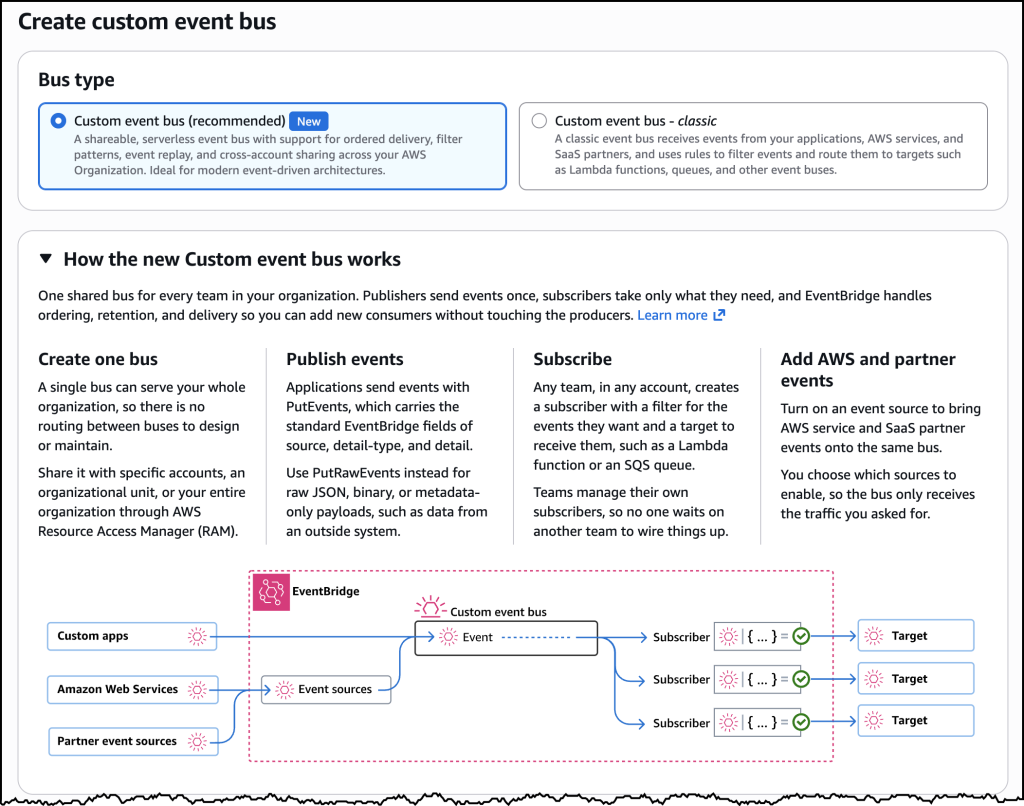
Existing custom event buses will remain fully operational without requiring immediate migration, designated within the management console as classic custom event buses. Enterprises can adopt the enhanced architecture incrementally, minimizing migration risk and avoiding forced refactoring cycles.
Availability and Deployment Roadmap
The enhanced custom event bus is generally available starting today across a broad spectrum of global AWS Regions, including US East (N. Virginia, Ohio), US West (Oregon), Europe (Ireland, Frankfurt, Stockholm, Spain), and Asia Pacific (Hong Kong, Malaysia, Mumbai, Singapore, Sydney, Thailand, Tokyo).
Enterprise architects and platform engineers can provision, configure, and manage the new enhanced custom event bus via the AWS Management Console, the AWS Command Line Interface (AWS CLI), or standard EventBridge APIs. Comprehensive documentation and configuration guides are currently accessible via the official AWS documentation portal, empowering organizations to begin modernizing their event-driven infrastructures immediately.
Related posts: