Speculative Decoding Explained: How This Technique Achieves 3x Faster LLM Inference

In the rapidly evolving landscape of generative artificial intelligence, the deployment of large language models (LLMs) has hit a persistent performance wall. As models like GPT-4, Llama 3, and Claude scale to hundreds of billions of parameters, the computational demand for inference—the process by which these models generate text—has outpaced hardware advancements. The primary culprit is the autoregressive nature of current transformer architectures, which generate output one token at a time. This sequential bottleneck has prompted the development of speculative decoding, an innovative inference strategy that significantly accelerates generation speeds without compromising output quality. By leveraging a two-tiered model architecture, speculative decoding allows organizations to deliver faster, more responsive AI applications while maintaining the mathematical integrity of the original, larger models.
The Architecture of the Bottleneck
To understand the necessity of speculative decoding, one must first analyze the fundamental constraints of modern GPU architecture. Large language models operate on a "predict-the-next-token" basis. For every single token generated, the system must read the entire weight set of the model from the GPU’s high-bandwidth memory (HBM) and move it into the processing cores. Because the model weights are enormous, the time taken to move data from memory to the compute engine far exceeds the time taken to perform the actual matrix multiplication.
This condition is known as being "memory-bandwidth bound." In practical terms, even if a facility upgrades to the latest NVIDIA H100 or B200 GPUs, the performance gain for a single-user request is often limited by the physical speed of the memory bus. While these GPUs are capable of performing trillions of operations per second, they spend the vast majority of their operational cycles idling, waiting for the next set of weights to be loaded. For real-time applications—such as live coding assistants, instantaneous customer support chatbots, or complex autonomous agents—this latency is often prohibitive, leading to the "stuttering" effect users frequently experience when interacting with large models.
The Emergence of Speculative Decoding: A Chronology of Innovation
The concept of speculative decoding gained significant traction in early 2023, following groundbreaking research papers published by teams at Google and DeepMind, as well as independent researchers at Stanford University. Before this, the industry largely focused on model quantization—reducing the precision of model weights from 16-bit to 8-bit or 4-bit—to speed up inference. While effective, quantization often carries a risk of "model degradation," where the reduction in precision leads to a decline in reasoning or accuracy.
Speculative decoding offered an alternative paradigm: instead of changing the model itself, change the strategy of how it interacts with hardware. By mid-2023, major inference engines began incorporating speculative decoding as a standard feature. In late 2023 and early 2024, the focus shifted from simple "draft-and-verify" setups to more sophisticated, integrated methods like Medusa and Eagle, which reduced the need for external draft models. This evolution marked a shift in industry priority, moving from raw model size to the efficiency of the inference pipeline.
The Mechanics of the Draft-and-Verify Loop
Speculative decoding operates through a hierarchical approach involving two distinct entities: a target model and a draft model. The target model is the large, high-quality, parameter-dense model (e.g., Llama-3-70B). The draft model is a significantly smaller, faster, and more "agile" model (e.g., Llama-3-8B or a tiny distilled model).
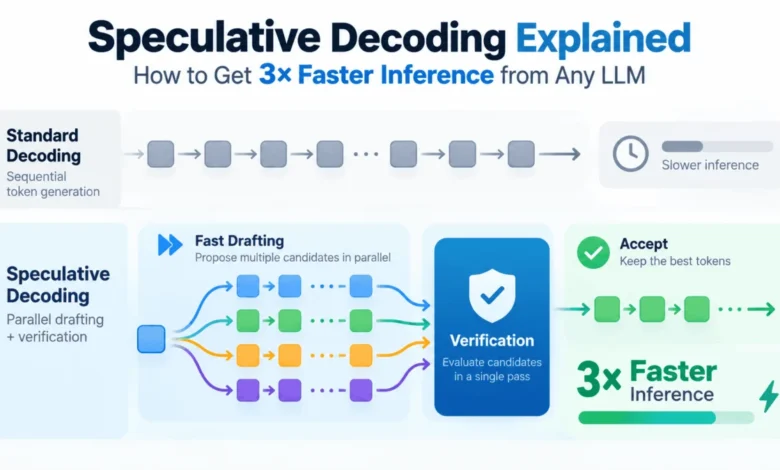
- The Drafting Phase: The small draft model predicts a sequence of tokens—typically between four to eight—in a rapid, autoregressive burst. Because the draft model has fewer parameters, it loads and processes these tokens in a fraction of the time required by the target model.
- The Verification Phase: The target model receives the entire sequence generated by the draft model. Using the parallel processing capabilities of the GPU, the target model evaluates all these tokens simultaneously in a single forward pass.
- The Decision Logic: The target model compares the draft model’s predictions against its own internal probability distribution. If the draft model’s tokens match the target model’s confidence, they are accepted. If they differ, the target model corrects them. Crucially, the mathematical framework ensures that the final output is identical to what the target model would have produced on its own.
Data from recent benchmarks indicate that when the draft model is well-aligned with the target, acceptance rates often hover between 60% and 80%. This means for every single forward pass of the large, expensive model, the system successfully outputs multiple tokens, effectively "multiplying" the speed of the GPU’s memory bandwidth.
Comparative Analysis: Traditional vs. Speculative Inference
The impact on real-world latency is substantial. In a traditional setup, generating 50 tokens requires 50 separate memory-heavy forward passes. In a speculative setup with an acceptance rate of 75% and a draft length of 5, the system might generate those same 50 tokens in roughly 15 to 20 forward passes.
| Metric | Traditional Decoding | Speculative Decoding |
|---|---|---|
| Memory Reads | High (One per token) | Low (Amortized over batch) |
| Compute Utilization | Idle (Waiting for memory) | Efficient (Parallel batching) |
| Output Quality | Baseline (100%) | Mathematically Identical (100%) |
| Latency | High | 2x – 3x Lower |
Industry practitioners note that while the gains are impressive, they are not universal. Speculative decoding excels in single-request scenarios, such as a user chatting with an AI. However, in high-throughput environments where thousands of users are querying the same model simultaneously, the draft model consumes memory and GPU cycles that could otherwise be used to serve more concurrent users. Therefore, architects must decide whether their infrastructure goal is to reduce time-to-first-token for a single user or to maximize total throughput for a large user base.
Next-Generation Evolutions: Medusa and Beyond
As the technique has matured, the industry has moved toward "Self-Speculation." The Medusa approach represents a significant leap forward by removing the need for a separate, secondary draft model. Instead, researchers add "Medusa heads"—small, lightweight layers—to the existing target model. These heads are trained to predict the next few tokens simultaneously based on the target model’s hidden states.
Similarly, the Eagle algorithm utilizes the rich, high-dimensional hidden states of the target model to make more accurate predictions than a standalone draft model ever could. By tapping into the contextual depth already present in the target model, Eagle often achieves higher acceptance rates, particularly in specialized domains like legal or medical documentation where standard draft models struggle to keep up with the target model’s sophisticated vocabulary.
Implications for the Future of AI Deployment
The transition to speculative decoding reflects a broader shift in the AI sector: the realization that software efficiency is just as critical as hardware power. For businesses, this translates to lower operational costs, as more users can be served on existing hardware. For users, it means the end of the "typing delay" that has characterized early LLM interfaces.
Looking forward, as speculative decoding becomes a "default" configuration in major frameworks like vLLM and llama.cpp, the focus will likely shift to automated drafting. Future systems may dynamically swap draft models based on the domain of the input—using one draft model for Python code generation and another for creative writing. As these systems become more autonomous, the line between the "drafting" and "verifying" phases will continue to blur, potentially leading to architectures where the model effectively "drafts itself" at a constant, high-velocity rate.
In conclusion, speculative decoding is a landmark development that bypasses the physical limitations of GPU hardware. By transforming the sequential nature of LLM inference into a parallel-friendly verification task, researchers have unlocked a path to performance gains that do not sacrifice the accuracy or quality of the underlying intelligence. As this technology continues to integrate into the backbone of global AI infrastructure, it serves as a powerful reminder that in the world of computing, algorithmic ingenuity often proves more transformative than raw hardware throughput.