LangGraph Revolutionizes Python-Based Agentic Workflows with Structured AI Development

The rapid evolution of Large Language Models (LLMs) has ushered in a new era for AI agents, promising autonomous systems capable of complex decision-making and interaction. However, transitioning from simple, single-turn AI interactions to robust, persistent, and tool-augmented agentic workflows has historically presented significant architectural and development challenges. A groundbreaking solution emerging from this landscape is LangGraph, a powerful Python framework designed to build comprehensive AI agent systems, offering a structured approach from basic model calls to sophisticated, tool-integrating agents with enduring conversational memory. This article delves into how LangGraph addresses these critical needs, providing a clear pathway for developers to construct intricate AI applications that are both performant and transparent.
The Evolving Landscape of AI Agents: From Simple Prompts to Complex Workflows
For much of the nascent AI agent development phase, solutions effectively handled single-turn interactions: a user poses a question, an LLM processes it, and an answer is returned. While foundational, this approach quickly falters when agents require more nuanced capabilities. Real-world applications demand agents that can query external databases, recall context from previous interactions, or provide granular visibility into their decision-making processes. The absence of a standardized, robust framework for these challenges often led to bespoke, fragile implementations that struggled to scale or maintain coherence. This technical fragmentation underscored the urgent need for a more organized and predictable method for building advanced AI agents.
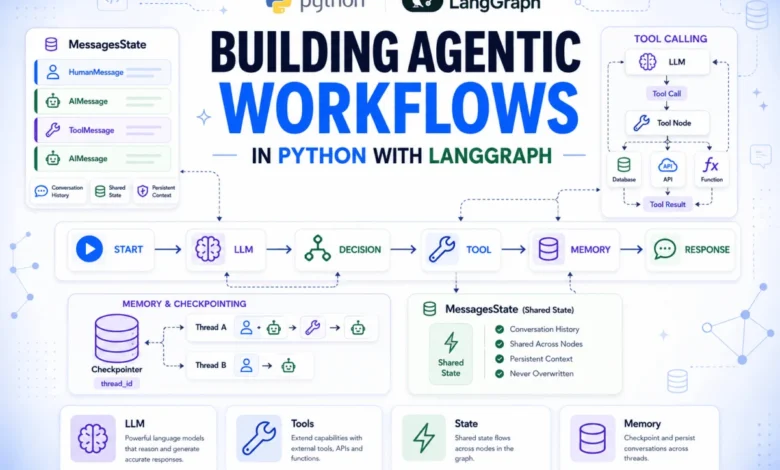
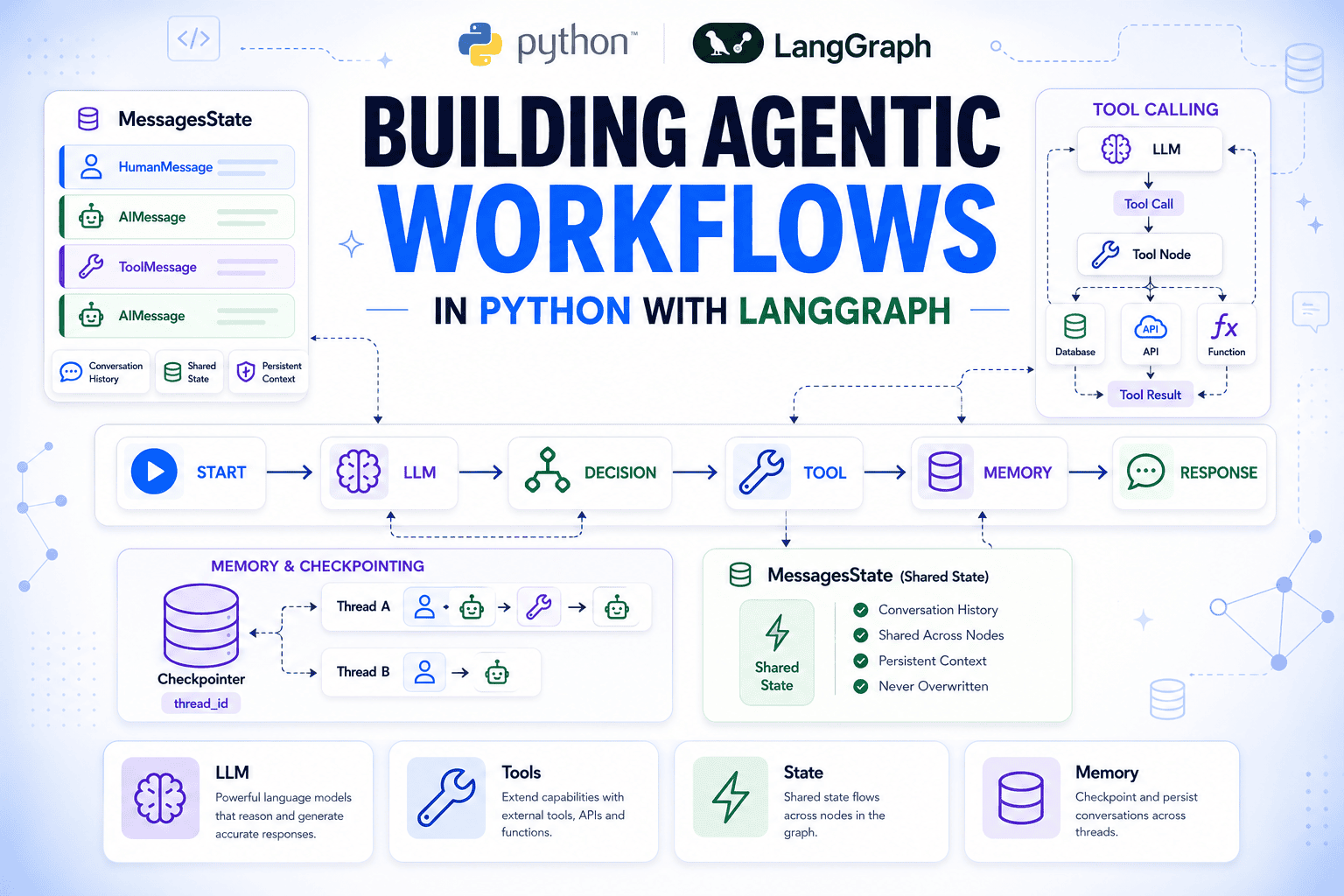
LangGraph, an extension of the popular LangChain framework, emerges as a pivotal tool in this context. It fundamentally redefines agent construction by representing an agent as a graph. Within this graph, distinct units of work are encapsulated as "nodes," the flow of execution is governed by "edges," and a "shared state object" meticulously carries the complete message history across every step. This graph-based paradigm ensures that every reasoning step, every tool call, and every model response becomes an integral part of the graph’s state. The result is an execution flow that is not only visible and inspectable but also dynamically available to any subsequent node, dramatically enhancing debugging, transparency, and overall system reliability.
Foundational Pillars: State, Nodes, and Edges
At the core of every LangGraph agent lies three fundamental components: State, Nodes, and Edges. Understanding these primitives is crucial for building any LangGraph application, regardless of its complexity.
-
State: This is conceptualized as a
TypedDictthat serves as the universal memory for the entire graph. Every node within the graph interacts with this shared state, reading current information and writing back updates. This singular point of truth ensures data consistency and simplifies data flow management. Importantly, nodes only return the fields they intend to modify; unaddressed fields remain untouched, preserving data integrity. For fields requiring cumulative updates, such as a conversation log or message history, LangGraph allows for the annotation of fields with "reducer functions." For instance, applyingoperator.addto a list field ensures that new entries are appended rather than overwriting previous ones, a critical feature for maintaining conversational context. -
Nodes: These are essentially plain Python functions. Each node accepts the current graph state as an argument and returns a dictionary of the fields it wishes to update within that state. The simplicity of registering these functions using
add_node—without requiring specialized decorators or base classes—underscores LangGraph’s commitment to developer-friendliness and integration with existing Python codebases. This modularity allows developers to encapsulate specific tasks, such as calling an LLM, invoking a tool, or performing data processing, into discrete, manageable units. -
Edges: Edges dictate the flow of execution within the graph. A direct edge,
add_edge(A, B), specifies a sequential execution where node B runs immediately after node A completes. More sophisticated control is achieved throughadd_conditional_edges, which, after a node (e.g., A) finishes, invokes a routing function to determine the next node based on specific conditions within the graph state. Every graph mandates aSTARTentry point and at least one path leading toEND, ensuring a clear beginning and conclusion to any agentic workflow.
Managing Conversational History with MessagesState
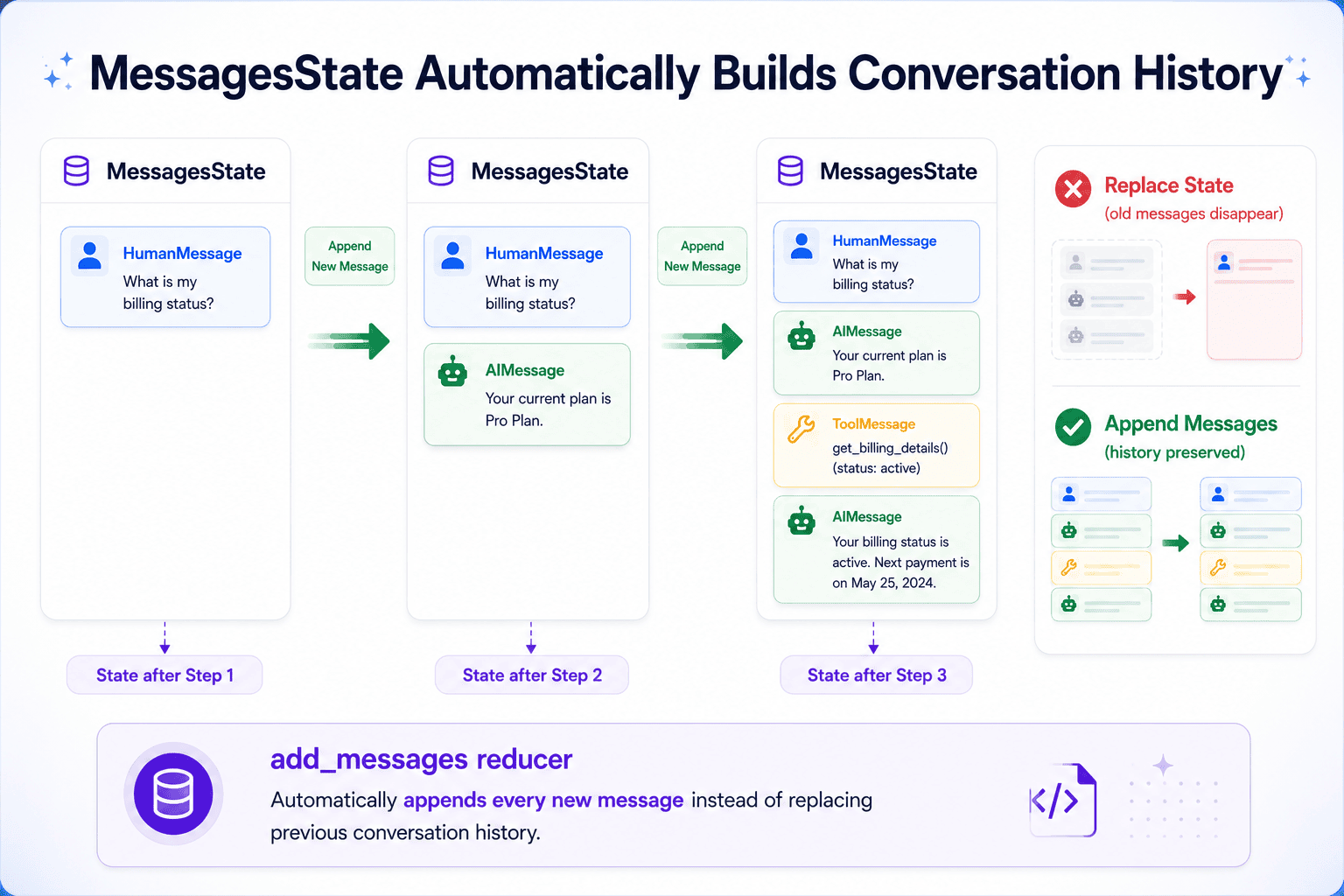
One of the most persistent challenges in conversational AI is maintaining a coherent and complete dialogue history. LLMs require access to previous turns to understand context, track entities, and generate relevant responses. LangGraph addresses this with its built-in MessagesState. This specialized TypedDict includes a single messages field, crucially configured with the add_messages reducer. Unlike standard field updates that would overwrite previous content, add_messages intelligently appends new messages to the existing list while also handling deduplication and ensuring proper message ordering. This feature liberates developers from the intricate task of manually managing and stitching together conversation history, enabling the agent to always access a full, chronological record of the dialogue. Developers can also extend MessagesState with custom fields, such as customer_id or priority_flag, to enrich the agent’s contextual awareness without compromising message history management.
Integrating Language Models and Tool-Calling Capabilities
The ability of an AI agent to interact with external systems and data sources is paramount for practical applications. LangGraph simplifies the integration of language models and the orchestration of tool calls, transforming a conversational agent into an actionable one.
-
Calling the Model Inside a Node: The central node in any LangGraph agent involves passing the current message list to an LLM and then incorporating its response back into the state. LangGraph seamlessly integrates with various LLMs, including OpenAI models via
ChatOpenAI, as well as providers like Anthropic, Google, or local models through Ollama. The framework’s design ensures that swapping between different LLM providers primarily involves changing the import and model string, leaving the core node logic intact. System messages, which define the model’s role or instructions, can be passed on every call without being permanently stored in the state, thus keeping the persistent history clean and focused on the core conversation. -
Registering Tools and Routing Calls: While LLMs excel at general knowledge, domain-specific tasks—like retrieving customer account details or subscription tiers—necessitate "tool calls." LangGraph empowers agents with tool-calling capabilities through a simple
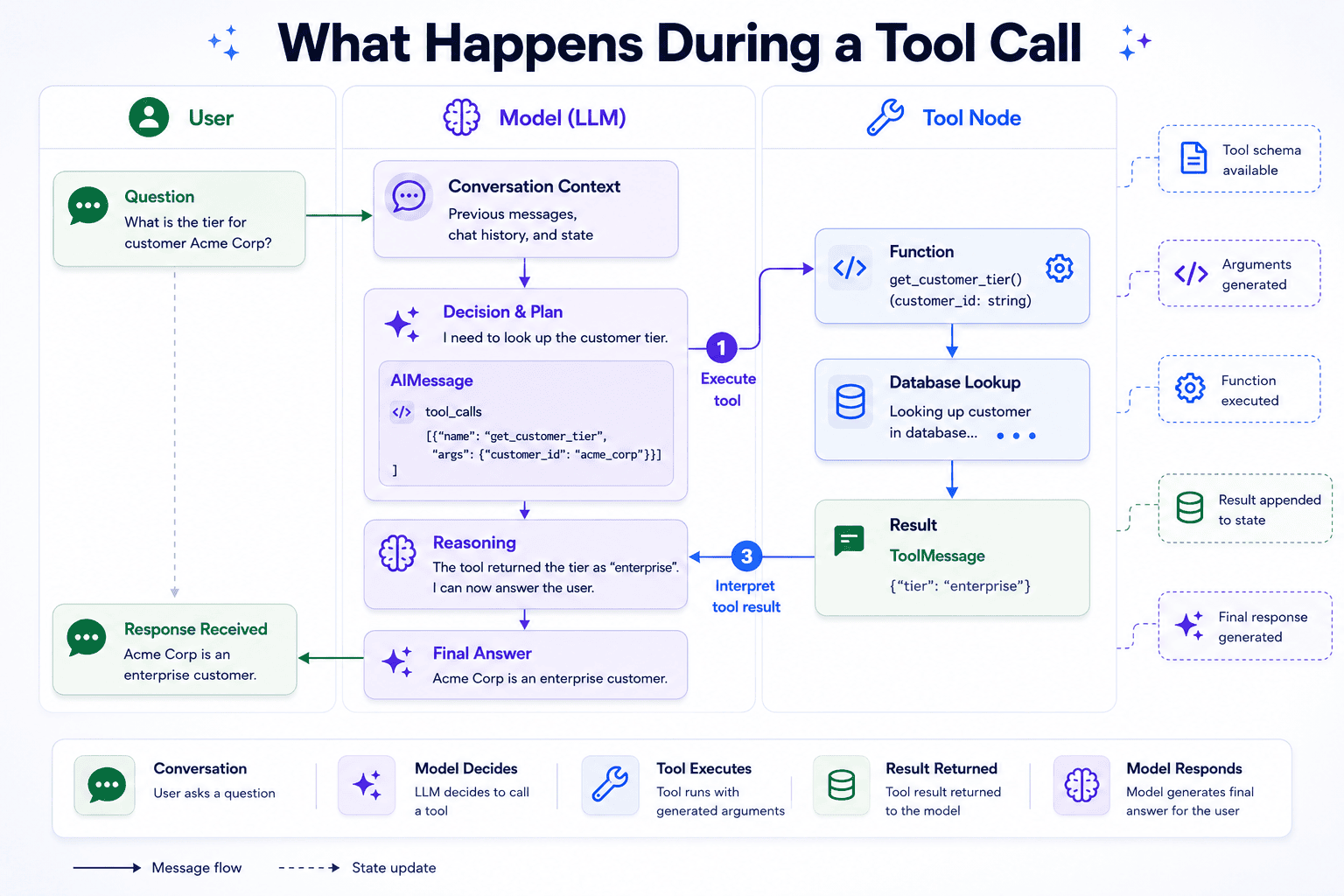
@tooldecorator. This decorator, applied to standard Python functions, transforms them into callable tools, with their docstrings serving as critical descriptions that the LLM uses to decide when and how to invoke them. Precision in docstrings is vital to prevent misinterpretations or malformed arguments. Once defined, tools are "bound" to the LLM usingbind_tools, which informs the model of their existence and schema. When the model determines a tool is needed, its response is anAIMessagepopulated with atool_callsfield, rather than plain text.
To manage tool execution and subsequent routing, LangGraph leverages ToolNode and tools_condition. ToolNode is a pre-built component that reads tool_calls from the last AIMessage, executes the corresponding function with the model-specified arguments, and appends the result as a ToolMessage to the graph state. tools_condition acts as a conditional edge, checking the last AIMessage after every model call. If tool_calls are present, it routes execution to the tools node; otherwise, it routes to the __end__ of the graph. The critical loop is closed by an edge from the tools node back to the run_model node, ensuring that the tool’s output is fed back to the LLM for interpretation and final response generation.
Tracing the Reasoning Loop: Transparency and the ReAct Pattern
Understanding the internal workings of an AI agent is crucial for debugging, optimization, and ensuring reliability. LangGraph’s structured approach provides unparalleled transparency into the agent’s reasoning process. When an agent uses a tool, the sequence of messages reveals a clear "ReAct pattern" (Reasoning and Acting):
- HumanMessage: The user initiates a query.
- AIMessage (Tool Call): The LLM, based on the query and available tools, decides to invoke a tool, signaling its intent via
tool_callsin its response. - ToolMessage: The
ToolNodeexecutes the specified tool, and its output is recorded as aToolMessage. - AIMessage (Final Answer): With the tool’s result now in context, the LLM processes this information and generates a final, informed answer.
This detailed message sequence, visible in the graph’s state, highlights that each tool use typically involves two model calls: one for deciding to use the tool and another for interpreting its result. This insight is invaluable for developers considering latency, computational costs, and the complexity introduced by adding more tools to their agents. The explicit tracing capability ensures that developers can pinpoint exactly what the model decided at each step and why, fostering greater trust and control over AI agent behavior.
Persisting Conversations and Enhancing Application State
For any real-world AI application, the ability to remember past interactions is fundamental. LangGraph addresses this with its robust persistence mechanism through "checkpointers." By attaching a checkpointer when compiling the graph, developers can ensure that the graph’s state is saved and restored across separate invocations.
-
Checkpointers for Thread State: A
thread_idis used to identify and retrieve a specific conversation’s state. Whengraph.invoke()is called with athread_id, the checkpointer first restores the thread’s state from the previous interaction before execution and then saves the updated state afterward. This enables seamless, multi-turn conversations where the agent maintains full context over extended periods. For development and testing,InMemorySaverstores checkpoints in process memory. However, for production deployments requiring durability and scalability,InMemorySaveris typically replaced with persistent checkpointers backed by databases or other durable storage solutions, such as those integrating with PostgreSQL, Redis, or other enterprise-grade data stores. The beauty of this design is that the core graph code remains unchanged, providing a flexible and adaptable persistence layer. -
Stores for Application-Level Data: Complementing checkpointers, LangGraph also introduces the concept of "Stores." While checkpointers persist graph state for a specific conversational thread, Stores provide durable, application-level storage for data that exists independently of any single conversation. This could include user profiles, preferences, long-term memories shared across multiple threads, or any other static or slowly changing data critical to the application’s functionality. Stores offer a mechanism for agents to access and modify persistent data beyond their immediate conversational context, enabling more sophisticated and personalized AI applications.
Wrapping Up: The Future of Agentic AI Development
LangGraph represents a significant leap forward in the development of AI agents, providing a robust, modular, and transparent framework for building complex workflows in Python. By clearly defining state, nodes, and edges, it offers a predictable and extensible architecture that scales from simple chatbots to highly sophisticated multi-agent systems. The framework’s ability to seamlessly integrate LLMs, orchestrate tool calls, manage conversational history, and persist state across invocations addresses the most critical challenges faced by developers in this rapidly evolving field.
One of LangGraph’s core strengths is its independence of components. Developers can swap out language models, introduce new tools, or change persistence mechanisms without necessitating a redesign of the entire graph. This flexibility, combined with the transparent flow of information through shared state, ensures that LangGraph-powered agents are not only predictable and easy to extend but also maintainable and debuggable. The underlying principles—structured state management, modular execution units, and conditional routing—are universally applicable, even extending to the development of multi-agent systems where a coordinator agent might route requests to specialized agents. As AI continues to integrate more deeply into enterprise applications, frameworks like LangGraph will be instrumental in driving the creation of intelligent, reliable, and scalable AI solutions.