Ollama integrates real-time text-to-speech capabilities via the Phonon model family on macOS


The landscape of local artificial intelligence took a significant step forward this week as Ollama, the widely adopted open-source platform for running large language models (LLMs) on personal hardware, announced the integration of text-to-speech (TTS) functionality. This development marks a shift for the platform, which has traditionally focused on text-based generative AI, by introducing the Phonon model family developed by Gradium. The new capability is currently exclusive to macOS users equipped with Apple Silicon, though the company has confirmed that support for Windows and Linux environments is in active development and slated for release in the near future.
Understanding the Ollama Ecosystem and Local AI
Ollama has solidified its reputation as a cornerstone of the local AI movement, functioning as a streamlined bridge between complex machine learning repositories—such as Hugging Face—and the end-user. By enabling the execution of models directly on local hardware, the platform addresses two primary concerns for enterprise and individual users alike: data privacy and connectivity. Because the processing occurs on the device, user data does not need to be transmitted to external servers, a critical feature for industries dealing with sensitive information.
The platform’s growth has been exponential, evidenced by its status as one of the most starred projects on GitHub, boasting nearly 185,000 stars and over 18,600 forks. This popularity is driven by the project’s ease of use, allowing developers to pull and run models with simple command-line interface (CLI) interactions. By leveraging Apple’s MLX framework, Ollama optimizes these operations specifically for the unified memory architecture of Apple Silicon chips, which allows for significantly lower latency and higher memory bandwidth compared to traditional hardware configurations.
The Integration of Phonon: Bridging Text and Speech
The introduction of Phonon represents the first instance of native speech generation within the Ollama ecosystem. Phonon is described by its creators at Gradium as a state-of-the-art, compact family of models specifically engineered for high-fidelity, real-time voice synthesis. Unlike legacy TTS systems that require a "batch" approach—where the user waits for the entire text block to be processed before audio playback begins—the integration in Ollama is designed for streaming.
This real-time generation capability means that as an LLM generates a response, the audio stream is produced concurrently. This creates a more natural, fluid user experience, particularly for conversational AI applications or accessibility tools. The Phonon models currently support five primary languages: English, French, German, Spanish, and Portuguese. Furthermore, the system provides both language-specific models and a unified multilingual model, allowing for a degree of versatility that caters to diverse global user bases.
Technical Performance and Optimization
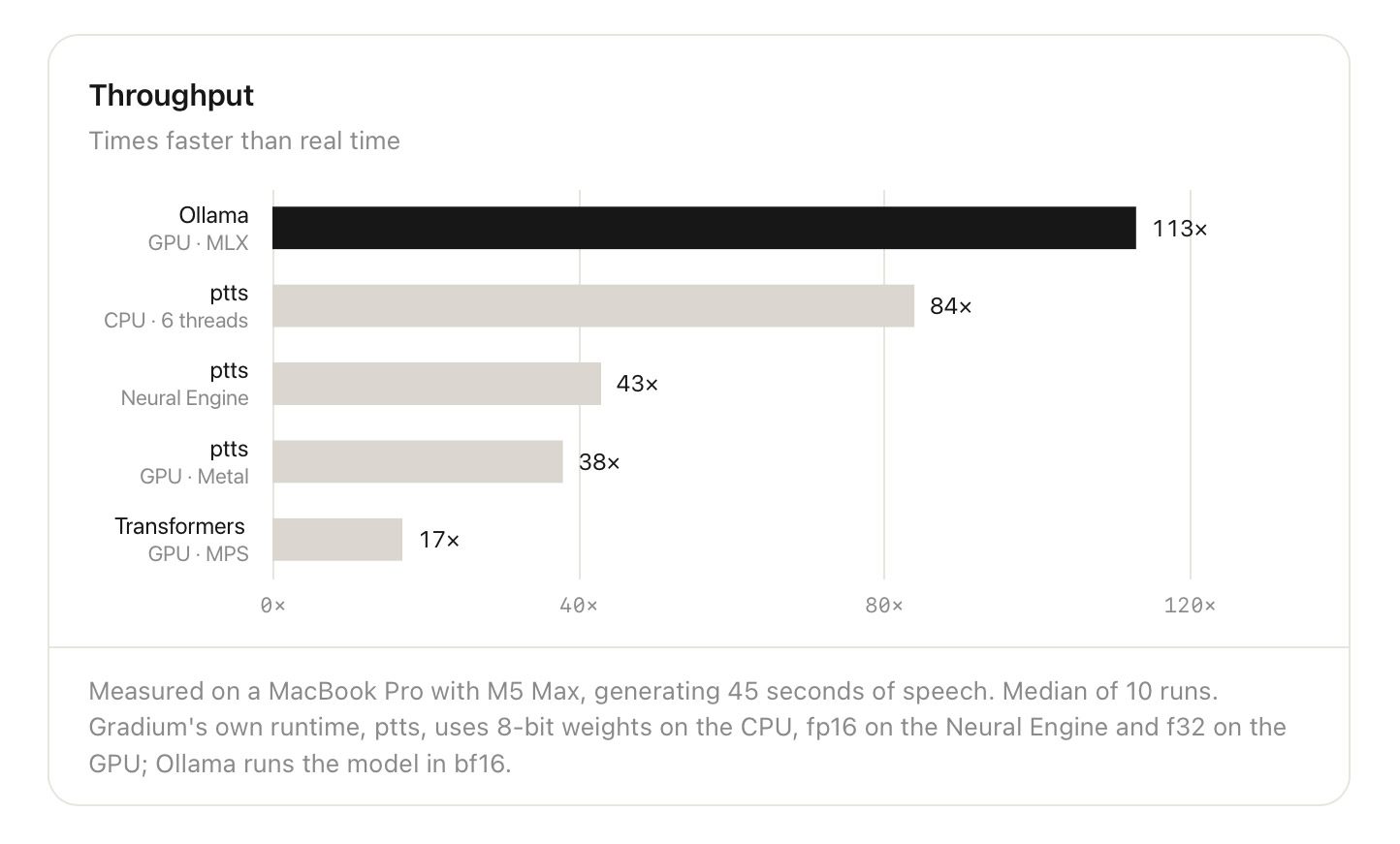
The technical marriage between Ollama and the Apple Silicon hardware stack has produced impressive results in initial benchmarks. According to data provided by the Ollama team, the integration of the MLX framework allows for a 35% improvement in generation speed compared to the standard implementation of the Phonon models provided by Gradium.
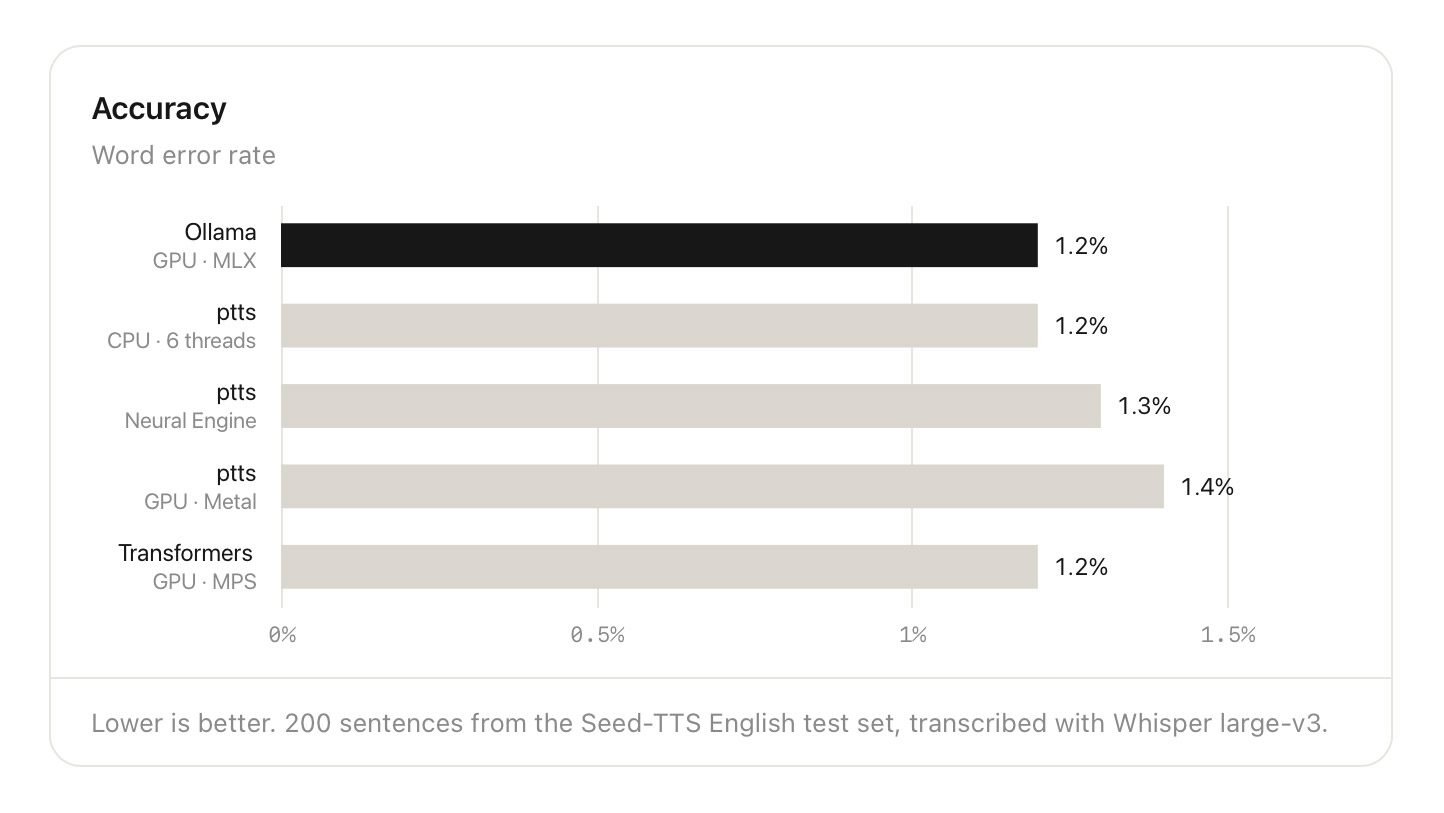
In controlled tests conducted on a MacBook Pro powered by the M5 Max chip, researchers observed that the system not only outperformed the reference implementation in throughput but also maintained high linguistic accuracy. Specifically, the Word Error Rate (WER)—a common metric used to gauge the performance of speech models—matched the results seen in the Hugging Face Transformers benchmark, ensuring that the speed gains did not come at the expense of audio clarity or phonetic precision.
Chronology of the Update
The rollout of this feature follows a period of rapid iteration for the platform:
- Early 2024: Ollama expands support for a wider array of Llama-based models and improves its API documentation for developers.
- Mid-2024: The team focuses heavily on optimization for Apple’s M-series chips, deepening the integration with the MLX machine learning framework.
- October 2026: Following a period of beta testing and optimization of the Phonon architecture, the team officially launches speech model support with the release of version 0.40.11.
- Future Outlook: The roadmap indicates that the focus will now shift to cross-platform parity, with Windows and Linux users expected to gain access to the same TTS features within the coming months.
The Broader Impact on Local AI
The implications of bringing high-quality, local speech synthesis to the masses are substantial. For developers, this lowers the barrier to entry for building voice-activated assistants that do not rely on cloud-based APIs from major tech conglomerates. By removing the dependency on external cloud costs and privacy-invasive data telemetry, individual developers and small businesses can build sophisticated AI agents that function entirely offline.
Furthermore, this move signals a maturation in the "Small Language Model" (SLM) space. As models like Phonon become more efficient, the necessity for massive server farms to handle simple voice-to-text or text-to-voice tasks diminishes. This trend toward "edge computing"—performing data processing on the device where it is collected—is expected to be a primary driver in the next phase of AI adoption, particularly in mobile and embedded systems.
Official Guidance and User Implementation
For users looking to experiment with the new capabilities, the process is streamlined to fit within the existing Ollama CLI workflow. The models are available for download immediately, and the API has been updated to include specific endpoints for speech generation.
The Ollama team has published extensive documentation on their official blog, providing code snippets and examples for developers who wish to integrate the Phonon models into their own applications. For end-users, the experience is largely "plug-and-play," provided they are running the latest version of the software. The flexibility of voice selection—which includes regional variations like American and British English—adds a layer of personalization that was previously missing from local AI solutions.
Analysis: Privacy and Performance
The success of this implementation hinges on the trade-off between model size and hardware capability. While the Phonon models are noted for being "small," they still require significant compute cycles. The reliance on Apple Silicon is a strategic choice; by targeting a specific, high-performance architecture, the Ollama team can guarantee a consistent user experience that would be difficult to replicate on fragmented hardware environments.
The privacy aspect cannot be overstated. In an era where AI-driven voice services often process user queries in the cloud, having a local, ephemeral option provides a robust alternative. Whether for transcription, accessibility, or conversational interfaces, the ability to generate speech locally ensures that the voice data—and the text that informs it—never leaves the local machine. As Windows and Linux versions arrive, the real test will be whether the performance gains seen on Apple Silicon can be replicated across the more diverse hardware configurations found in the broader PC market.
In summary, the addition of Phonon to the Ollama library is more than a simple feature update; it is a strategic expansion of the platform’s utility. By bridging the gap between text-based reasoning and voice output, Ollama is positioning itself as a comprehensive engine for local, private, and highly efficient artificial intelligence. For the developer community, the next few months will be critical as they begin to integrate these speech capabilities into broader applications, potentially sparking a new wave of local-first voice applications.
Related posts: