‘Immersive Explorations’ in Gemini is a visual adventure for traversing stellar topics

In a significant evolution of its educational technology suite, Google has officially introduced "Immersive Explorations" to its Gemini student hub. This feature marks a departure from traditional, text-heavy information delivery, opting instead for a layered, interactive visual interface designed to enhance cognitive retention and engagement among students. By allowing users to peel back the layers of complex subjects—ranging from celestial mechanics to biological structures—Google is positioning its generative AI platform as a comprehensive pedagogical tool rather than a simple chatbot.
The Mechanism of Immersive Explorations
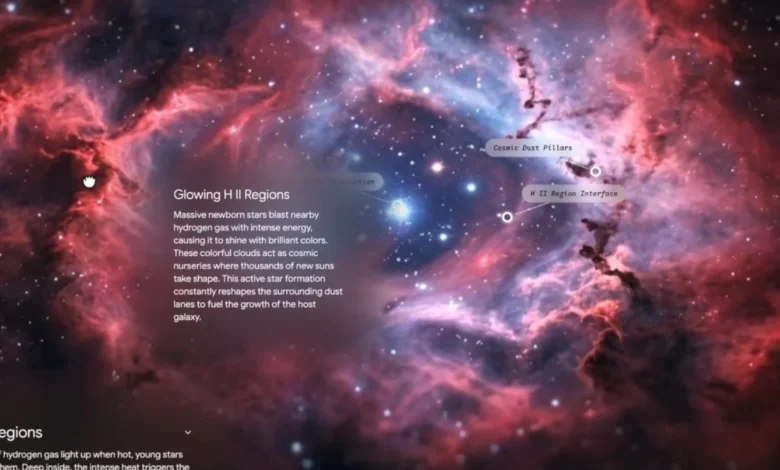
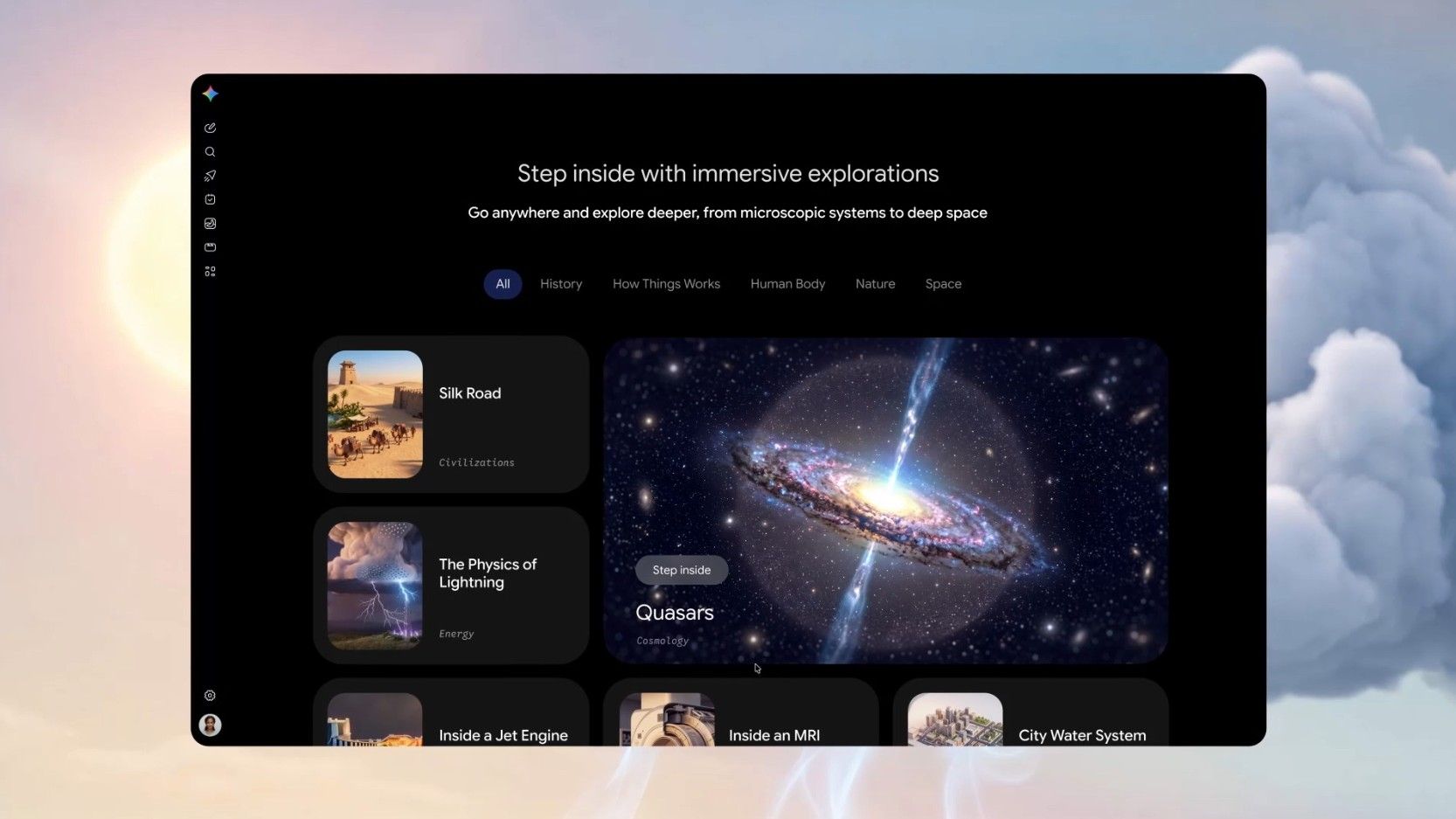
At its core, Immersive Explorations is designed to combat the "wall of text" fatigue that often accompanies digital research. When a student queries a topic, the platform generates high-fidelity visual representations that are segmented into interactive components. For example, when exploring a quasar, a student is not merely presented with a static image or a descriptive paragraph. Instead, they are provided with an interactive model where they can zoom in to examine the host galaxy, interstellar dust lanes, and other structural nuances.
Each layer of the visual acts as a gateway to more granular information. By clicking on specific segments of an image, the system provides contextual data, effectively allowing the student to deconstruct a complex subject into its constituent parts. This approach mirrors the scientific method of inquiry: starting with the macro observation and systematically investigating the micro-details that contribute to the whole. Beyond astrophysics, the feature covers diverse curriculum-relevant topics such as the molecular architecture of botanical specimens, the complex physics governing atmospheric lightning, and paleontological reconstructions.
Strategic Context and Timeline of Gemini’s Educational Integration
The rollout of Immersive Explorations is the latest milestone in a sustained effort by Google to integrate its proprietary AI, Gemini, into the educational ecosystem. The timeline of this integration reveals a clear strategy of incremental deployment and safety-first development:
- Initial Launch (2023): Google begins the broader integration of generative AI into its Workspace for Education, signaling an intent to compete with specialized educational platforms.
- Expansion to Teens (2024): Google expands access to Gemini for teenagers using school accounts, a rollout characterized by the implementation of strict safety guardrails and mandatory fact-checking modules to prevent the spread of misinformation.
- Introduction of "Coach" (Mid-2024): To supplement the conversational interface, Google introduces "Coach," a structured, step-by-step assistant designed to guide students through quiz-based learning and knowledge-building exercises.
- Integration with Classroom/NotebookLM (Late 2024): The integration of AI into Google Classroom and the transition of NotebookLM into the Gemini ecosystem allowed educators to create AI "experts" for specific curricula, enabling the generation of personalized rubrics and assessments.
- Current Development (Present): The debut of Immersive Explorations marks the move toward a more visually intuitive interface, emphasizing the shift from "AI as a search engine" to "AI as a laboratory."
Data-Driven Educational Impact
While quantitative data on student performance specifically related to Immersive Explorations is currently in its infancy, existing literature on visual learning provides a strong framework for why Google has invested in this modality. According to the Dual Coding Theory, championed by psychologist Allan Paivio, the combination of verbal and visual information creates multiple pathways for memory retrieval, significantly increasing the likelihood of long-term retention compared to text-only instruction.
Furthermore, industry reports indicate that digital literacy among students is increasingly contingent upon the ability to navigate interactive interfaces. By moving away from static search results, Google is addressing the "information density" problem, where students are often overwhelmed by the sheer volume of search results. By providing a curated, visual-first experience, the platform aims to reduce the "cognitive load" that students experience when synthesizing information from disparate sources.
Official Stance and Implementation Details
Google has framed the release as a direct response to the needs of modern learners who require more dynamic tools for complex scientific discovery. In its official communications, the company highlighted that while the visuals are the centerpiece, they remain supplemented by concise, accurate, and high-level summaries to ensure that the depth of information remains academically rigorous.
The feature is currently available within the Gemini application for users across several major linguistic regions. To maximize accessibility, Google has launched the tool in English, Indonesian, Hindi, Brazilian Portuguese, French, and Simplified Chinese. For users operating in languages not yet supported by the interactive visual library, the system is designed to default to English, with the company promising a phased rollout of additional language support as the underlying models are optimized for those markets.
Analysis of Implications for the EdTech Landscape
The deployment of Immersive Explorations has broader implications for the competitive landscape of educational technology. By embedding this functionality directly into the existing Gemini ecosystem, Google is effectively creating a "one-stop-shop" for both teachers and students.
For educators, the shift is profound. Historically, teachers have had to rely on third-party interactive software—often behind expensive paywalls—to provide visual simulations for complex topics. With Gemini now offering these features as part of its standard educational suite, the barrier to entry for high-quality, visual, and interactive instruction is lowered. This creates a challenging environment for smaller EdTech startups that rely on selling standalone simulation software to school districts.
However, the reliance on AI also introduces a critical dependency. The accuracy of the "layered" information provided by Immersive Explorations is entirely dependent on the underlying Large Language Model (LLM). As Google continues to refine the "fact-check" capabilities within its student hub, the pressure remains on the company to ensure that these visual representations do not succumb to the "hallucinations" common in generative AI. The commitment to linking visuals to verified, reliable data sources will be the deciding factor in whether this tool becomes a standard utility or remains an auxiliary resource.
Challenges and Future Considerations
While the visual approach offers significant benefits, it is not without challenges. The primary concern among educational stakeholders remains the "black box" nature of AI. In traditional textbooks, diagrams and scientific models are peer-reviewed and vetted for accuracy. In an AI-generated interface, the synthesis of data must undergo a similar level of scrutiny.
Google’s inclusion of "Coach" and its integration with Google Classroom suggests that they are aware of these concerns. By keeping the AI "in the loop" with classroom management tools, they are ensuring that the teacher remains the final arbiter of what the student learns, even when the student is engaging with an autonomous AI tutor.
As the platform matures, it is expected that Google will integrate more user-generated content or allow educators to customize these immersive experiences further. The potential for teachers to create their own "layers" of information for specific class projects would represent the next logical step in the evolution of this technology.
Conclusion
The introduction of Immersive Explorations represents a strategic pivot for Google. By synthesizing generative AI with interactive visual pedagogy, the company is attempting to redefine the role of the digital assistant in the classroom. If successful, it will move the needle from simple information retrieval to a more sophisticated, visually-aided mastery of complex subjects. For the student of the 21st century, the ability to "zoom into" a topic is not just a novelty—it is a fundamental change in how knowledge is constructed, synthesized, and ultimately, retained. As the platform continues to iterate, the educational community will be watching closely to see if this visual-first approach can truly bridge the gap between abstract information and tangible understanding.