AWS Continuum for Code Vulnerabilities Launches to Automate and Validate Security Fixes

The landscape of cybersecurity is undergoing a radical shift as threat actors increasingly leverage frontier artificial intelligence models to weaponize vulnerability disclosures within minutes. To counter this mounting threat, Amazon Web Services (AWS) has announced the general availability of AWS Continuum for code vulnerabilities. This advanced security service is designed to autonomously identify, validate, and propose targeted patches for application vulnerabilities, directly addressing the overwhelming volume of security alerts that modern engineering teams face on a daily basis.
Available immediately in the US East (N. Virginia) and US West (Oregon) AWS Regions, AWS Continuum represents a significant evolution in vulnerability management. Rather than merely generating static lists of potential flaws, the service actively investigates whether a vulnerability is genuinely exploitable in a specific runtime environment, ranks the findings by actual business impact, and delivers ready-to-review remediation patches directly into code repositories.
The Scale of Modern Vulnerability Fatigue
In the contemporary software development lifecycle, automated code scanners and static analysis tools are indispensable. However, they frequently generate a cacophony of alerts, often producing thousands of individual findings per day within large application estates. A significant portion of these alerts represent theoretical risks that require no immediate action—they may be unreachable over the network, completely unexploitable in practice, or already effectively mitigated by existing runtime controls.
Traditionally, security teams have relied on generic severity scoring systems, such as the Common Vulnerability Scoring System (CVSS), to prioritize remediation efforts. Yet, these scores possess a critical limitation: they lack vital contextual awareness regarding network architecture and business logic. Under generic metrics, a critical vulnerability residing on an isolated, developer-only utility can appear identical to a medium-severity flaw situated merely one network hop away from a core financial payments database.
Confirming whether a finding posed a genuine operational risk historically required hours or days of painstaking manual investigation by security analysts. Furthermore, deploying a fix demanded extensive cross-functional coordination spanning security, infrastructure, and application development teams, primarily because assessing the blast radius of a code modification without deep business context is fraught with uncertainty.
How AWS Continuum Operates: Context Graphs and Automated Validation

AWS Continuum bridges this critical visibility gap by constructing a comprehensive context graph derived from two primary sources: connected code repositories and live AWS infrastructure environments.
To incorporate infrastructure context, organizations deploy an AWS Continuum collector within the specific AWS account and Region where their applications execute. This collector aggregates detailed resource metadata, including AWS Config data and network configurations. By synthesizing this information, Continuum develops an intricate map of the application ecosystem. It learns which systems hold the highest business criticality, identifies service ownership, charts dependency chains between microservices, and tracks the specific types of data handled by each component.
By mapping these pathways, the service can accurately pinpoint high-value assets—such as customer data stores, authentication services, and transaction pipelines—and dynamically rank vulnerabilities based on the proximity of their attack paths to these critical systems.
Rigorous Evidence Levels and Sandbox Exploitation
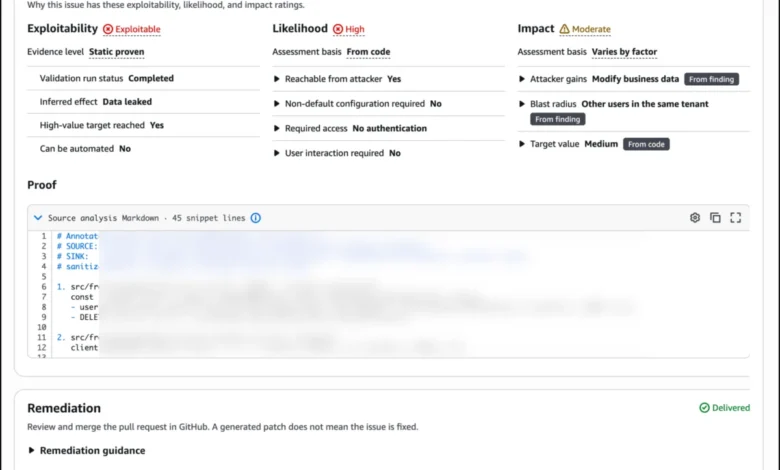
When a scan initiates, AWS Continuum analyzes individual findings against the gathered code and environment context, assigning a clear evidence level. For vulnerabilities it can definitively reproduce, the service executes the potential exploit within an isolated sandbox environment. It then attaches concrete proof-of-concept code, complete with exact reproduction steps, the resulting attack path, and a thorough assessment of the potential blast radius. Additionally, the service evaluates whether existing perimeter and runtime defenses would successfully detect and halt the validated attack path.
This rigorous validation process transforms the remediation workflow. Instead of wading through a dense log of raw scanner outputs, engineering teams are presented with a prioritized queue of verified issues accompanied by empirical proof of exploitability.
Streamlined Remediation via Pull Requests
Once an issue is validated, AWS Continuum automatically generates a precise remediation—whether that involves a code patch, a dependency upgrade, or a specific configuration change—and opens it as a pull request within the organization’s connected repository, such as GitHub or an Amazon S3-backed source.
Adhering strictly to a human-in-the-loop security paradigm, every generated fix initially operates in a supervised review mode. The automated patch does not equate to automatic deployment; instead, an authorized engineer must review and merge the pull request. This ensures that internal teams maintain absolute control over production codebases. Looking forward, AWS has indicated that organizations will soon be able to establish confidence thresholds—incorporating metrics such as test coverage, scope bounds, and historical success rates—allowing Continuum to autonomously apply trusted remediation classes within predefined guardrails.
Console Workflow and Practical Implementation
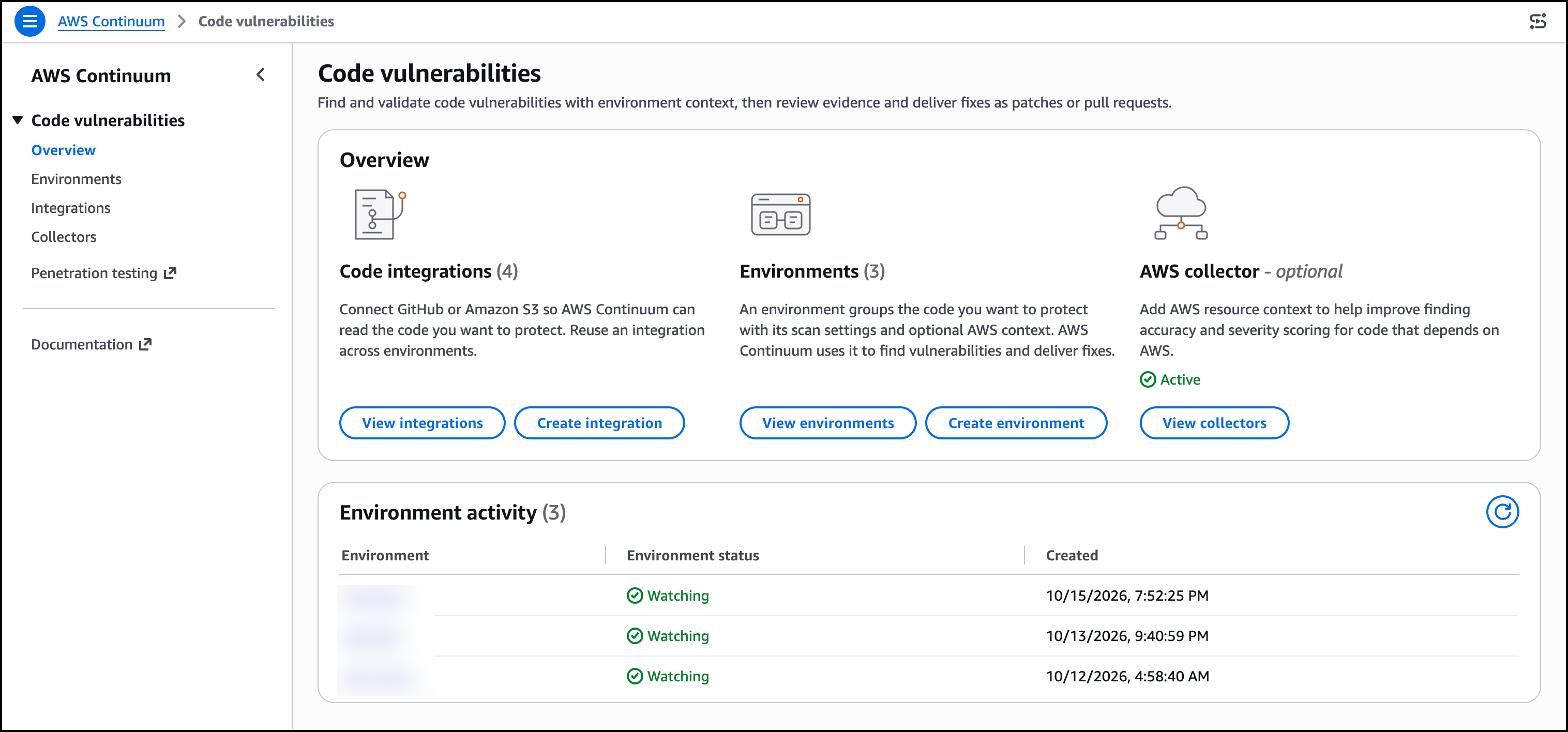
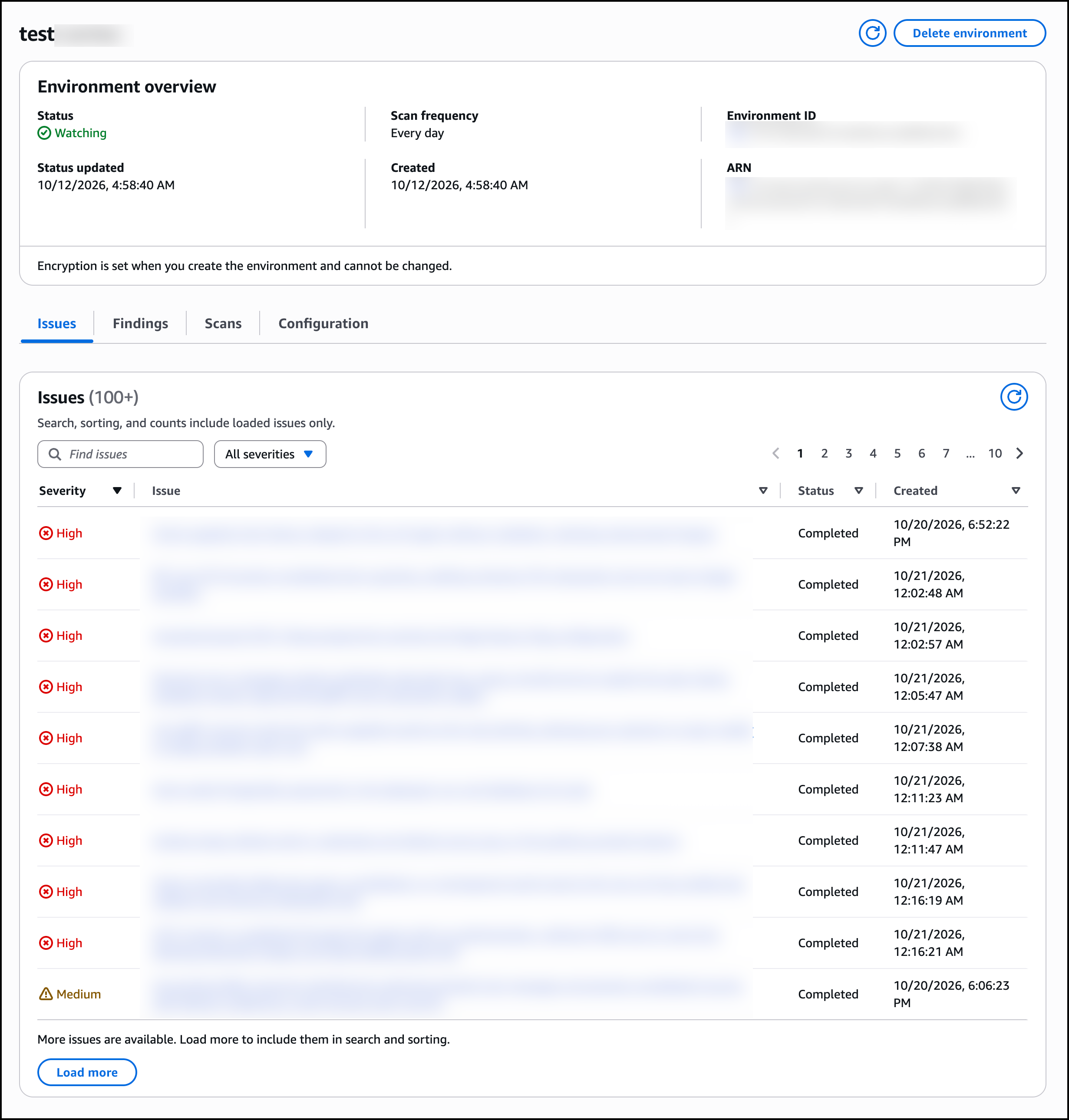
Navigating the AWS Continuum console provides administrators with a centralized dashboard to oversee their security posture. The Overview page consolidates code integrations, active scanning environments, and the real-time operational status of AWS collectors.
Within individual environments, the Issues tab displays prioritized, validated findings complete with severity ratings, status indicators, and timestamps. Selecting a specific issue reveals a granular Risk Assessment breaking down exploitability, likelihood, and impact. For instance, a high-severity finding with static-proven exploitability, unauthenticated reachability, and moderate business impact will display supporting source analysis alongside the direct remediation pull request.
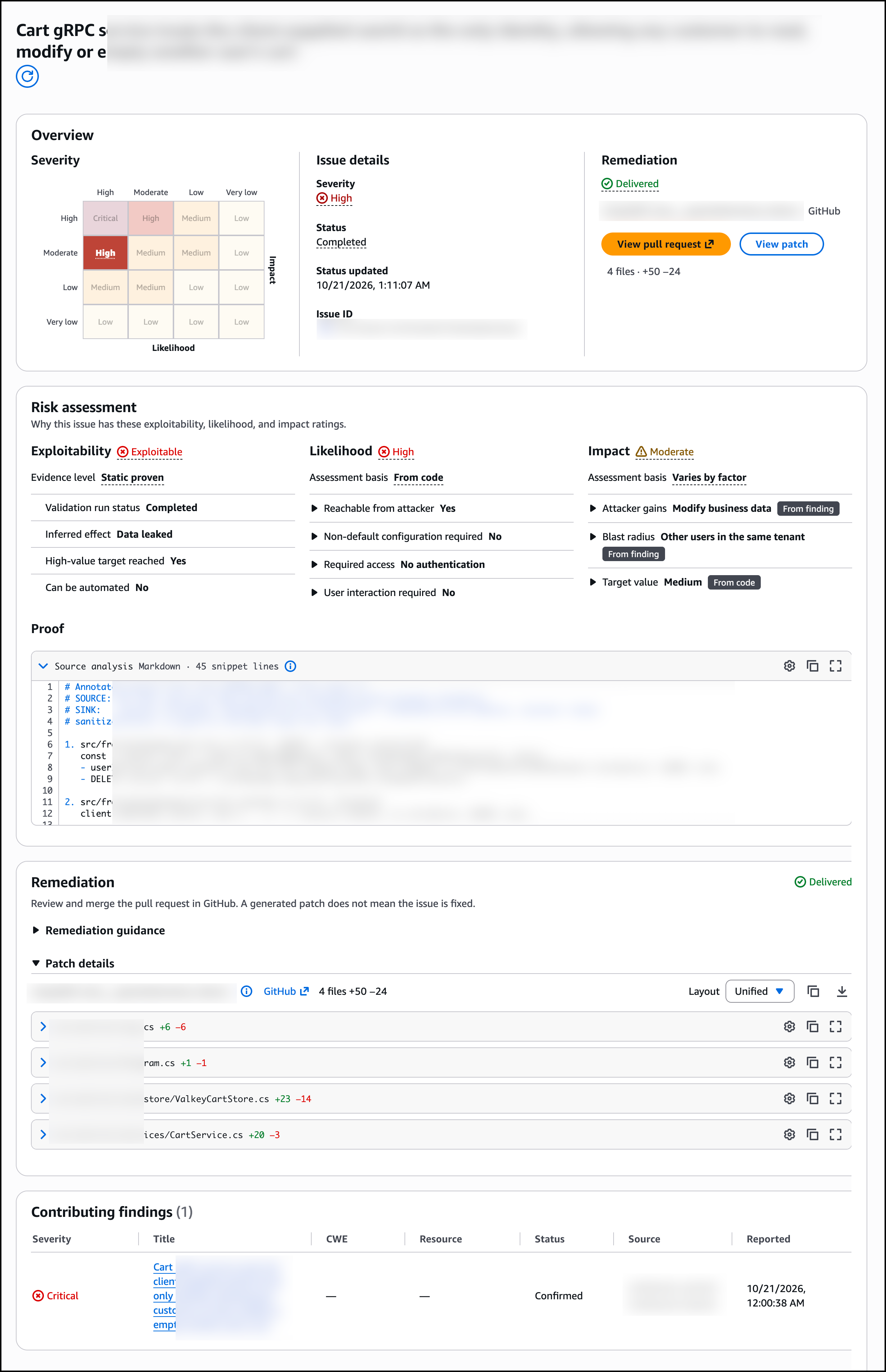
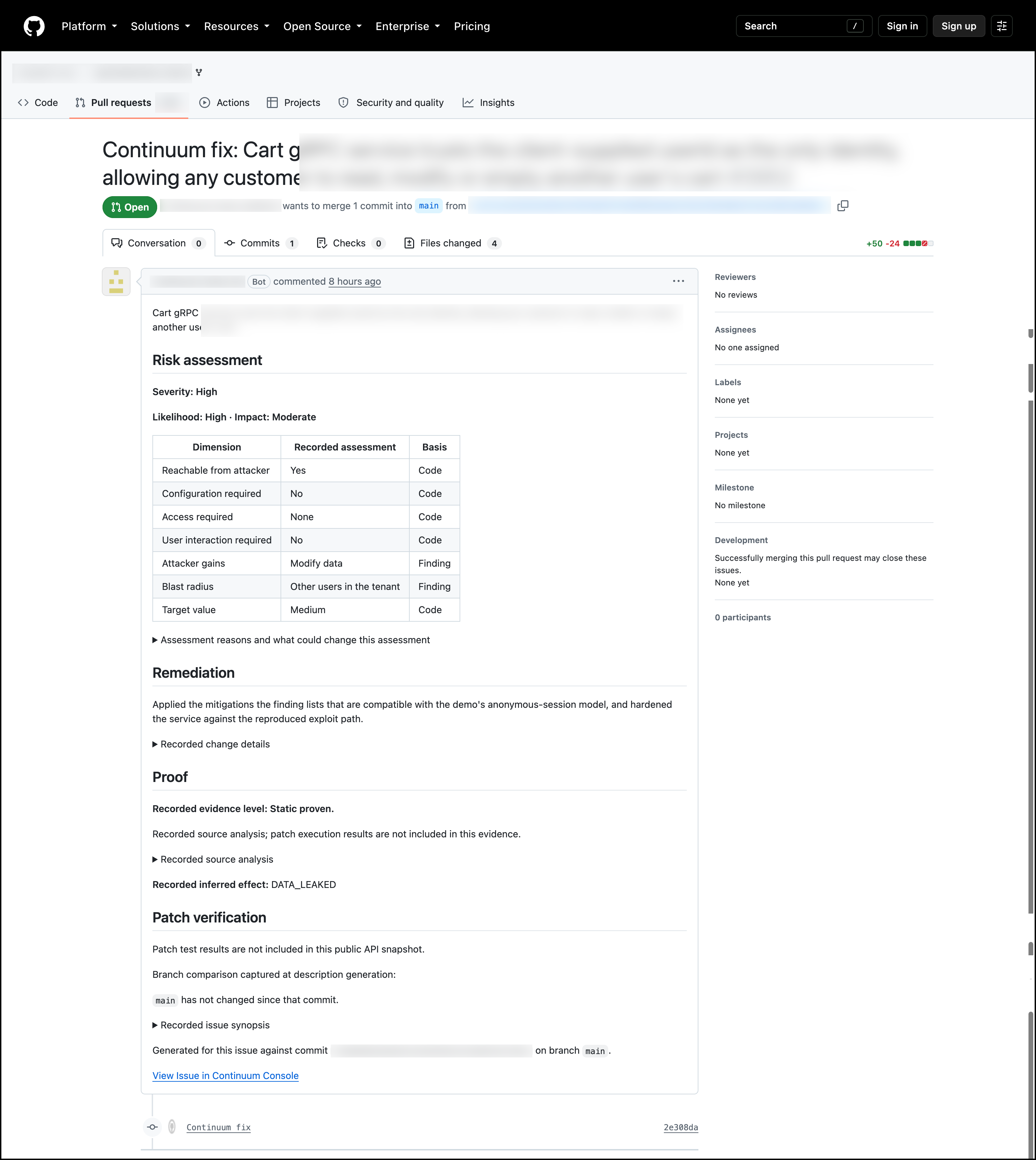
The accompanying pull request documentation mirrors the console’s risk assessment and remediation summary, ensuring that code reviewers can evaluate the necessary context without switching workflows or leaving their native Git environment. Additional tabs within the console allow teams to review raw scanner findings, audit historical scan execution times, and dynamically configure scan cadences or trigger on-demand evaluations.
Industry Implications and Future Outlook
The introduction of AWS Continuum for code vulnerabilities arrives at a pivotal moment for enterprise security architectures. As generative artificial intelligence democratizes the capability to rapidly convert vulnerability disclosures into functioning exploit payloads, traditional vulnerability management life cycles have become dangerously protracted.
Industry analysts observe that bridging the gap between detection and remediation is the single most effective way to shrink the operational window of vulnerability for malicious actors. By automating the labor-intensive processes of exploit validation, context mapping, and patch generation, AWS Continuum enables security operations centers (SOCs) and software development life cycle (SDLC) teams to drastically reduce their backlog of vulnerabilities while simultaneously preserving rigorous human oversight.
As organizations increasingly migrate complex, distributed workloads to cloud environments, tools that seamlessly integrate application-level code analysis with cloud-native infrastructure telemetry are poised to become standard enterprise requirements. With the general availability of AWS Continuum, Amazon has established a robust framework for secure, context-aware remediation, setting a new benchmark for cloud security automation. Comprehensive pricing details and technical documentation are currently available through the official AWS Continuum product portal and user guides.