How to Give Your AI Agent Memory and Overcome Session Amnesia in Modern Application Development

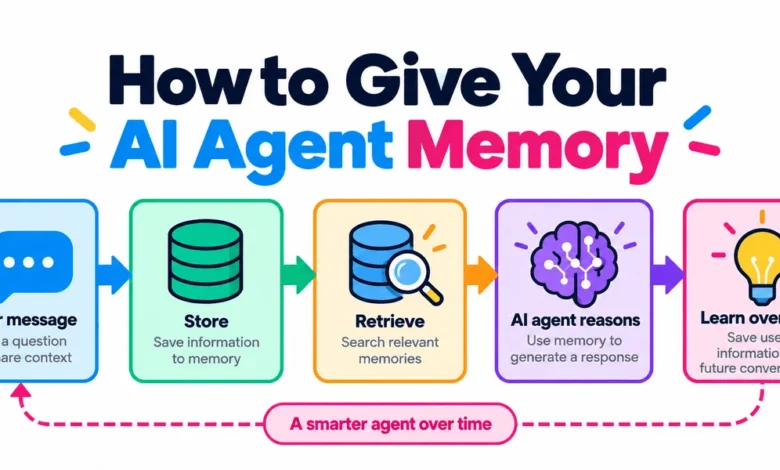
In the rapidly evolving landscape of artificial intelligence, foundational models and autonomous agents have achieved unprecedented capabilities in multi-step reasoning, tool execution, and complex task completion. Despite these architectural leaps forward, developers and enterprise engineers continue to grapple with a persistent operational bottleneck: session amnesia. When a standard conversational thread or agentic loop concludes, the underlying system typically wipes its working context clean. Consequently, subsequent interactions reset to a blank slate, forcing users to repeatedly re-explain project constraints, coding frameworks, and personal preferences.
Addressing this fundamental limitation has become a primary engineering objective across the software development lifecycle. By integrating persistent storage architectures into agentic frameworks, developers can bridge the gap between stateless large language models and stateful, personalized enterprise applications. This technical evolution mirrors the transition in traditional computing from volatile Random Access Memory to non-volatile storage, enabling AI systems to accumulate experiential knowledge over time without suffering from exponential context window inflation.
The Mechanics of Persistent Agentic Memory
To understand how modern memory integration functions, it is necessary to examine the operational lifecycle of a stateful AI agent. Traditional deployments rely strictly on context windows, appending every conversational turn into a linear prompt structure. As sessions lengthen, this approach becomes computationally expensive, highly prone to latency degradation, and susceptible to attention dilution, where the model loses track of critical instructions buried deep within massive token arrays.
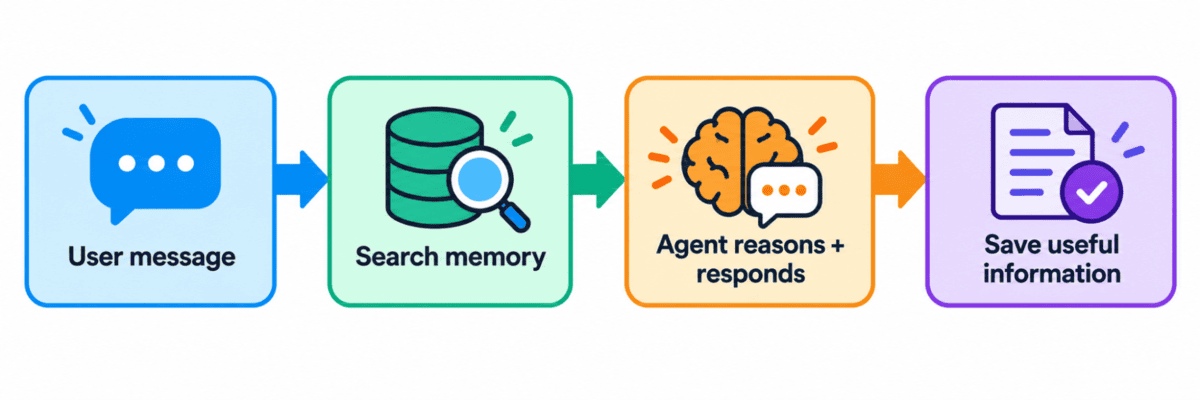
Stateful memory architectures bypass these inefficiencies by implementing a structured cognitive loop. When a user transmits a query, the agent intercepts the input and initiates a semantic search across a decoupled storage database. Instead of ingesting entire historical archives, the retrieval mechanism extracts only the specific data points relevant to the immediate request. The agent then synthesizes this contextual data during its reasoning phase, generates an informed response, and selectively writes new, durable facts back to the persistent store for future retrieval.
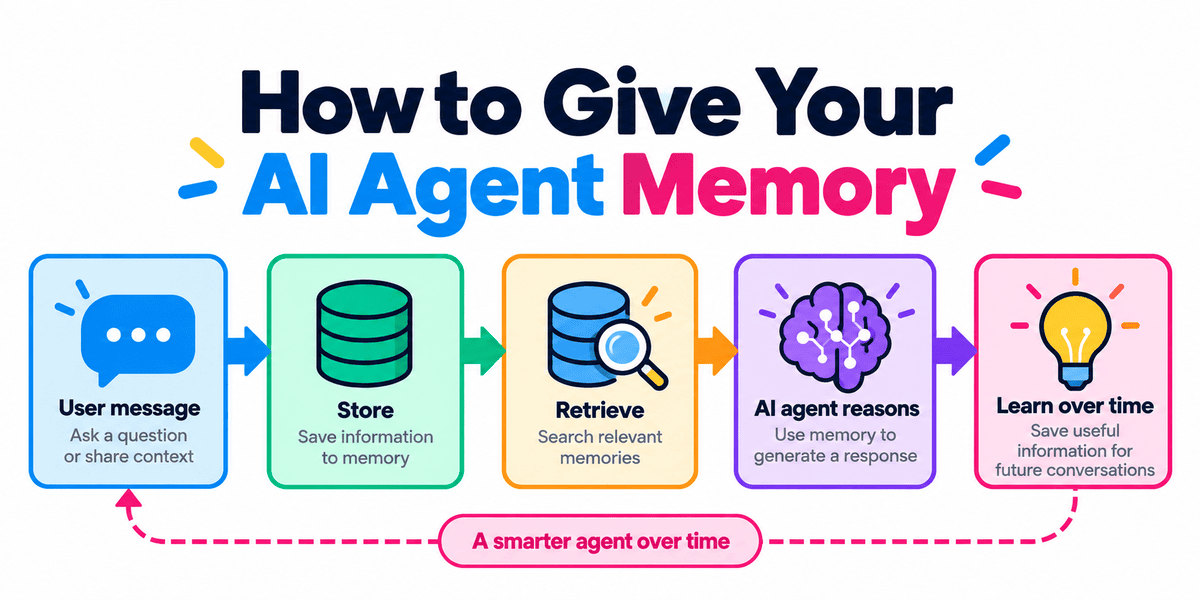
This retrieval-augmented memory model relies heavily on vector embeddings and semantic search parameters. Even when user queries use phrasing that diverges from previously stored text, vector distance calculations allow the system to map concepts accurately. Furthermore, this selective retention protocol ensures that transient pleasantries, temporary debugging outputs, and redundant dialogue are automatically filtered out, preserving memory hygiene and minimizing unnecessary database bloat.
Constructing a Stateful Agent with the OpenAI Agents SDK and Mem0
Implementing long-term memory in custom Python applications requires orchestrating an agentic framework with a specialized memory layer. A prominent approach utilizes the OpenAI Agents SDK paired with Mem0, an infrastructure layer designed specifically to manage semantic memory for AI systems.
The implementation process begins within a standard development environment by installing the necessary software development kits via package management utilities:
pip install openai-agents mem0aiFollowing the installation phase, developers must configure environment variables to authenticate API requests securely with both OpenAI and the memory management platform:
export OPENAI_API_KEY="your-openai-key"
export MEM0_API_KEY="your-mem0-key"
With the environment initialized, developers instantiate the required classes to establish identity boundaries. Isolating memory storage by user identifiers is critical for maintaining data privacy and operational accuracy in multi-tenant environments:
from agents import Agent, Runner, function_tool
from mem0 import MemoryClient

memory = MemoryClient()
USER_ID = "enterprise_user_01"
The next architectural requirement involves constructing discrete tool definitions that empower the agent to independently query and update its knowledge base. The first of these tools, search_memory, executes a semantic lookup against the user’s isolated profile, retrieving the top relevant data points based on similarity scores:
@function_tool
def search_memory(query: str) -> str:
    """Search for relevant memories about the user."""

    results = memory.search(
        query=query,
        filters="user_id": USER_ID,
        top_k=5,
    )

    memories = results.get("results", [])

    if not memories:
        return "No relevant memories found."

    return "n".join(
        f"- item['memory']"
        for item in memories
    )
Conversely, the agent must be equipped to write information back into the persistence layer without human intervention. The save_memory function captures significant user directives, technical choices, or workflow preferences and registers them within the memory backend:
@function_tool
def save_memory(content: str) -> str:
    """Save useful long-term information about the user."""

    memory.add(
        messages=[

                "role": "user",
                "content": content,

        ],
        user_id=USER_ID,
    )

    return "Memory saved."
Once the storage and retrieval functions are defined, they are bound to an agent instance through targeted instructions. These prompt instructions dictate behavioral boundaries, compelling the agent to query historical context proactively before formulating answers and instructing it to confirm successful memory persistence:
agent = Agent(
    name="Enterprise Memory Assistant",
    model="gpt-5.6-luna",
    instructions="""
    You are a technical assistant equipped with long-term memory.
    Always call search_memory before answering, even for general queries.
    When relevant memory surfaces, acknowledge it naturally,
    for example: "I recall that you prefer...", and apply it.
    Save durable technical preferences, project goals, and constraints;
    confirm each save concisely. Omit greetings, temporary data, and duplicates.
    """,
    tools=[
        search_memory,
        save_memory,
    ],
)
By executing this agent within a synchronous runner function, applications achieve persistent state continuity, ensuring that insights gathered during initial debugging sessions remain accessible across application restarts and server reboots.
Expanding Persistent Memory to Developer Tooling via Model Context Protocol
While custom Python scripts offer granular control over agentic memory, enterprise developers frequently rely on specialized integrated development environments and coding assistants. Extending persistent memory to dedicated coding agents without rewriting native integration layers requires standardized communication protocols.

The Model Context Protocol (MCP) provides a standardized framework for connecting AI models to external data sources and tools. Mem0 offers an official hosted MCP server that exposes native operations—including memory addition, semantic searching, direct retrieval, updating, and deletion—directly to MCP-compatible coding environments such as OpenCode.
Integrating this memory layer into a developer environment involves registering the remote MCP server endpoint via command-line tooling:
npx mcp-add
  --name mem0-mcp
  --type http
  --url "https://mcp.mem0.ai/mcp"
  --clients "opencode"
Once the client configuration is updated and the development environment is restarted, coding assistants gain immediate access to cross-session persistence. For instance, a developer can declare a specific package manager preference during an initial setup phase:
Remember that I prefer uv instead of pip for initializing new Python projects.When closing the session, terminating the environment, and subsequently opening a new project workspace in a later session, the coding assistant automatically queries the MCP memory server when prompted to scaffold a repository:
How should I initialize this Python project?Rather than defaulting to generic installation instructions, the coding assistant retrieves the user’s historical preference through the integrated MCP tools and generates tailored configuration commands incorporating the preferred tooling stack. System administrators can audit active memory integrations and verify tool availability at any time by executing verification commands within the terminal interface:

opencode mcp listBroader Industry Implications and Future Outlook
The integration of persistent memory architectures into AI agents represents a significant maturation phase in software engineering. Commercial applications, exemplified by consumer-facing platforms like OpenAI’s ChatGPT, have long utilized proprietary memory layers to retain user context across disparate chat threads, setting a high benchmark for user experience. Replicating this capability in open-source and enterprise-grade environments democratizes personalized AI deployment.
From an economic and operational perspective, the shift toward stateful agents reduces cognitive friction for enterprise users. Customer support bots can recall past ticket resolutions without requiring users to restate their account configurations; internal data analytics tools can track longitudinal business metrics tailored to an executive’s preferred reporting formats; and software development workflows become frictionless as coding assistants internalize organizational coding styles, security guidelines, and architectural constraints.
Nevertheless, the widespread adoption of long-term agentic memory introduces complex security and governance challenges. Storing persistent user data necessitates rigorous encryption standards, robust access control lists, and explicit data governance policies to prevent unauthorized memory extraction or poisoning attacks. As regulatory frameworks surrounding data privacy tighten globally, developers implementing semantic memory solutions must incorporate automated mechanisms for memory auditing, user consent management, and data expungement.
Ultimately, overcoming session amnesia transforms AI agents from reactive, stateless tools into proactive, context-aware digital collaborators. By combining robust foundational models with structured memory layers like Mem0 and standardized connectivity protocols like MCP, the technology sector is steadily moving past the limitations of episodic computing toward an era of continuous, adaptive machine intelligence.