The Innovation Paradox: How Legacy IT Systems and Vendor Lock-In Are Impeding the Enterprise AI Revolution

The global corporate landscape is undergoing a profound paradigm shift, moving rapidly from experimental artificial intelligence deployments to fully autonomous, agentic workflows capable of executing complex, multi-step operations. Yet, beneath the veneer of modern digital transformation, a persistent structural friction threatens to derail progress. According to new research released by Google Cloud in partnership with Hypothesis Group, enterprise organizations are trapped in an "innovation paradox," where the legacy software systems they rely on for daily operations are simultaneously acting as an innovation tax, severely hindering their broader artificial intelligence objectives.
The comprehensive study, which surveyed 1,250 enterprise IT and business decision-makers across the United States, sheds light on a systemic tension defining modern corporate technology. While nearly 90% of Fortune 100 companies have already adopted platforms like Gemini Enterprise to build, scale, and govern autonomous agents, the foundational infrastructure of the broader market remains anchored to yesterday’s technology. As artificial intelligence systems begin to plan, reason, and work alongside human teams, corporate leadership is increasingly forced to confront the operational drag of aging, on-premises architectures.
Defining the Legacy Burden and Its Operational Toll
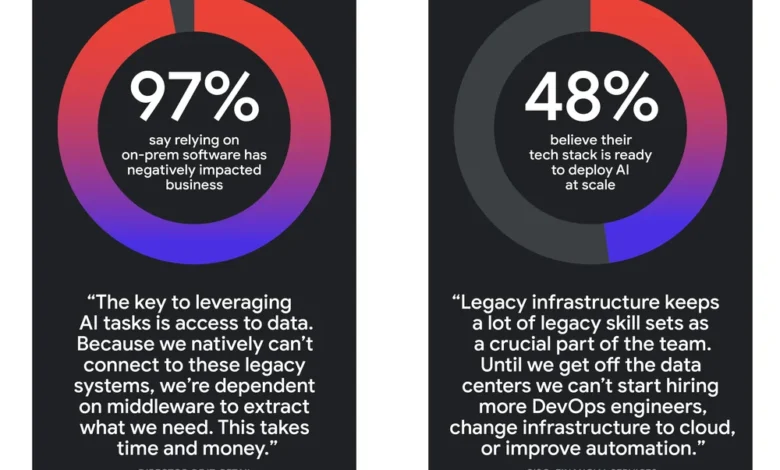
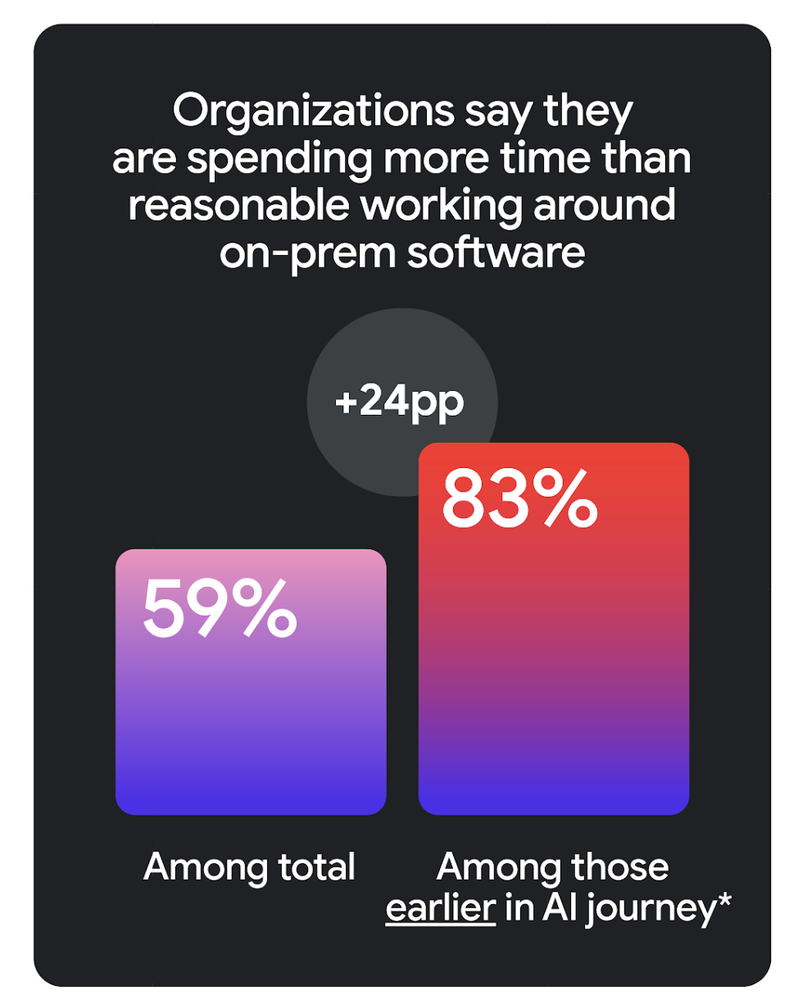
To accurately gauge the friction points within modern enterprises, the study defined "legacy technology" not merely as outdated equipment, but as software running locally on physical computers and servers rather than natively within agile cloud environments. Across virtually all major industries, IT decision-makers reported that maintaining this local footprint exerts a constant, compounding drag on their strategic AI ambitions.
The consequences of this technological inertia are far from theoretical or isolated. Nearly half—specifically 49%—of all surveyed respondents revealed that their continued reliance on on-premises software has directly delayed, reduced in scope, paused, or entirely canceled planned artificial intelligence and digital transformation initiatives. Rather than dedicating valuable engineering talent and financial resources toward cutting-edge machine learning development, corporate IT departments find themselves caught in a reactive cycle of routine maintenance.
This dynamic has created a high-stakes, zero-sum game within enterprise engineering departments. As AI-enabled vulnerability discovery accelerates across the digital ecosystem, the sheer volume of software flaws surfaced in legacy codebases has outpaced the capacity of human security teams to remediate them. Consequently, highly skilled engineers are diverted from driving forward-looking modernization projects to spend countless hours patching decades-old systems, essentially paying a heavy maintenance tax just to keep the past running.
The Architecture of Enterprise Monoculture and Vendor Lock-In
The persistence of these legacy environments is rarely the result of deliberate architectural preference. Instead, corporate technology leaders frequently find themselves cornered by deeply entrenched commercial dynamics, most notably vendor lock-in and enterprise monoculture.
Beyond restricting an organization’s freedom to choose best-of-breed software solutions, deep provider dependence introduces profound commercial constraints. In the Google Cloud and Hypothesis Group study, 39% of decision-makers reported that their heavy reliance on legacy software and incumbent cloud providers forces them to navigate labyrinthine licensing rules, restrictive contract structures, and severely limited negotiating flexibility. Vendors often bundle desktop productivity suites, operating systems, and basic cloud hosting into rigid packages that discourage diversification.

More concerning than the financial implications, however, is the systemic operational risk generated by single-vendor concentration. When an enterprise concentrates its entire digital footprint—including operating systems, productivity applications, cloud infrastructure, and emerging artificial intelligence models—within a single vendor’s proprietary ecosystem, it creates a massive single point of failure.
Cybersecurity experts emphasize that an autonomous AI agent is only as secure as the underlying operating system and network infrastructure it traverses. When that underlying technology stack is bloated with legacy vulnerabilities, organizations are not deploying resilient, enterprise-grade intelligence; rather, they are exponentially expanding their corporate attack surface. A compromise anywhere within the monolithic stack can cascade rapidly across interconnected autonomous workflows, leaving the entire enterprise exposed.
The Growing Demand for Customer Choice and Interoperability
As corporate boards and chief information officers grapple with these mounting risks, a clear consensus is emerging around the necessity of open architectures and genuine interoperability. Industry analysts note that enterprise buyers and regulatory policymakers alike must take active steps to ensure organizations retain the freedom to select software, cloud platforms, and AI models on their individual merits, free from anti-competitive bundling practices.
The survey data underscores this widespread appetite for flexibility. An overwhelming 80% of enterprise leaders agree that a provider’s existing installed base of legacy software should never dictate which artificial intelligence technology an organization ultimately chooses to deploy. Furthermore, 78% of respondents believe that the technology providers who successfully led the previous era of enterprise computing may not necessarily be structurally or culturally best positioned to lead the current era of artificial intelligence.
Organizations increasingly demand best-of-breed intelligence that can integrate seamlessly across diverse environments, rather than being forced to accept default pairings tied to legacy desktop applications. This shift in mindset reflects a broader realization that innovation thrives in open ecosystems where APIs, modular design, and multi-cloud strategies prevent the stagnation characteristic of twentieth-century IT procurement.
A Chronology of Transformation: From Cloud Migration to Agentic AI
To understand how enterprises arrived at this current crossroads, industry historians point to a distinct technological timeline over the past two decades. The journey began in the early 2010s with the initial wave of enterprise cloud migration, as forward-thinking companies sought to escape the capital expenditures associated with physical server rooms. However, many organizations pursued "lift-and-shift" strategies, moving legacy applications directly to cloud virtual machines without rearchitecting them for native cloud operations.
By the late 2010s and early 2020s, the focus shifted toward multi-cloud strategies and containerization via technologies like Kubernetes, allowing software to run more portably. Yet, millions of mission-critical core applications remained anchored to on-premises databases and monolithic codebases due to perceived migration risks or regulatory compliance hurdles.
The advent of large language models (LLMs) in 2022 and 2023 dramatically accelerated the stakes. Enterprises quickly realized that static data silos and legacy applications could not feed real-time, context-aware AI models efficiently. By 2024 and 2025, the industry transitioned from simple conversational assistants to autonomous, agentic workflows—AI systems capable of executing complex business processes independently across enterprise software suites. Today, in 2026, this collision between autonomous intelligence and legacy infrastructure has reached a boiling point, forcing leadership teams to confront the "innovation paradox" head-on.

Strategic Implications and the Road Ahead for IT Leadership
Overcoming the innovation paradox requires a deliberate reimagining of enterprise technology roadmaps. Industry observers and cloud architects suggest several critical imperatives for organizations looking to break free from the gravitational pull of legacy systems:
- Decoupling AI Strategy from Legacy Infrastructure: Organizations must establish sandbox environments and modular integration layers that allow advanced AI agents to interact with core business data without being bottlenecked by underlying legacy operating systems.
- Prioritizing Cloud-Native Modernization: IT budgets must be strategically reallocated away from endless patching of on-premises hardware toward automated, cloud-native refactoring and containerized microservices.
- Enforcing Interoperability Standards: Procurement teams should prioritize vendors that support open standards, robust APIs, and multi-vendor compatibility, actively resisting commercial terms that penalize technological diversity.
- Fostering Cross-Functional Alignment: Chief Information Security Officers (CISOs) and Chief Technology Officers (CTOs) must work in tandem to ensure that the deployment of autonomous workflows does not outpace the organization’s ability to secure the underlying network stack.
The ultimate promise of agentic artificial intelligence is to automate routine operational friction away, freeing human ingenuity to focus on higher-order strategic challenges. However, industry experts caution that this transformative future cannot be stably constructed on top of software foundations designed decades ago. As enterprise leaders map out their strategic trajectories for the years ahead, the core question remains whether their technological foundations are actively accelerating their future, or whether they are simply paying an exorbitant maintenance tax to keep the past alive.