Microsoft Azure Databricks Delivers Exceptional ROI, Outperforming Competitors in Independent Benchmarks

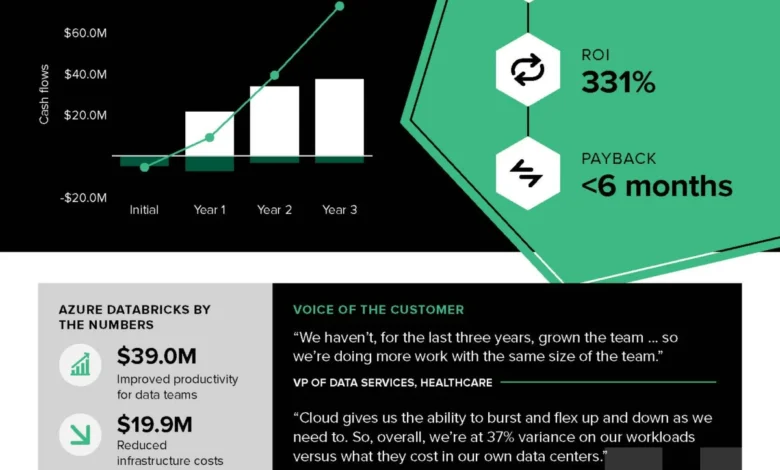
A groundbreaking Total Economic Impact™ (TEI) study commissioned by Microsoft and conducted by Forrester Consulting has revealed the substantial financial and operational advantages of Microsoft Azure Databricks. The report, released in June 2026, quantifies the tangible value proposition of this co-engineered data and AI platform, demonstrating a remarkable 331% return on investment (ROI) over a three-year period, with a net present value (NPV) of $58.1 million. Crucially, the study found that organizations can achieve a full payback on their investment in less than six months, underscoring the platform’s rapid value realization.
The TEI study modeled a composite organization, a $6 billion company operating within a regulated industry and managing approximately 10 petabytes of data. This representative entity experienced significant improvements after migrating to Azure Databricks, moving from a fragmented, costly, and unreliable data estate to a streamlined, governed, and performant environment. The research projected total benefits amounting to $75.6 million against costs of $17.5 million over three years, resulting in the impressive $58.1 million NPV.
This significant financial uplift stems from several key areas, according to Forrester’s analysis. While the specific dollar figures for each benefit were not detailed in the provided excerpt, the study identified four primary drivers of value. These are understood to encompass increased operational efficiency, enhanced data utilization, improved business agility, and reduced infrastructure and management overhead. The report further highlighted benefits that were not assigned a specific monetary value but are critical to the platform’s overall success, including seamless integration with native Azure services, accelerated delivery of business insights, broader data accessibility for stakeholders, and robust data governance facilitated by Unity Catalog.
Azure Databricks distinguishes itself through its deep, native integration as a first-party service within the Microsoft Azure ecosystem. This co-engineering by Microsoft and Databricks ensures a unified integration roadmap across the broader Microsoft data and AI stack. This approach translates into a singular go-to-market strategy, a consolidated billing process, and a unified support channel for customers. For technical teams, this means enhanced native integration capabilities and superior performance. For the business side, it translates to lower costs, reduced risk, and a faster path to achieving desired business outcomes. The inherent advantage is not an afterthought but is intrinsically built into the platform’s architecture and delivery.
Timeline of Strategic Partnership and Value Realization
The genesis of Azure Databricks lies in a strategic partnership between Microsoft and Databricks, aimed at delivering a unified and powerful data and AI experience on the Azure cloud. While the precise date of the initial co-engineering efforts is not publicly detailed, the ongoing collaboration has consistently focused on accelerating integration roadmaps and continuously optimizing the platform for performance. The release of the Forrester TEI study in June 2026 serves as a significant milestone, providing concrete, data-driven validation of the business value derived from this partnership. This timing suggests that the platform has been in widespread customer use for a sufficient period to allow for comprehensive analysis of its economic impact. The study’s findings reflect the culmination of several years of development and customer adoption, highlighting a consistent trajectory of value delivery.
Deep Dive into the Value Drivers
The substantial returns documented in the Forrester study are fundamentally rooted in Azure Databricks’ seamless integration into the existing Azure environment. As a true first-party Azure service, it eliminates the inefficiencies and added costs associated with managing separate data copies, disparate tooling, and complex integration workflows. This inherent advantage allows organizations to leverage the tools and services they already utilize within Microsoft’s ecosystem, thereby streamlining operations and reducing the total cost of ownership.
A prime example of this deep integration is the Azure Databricks Genie integration with Microsoft Copilot Cowork. This innovative feature allows users to infuse business context and build upon intelligence within familiar tools. Genie empowers individuals to query the lakehouse using natural language, now accessible directly within Microsoft Teams, Microsoft 365 Copilot, and Copilot Cowork. This capability grounds tasks in trusted data through Genie Ontology, ensuring that every response is precisely scoped by Unity Catalog according to user permissions. This ensures that critical business intelligence reaches users within their workflow without compromising governance standards.
The platform’s depth of integration extends across its comprehensive suite of capabilities. This includes:
- Unified Data Governance: Unity Catalog provides a singular catalog for all data assets, ensuring consistent security, compliance, and discoverability across the lakehouse. This centralized approach simplifies data management and mitigates risks associated with decentralized data environments.
- End-to-End AI Lifecycle Management: Azure Databricks offers integrated tools for every stage of the AI lifecycle, from data preparation and model training to deployment and monitoring. This streamlined workflow accelerates the development and deployment of AI solutions, driving faster innovation and competitive advantage.
- Optimized Performance for Diverse Workloads: The platform is engineered to handle a wide range of data processing and analytics workloads, from large-scale ETL (Extract, Transform, Load) operations to real-time analytics and machine learning model training. This versatility ensures that organizations can tackle complex data challenges efficiently.
- Seamless Integration with Azure Services: Beyond Copilot integrations, Azure Databricks integrates fluidly with other Azure services such as Azure Synapse Analytics, Azure Machine Learning, and Power BI. This interconnectedness allows for the creation of comprehensive, end-to-end data solutions that leverage the strengths of each service.
- Cost Efficiency through Resource Optimization: The platform’s architecture is designed for efficient resource utilization, automatically scaling compute resources up or down based on demand. This dynamic scaling helps organizations optimize costs by paying only for the resources they consume.
These integrations, while not always explicitly priced in the TEI study, are crucial enablers of the quantified productivity and cost benefits. They represent the underlying technological advancements that contribute directly to a more efficient and cost-effective data and AI strategy.
Independent Validation of Performance
Beyond the economic impact, the performance of Azure Databricks has also been rigorously tested by independent entities. Principled Technologies, a reputable firm in performance benchmarking, conducted an industry-standard decision-support benchmark, similar to TPC-DS, on a 10-terabyte dataset. The results demonstrated a clear performance advantage for Azure Databricks. In single-query stream tests, Azure Databricks completed queries up to 21.1% faster than Databricks on AWS (when autoscale was disabled). Furthermore, when running four concurrent query streams, Azure Databricks achieved a speed improvement of over nine minutes compared to its AWS counterpart. This independent validation underscores the platform’s ability to deliver both cost savings and superior performance, crucial factors for organizations dealing with large and complex data environments.
Broader Implications for Businesses
The findings of the Forrester TEI study and the independent performance benchmarks have significant implications for organizations looking to modernize their data and AI strategies. Choosing a data and AI platform is a long-term strategic decision, and Azure Databricks presents a cohesive and reinforcing ecosystem. The deep integrations drive the cost savings identified by Forrester, while the platform’s robust performance ensures that these gains are sustained even as data volumes and usage grow.
At its core, Azure Databricks is built upon a foundation of a first-party partnership, signifying that both Microsoft and Databricks engineering, product roadmaps, and support are fully aligned and committed to the platform’s success. This unified approach eliminates the friction and complexities often associated with multi-vendor solutions. The measured value, characterized by a 331% three-year ROI and a payback period of under six months, moves beyond mere claims to demonstrable financial outcomes. This compelling evidence is a key reason why numerous teams are selecting Azure Databricks to power their lakehouse architectures.
The broader impact extends to enabling organizations to become more data-driven, accelerate innovation, and gain a competitive edge in their respective markets. By simplifying data management, democratizing access to insights, and empowering advanced analytics and AI capabilities, Azure Databricks positions businesses for future growth and success. The platform’s ability to integrate with familiar Microsoft tools further lowers the barrier to adoption, allowing organizations to maximize their existing investments and empower a wider range of users.
Looking Ahead: Continued Innovation and Partnership
The ongoing collaboration between Microsoft and Databricks signals a commitment to continuous innovation. The accelerated integration roadmap ensures that customers will benefit from the latest advancements in data and AI technology as they emerge. This forward-looking approach, combined with the proven economic benefits and superior performance, solidifies Azure Databricks’ position as a leading platform for organizations seeking to unlock the full potential of their data.
The comprehensive nature of the TEI study and the independent performance benchmarks provide a clear picture of the tangible value that Azure Databricks delivers. It underscores that the platform is not just a technological solution but a strategic business enabler, driving significant financial returns and operational efficiencies. For decision-makers evaluating their data and AI investments, the evidence points towards Azure Databricks as a powerful, integrated, and highly cost-effective choice.
Organizations interested in exploring these benefits further can delve into the detailed findings of the Forrester Total Economic Impact™ study, which offers a deeper understanding of the methodologies and specific value drivers. Additionally, exploring the capabilities of Azure Databricks through available documentation and trials can provide hands-on experience with the platform’s transformative potential. The future of data and AI is being built on integrated, high-performance platforms, and Azure Databricks stands at the forefront of this evolution.
Related posts: