Seagate FireCuda Forge Review: Enterprise-Grade Tiered Storage Brought to the Desktop

The landscape of professional data management has long been defined by a fundamental compromise: creators and data-heavy enterprises must constantly choose between the blistering access speeds of solid-state drives (SSDs) and the massive, cost-effective capacities of traditional hard disk drives (HDDs). Historically, hybrid or tiered storage solutions that intelligently bridge this gap have been strictly confined to expensive, enterprise-level server racks and complex data center architectures. However, Seagate’s latest external storage solution aims to democratize this architecture. The Seagate FireCuda Forge external hard drive introduces dynamic tiered storage technology directly to desktop environments, blending a staggering 20TB mechanical storage core with a user-installable high-speed NVMe SSD caching layer.
Unpacking the Architecture: How Seagate Alkemi Tiered Storage Operates
At first glance, the FireCuda Forge presents itself as a robust, albeit conventional, desktop external drive. Available in 8TB and 20TB configurations, the unit under review features a 3.5-inch mechanical hard drive as its primary storage bedrock. Yet, its operational philosophy diverges sharply from standard external storage formats.
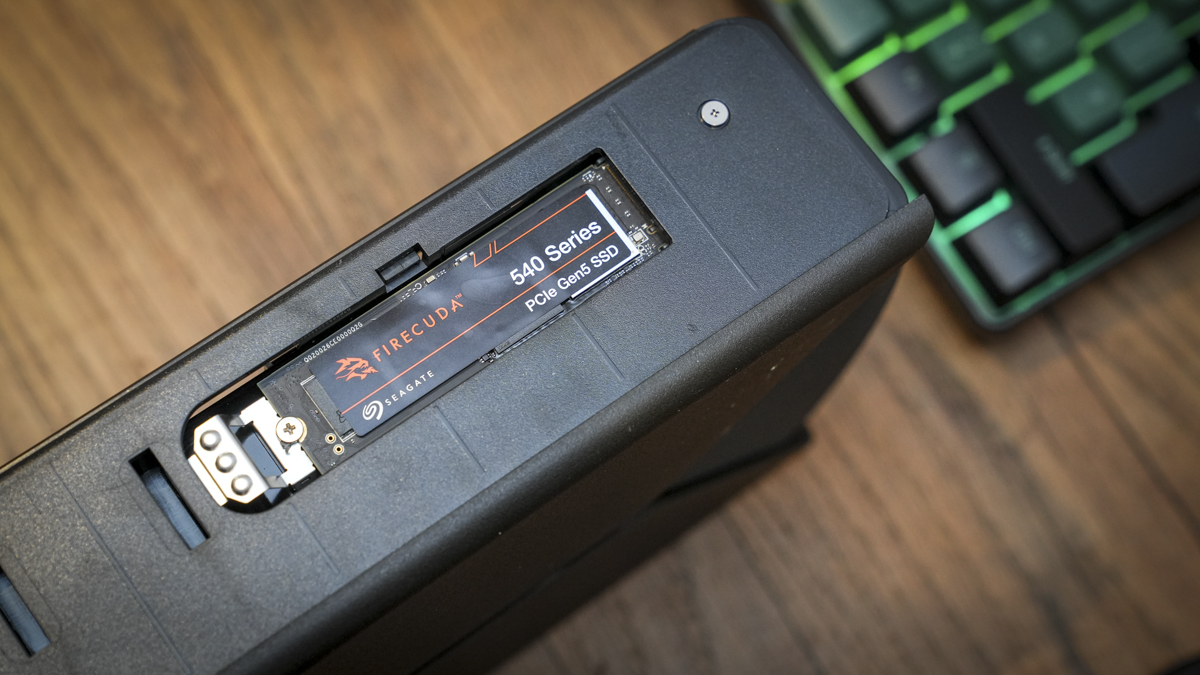
To initialize and operate the FireCuda Forge, users must first install an M.2 2280 NVMe SSD into a dedicated side-access compartment. While the unit arrives from the factory pre-installed with its massive HDD, the secondary solid-state drive is intentionally left unsupplied, requiring purchasers to factor in the acquisition of an independent NVMe module. Seagate recommends a PCIe Gen 3 or newer drive equipped with a dedicated DRAM cache, capped officially at a 1TB capacity limit, though practical testing has demonstrated compatibility with select 256GB to 2TB modules.
Once both drives are secured within the chassis and connected to a host machine via a high-bandwidth USB4 interface—which maintains backward compatibility with Thunderbolt 3, 4, and 5 ports—the operating system does not register two distinct volumes. Instead, Seagate’s proprietary Alkemi dynamic tiering technology amalgamates the hardware into a single, unified drive letter or mount point.
Behind the scenes, the Alkemi controller continuously monitors file access patterns. Frequently accessed working files, active operating system caches, and recently modified project assets are automatically promoted to the high-speed SSD layer, allowing read and write speeds to surge up to 2,500MB/s and 2,000MB/s respectively. Conversely, archival files, historical assets, and infrequently accessed data are autonomously relegated to the massive 20TB mechanical spindle.
Design, Build Quality, and Hardware Specifications
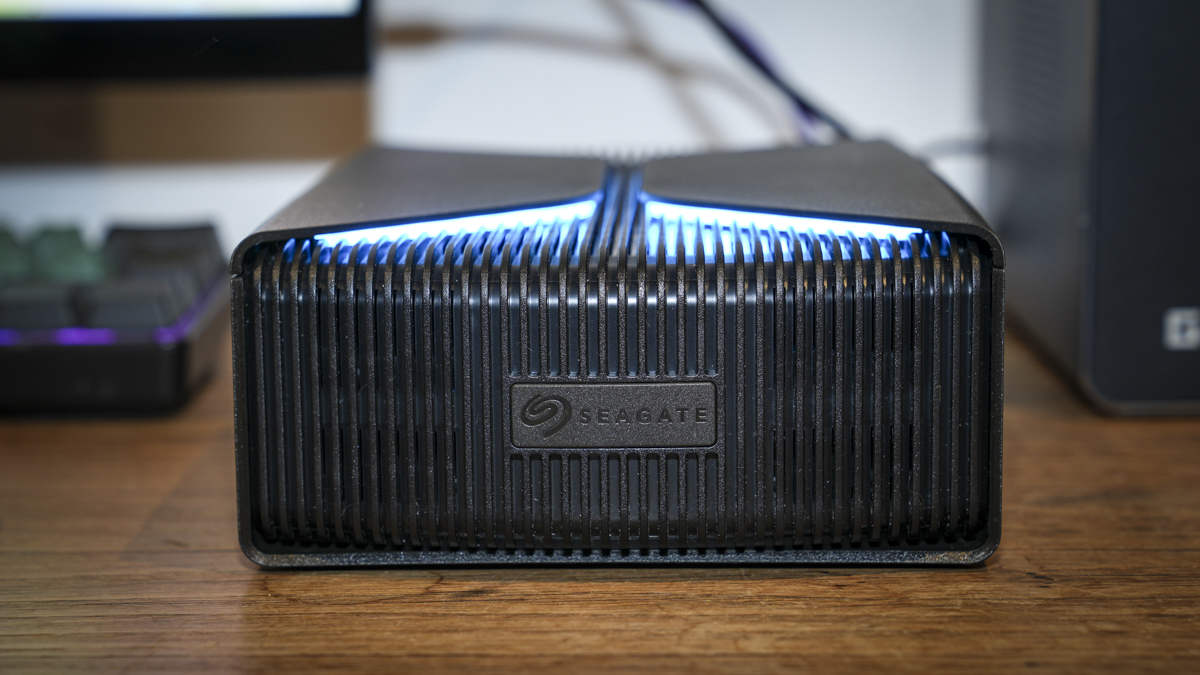
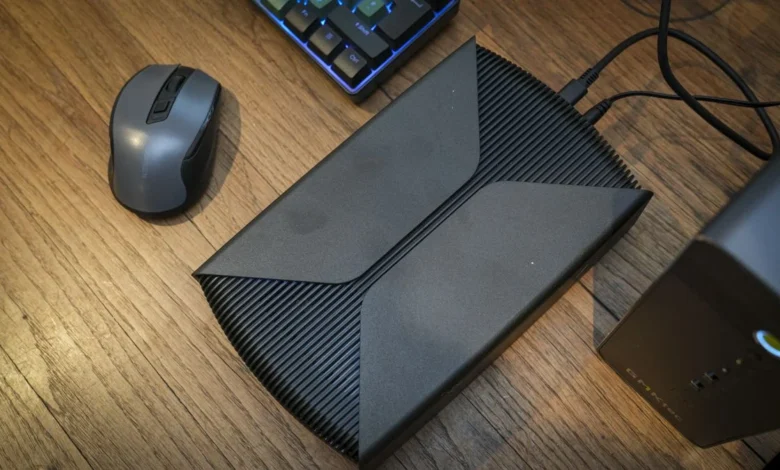
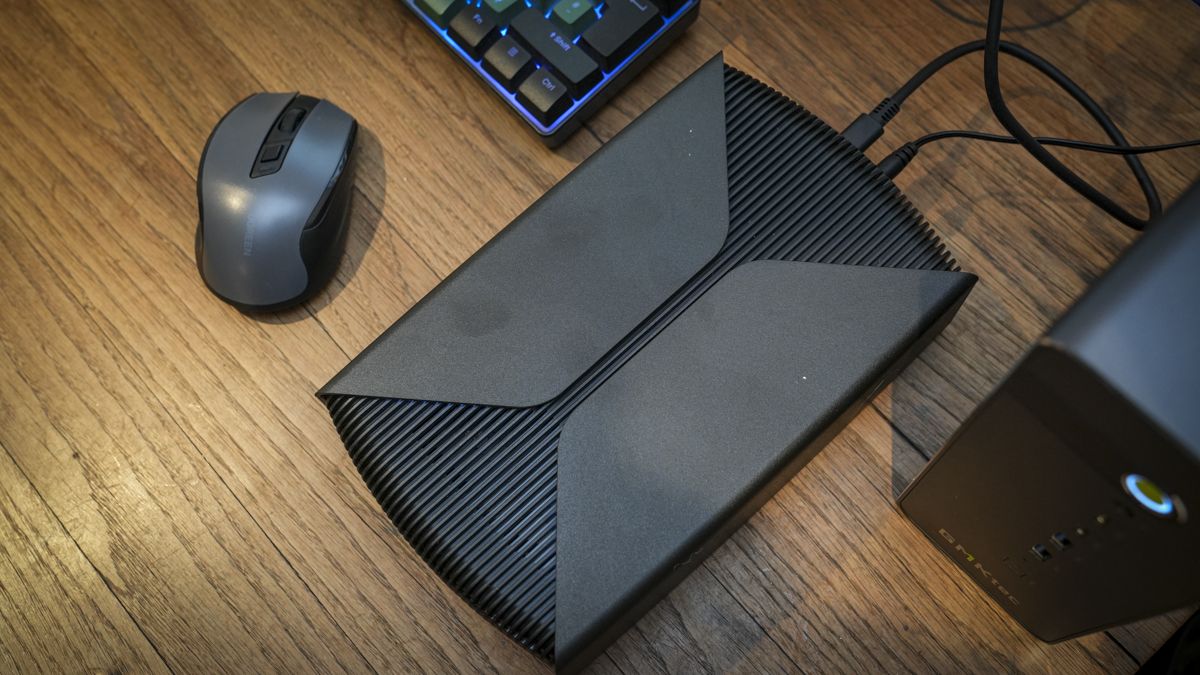
Physically, the Seagate FireCuda Forge departs from the anonymous black boxes that have dominated the external storage market for decades. Measuring 240.3 × 146.8 × 65.2mm and weighing approximately 1.92kg for the 20TB variant, the chassis is constructed from high-grade, premium-finished plastics that convey structural integrity and durability on a desktop workspace.
Unlike bus-powered portable drives, the Forge requires a dedicated external AC power adapter, ensuring stable voltage delivery during intensive read/write cycles. The top panel integrates a subtle status LED indicator that communicates basic drive activity and connection states. Connectivity is streamlined, featuring a single power input socket and a high-throughput USB4 (USB-C) data port.
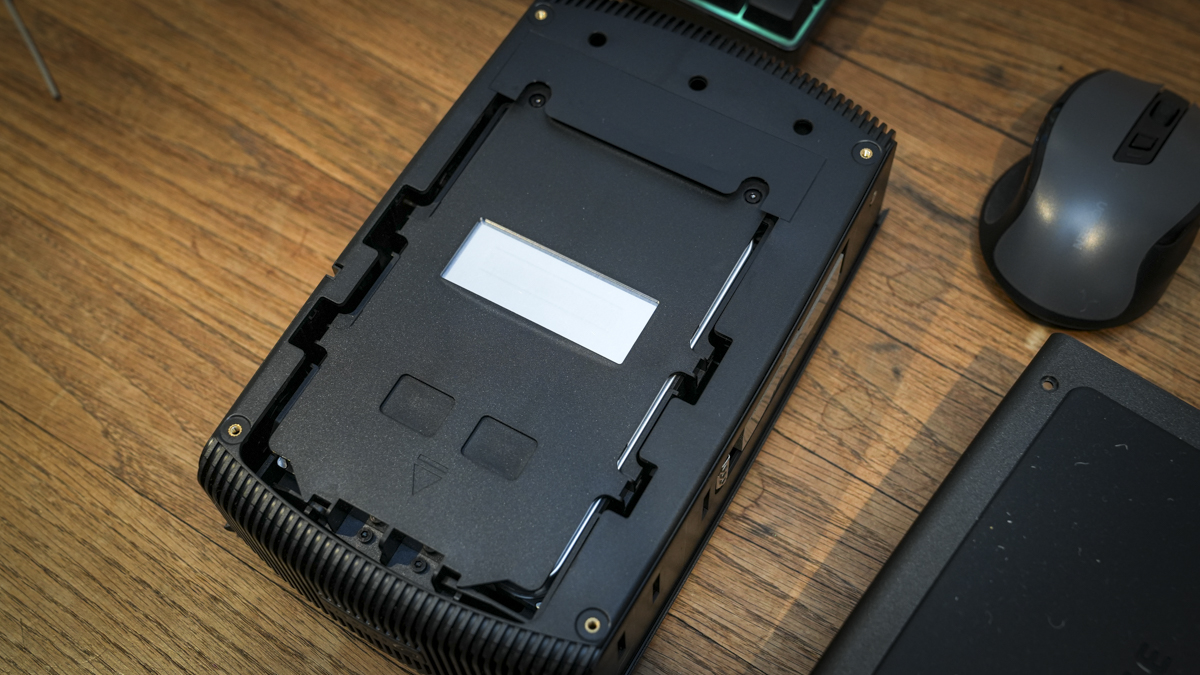
Accessing the internal hardware bays requires the removal of four hex screws on the base, granting entry to both the replaceable 3.5-inch mechanical drive and the side-mounted M.2 NVMe slot. Seagate includes the necessary hex key in the retail packaging, though users must supply a standard cross-head screwdriver to complete the SSD installation. Thermal management is handled via large, pre-cut thermal pads included in the box, ensuring that high-performance PCIe modules remain within safe operating temperatures during sustained data transfers.
Real-World Performance and Benchmarking Analysis
In laboratory testing conducted on a GMKtec EVO-X5 Pro mini PC, the FireCuda Forge demonstrated performance metrics that fundamentally challenge traditional expectations of mechanical storage. CrystalDiskMark 8 recorded sequential read speeds of 2,248.52 MB/s and sequential write speeds of 1,726.77 MB/s. Similar robust figures were corroborated by ATTO Disk Benchmark, which peaked at 2,320 MB/s read and 1,610 MB/s write.
These benchmark figures translate directly into tangible workflow improvements for creative professionals. During real-world testing involving the offloading of raw media from high-speed memory card readers—such as transferring over 1TB of video footage following a shoot—the FireCuda Forge completed the task in approximately 12 minutes. By comparison, a standard 3.5-inch external HDD typically requires up to an hour and twenty minutes for an identical workload.
When utilized as a live working drive for video editing suites like Adobe Premiere Pro, the drive exhibits near-SSD responsiveness for active projects under the 1TB threshold. Opening large project files and rendering timelines proceeds with minimal friction, avoiding the stuttering and latency traditionally associated with editing directly from mechanical drives.
However, performance parameters are bound by the physical limitations of the tiered architecture. When transferring massive single-batch datasets exceeding 1TB—such as a 4TB migration from a Thunderbolt 5 scratch disk—initial transfer speeds mirror high-end SSDs before gradually tapering down as the caching layer saturates and the system flushes data to the underlying mechanical platters. Similarly, tasks requiring random access across dispersed file structures, such as loading expansive modern video games or switching between massive local Large Language Models (LLMs), expose longer latency periods compared to dedicated internal solid-state drives.
Market Positioning, Pricing, and Cost-Benefit Implications
As the digital creation industry grapples with exponential increases in 4K, 8K, and RAW video file sizes, the demand for high-capacity, high-throughput storage has never been more acute. Standard portable SSDs offer exceptional speeds but quickly become financially prohibitive at capacities exceeding 4TB. Conversely, traditional high-capacity HDDs provide economical storage at the expense of crippling transfer times.
The Seagate FireCuda Forge occupies a unique middle ground. While official retail pricing has yet to be finalized at the time of publication, industry analysts project an introductory cost of approximately £900 for the 20TB enclosure, with an additional £100 to £180 required to source a compatible 1TB DRAM-cached NVMe SSD. When weighed against standard 20TB desktop archival drives—which retail significantly lower but lack performance capabilities—the Forge’s value proposition relies entirely on a user’s specific operational bottlenecks.
For photographers, videographers, and digital archivists who routinely ingest massive volumes of data from high-speed sources and require immediate, capacious working space without investing in complex Network-Attached Storage (NAS) configurations, the FireCuda Forge delivers an compelling balance of speed and scale. By bridging enterprise-tier dynamic caching with consumer-accessible USB4 connectivity, Seagate has engineered a versatile desktop storage solution that successfully redefines the operational limits of mechanical hard drives.
Related posts: