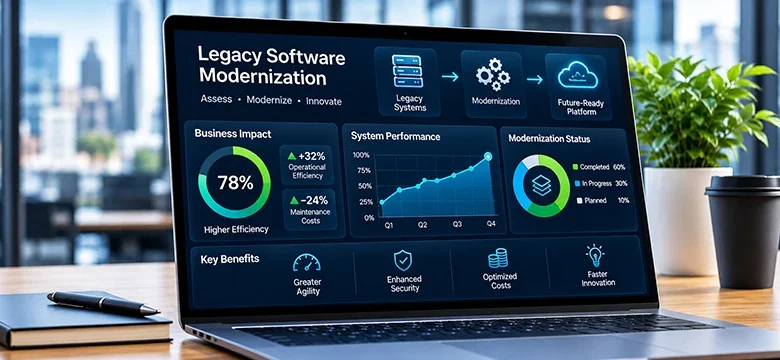
European businesses are increasingly relying on digital channels to drive core revenues, yet a significant operational vulnerability persists beneath the surface: the widespread reliance on legacy order and stock management systems built long before the e-commerce surge. According to Eurostat data from 2025, approximately 24% of EU enterprises successfully sold products or services online, generating 19% of their total turnover. However, the foundational software supporting these transactions often dates back decades, creating a growing architectural bottleneck for organizations seeking to scale.
When executive leadership teams finally authorize the overhaul of these aging frameworks, they invariably encounter complex strategic hurdles. Selecting the right external partner, negotiating optimal contractual terms, and determining which components to migrate first represent critical decision points. Fixed-price contracts frequently devolve into continuous change requests as hidden integrations emerge, whereas open-ended time-and-materials agreements with minimal milestone tracking risk ballooning in duration and cost.
To assist enterprise decision-makers in navigating this landscape, an examination of seven leading legacy software modernization companies in Europe for 2027 provides a clear comparative framework. By assessing their delivery models, sectoral focuses, and engagement terms, organizations can effectively shortlist implementation partners suited to their distinct operational needs.
Macroeconomic Trends Shaping Modernization Budgets in 2027
Enterprise software and IT modernization budgets face a highly competitive landscape in 2027, squeezed by escalating investments in artificial intelligence, heightened cybersecurity mandates, and rising professional service rates. Understanding these broader market dynamics is essential for accurate financial planning and risk mitigation.
Global expenditures on IT services are projected by Gartner to reach $1.87 trillion in 2026, representing a robust 9.0% growth rate following a 6.2% expansion in 2025. Total worldwide IT spending is forecast to climb to $6.31 trillion. For businesses undertaking large-scale software transformations, robust growth in the IT services sector translates to heightened demand for specialized engineering talent and firmer day rates. Consequently, organizations that secure project scope and team capacity early can insulate their budgets against mid-project inflationary pressures.
Concurrently, software-specific investments are outpacing general services in key European markets. Germany’s digital sector association, Bitkom, reported in its January 2026 market forecast that domestic software revenue would expand by 10.2% to reach €58.3 billion in 2026, outstripping IT services growth, which is pegged at 3.5% to €54.3 billion. This divergence highlights a structural reality: companies are allocating more capital to underlying platforms and software licenses than to the implementation labor required to deploy them. Successful modernization strategies must budget comprehensively for both, recognizing that enterprise software rarely delivers intrinsic value without extensive bespoke integration work.
Compounding these financial considerations is a tight digital talent pool. Bitkom projects that Germany’s digital sector will add roughly 11,000 jobs in 2026, bringing total employment to 1.36 million, up from 1.349 million at the close of 2025. With annual workforce growth hovering below 1%, experienced software architects and senior developers remain scarce. Partnering with established consultancy firms provides immediate engineering capacity that organic recruitment could take months to replicate.
Furthermore, foundational cybersecurity practices across the European Union remain uneven, leaving legacy architectures acutely vulnerable. Eurostat data indicates that only 39.8% of EU enterprises utilized multi-factor authentication (MFA) in 2024, while just 39.7% employed comprehensive data, document, or email encryption. Legacy systems frequently lack native support for these modern security protocols, necessitating significant code rewrites. Modernization initiatives offer an opportune moment to embed robust encryption and authentication mechanisms directly into the application layer, rather than attempting to bolt them onto obsolete codebases.
Disparities also exist in operational monitoring. While 79.2% of EU enterprises maintained offsite or cloud-based data backups in 2024, only 45.2% systematically preserved log files for post-incident security analysis. While backups ensure business continuity following a failure, structured logs are indispensable for root-cause analysis. Modern platforms integrate automated logging and monitoring standards, enabling internal security teams to trace anomalies within hours and present comprehensive audit trails to regulatory authorities.
Leading Legacy Software Modernization Providers in Europe
Modernization partners specialize in systematically dismantling and rebuilding legacy systems with minimal disruption to ongoing business operations. The structural approach adopted by each firm determines how operational risk is distributed between the vendor and the enterprise client.
Reenbit
Targeting growing enterprises reliant on .NET and Azure infrastructure, Reenbit specializes in phased modernization strategies designed to prevent operational downtime. Operating as a Microsoft Partner and AI-focused consultancy, the firm serves clients across fintech, energy, healthcare, retail, manufacturing, construction, and facility management. With a workforce exceeding 100 engineers—over 88% of whom hold official Microsoft or Azure certifications—Reenbit offers flexible engagement structures, including technology partnerships, dedicated teams, and IT staff augmentation.
Projects are executed incrementally, allowing legacy platforms to remain operational while individual modules are transitioned to cloud-native .NET architectures. The integration of autonomous AI agents accelerates code refactoring, while secure RESTful APIs expose legacy business logic to modern interfaces. Every deployment undergoes rigorous CI/CD pipeline verification. For an energy-sector client, Reenbit successfully reduced core operational processing times from 30–40 seconds down to 3–6 seconds, while retail brand Scandinavian achieved €400,000 in savings within the first year.
Sombra
Sombra caters to organizations requiring a structured modernization roadmap followed by phased execution and long-term maintenance. The firm executes transformations through a three-stage methodology: an initial system assessment resulting in a gap analysis and prioritized roadmap; phased development via refactoring, re-platforming, or rebuilding; and ongoing architectural maintenance. Sombra evaluates systems against seven distinct modernization strategies, ranging from simple rehosting to comprehensive rearchitecting.
Core capabilities include cloud migration to AWS or Google Cloud, security hardening aligned with OWASP ASVS standards, DevSecOps implementation, and technical debt reduction. Comprehensive documentation is delivered at every project milestone. Notably, for telecommunications provider Wifinity, Sombra engineers successfully migrated over 200,000 active users onto a modernized platform without service interruption.
The Software House
Specializing in complex post-merger integrations and the decomposition of legacy monoliths into scalable microservices, The Software House employs an incremental modernization strategy. By running legacy and modern systems in parallel, the firm mitigates the catastrophic risks associated with "big bang" cutovers. Engagements commence with a Modernization Roadmap Sprint, yielding a prioritized product backlog, architectural blueprints, component-wise migration paths, and detailed financial estimates.
Delivery encompasses re-platforming, code refactoring, complete rewrites with integrated data migration, and API development to decouple monolithic architectures. The firm utilizes its proprietary AI delivery framework, Copilot Collections, to streamline engineering workflows, deploying self-managed teams capable of onboarding within two weeks.
Boldare
Boldare offers modular legacy modernization tailored for PHP, Symfony, Java, and .NET environments, structured into distinct, purchasable phases. The process begins with a Legacy AI Readiness Scan lasting 3 to 5 business days, which maps existing technical debt, evaluates migration risks, and establishes a prioritized roadmap complete with AI-generated time estimates. Boldare credits the fee for this initial assessment toward subsequent modernization phases.
Execution proceeds via Legacy Migration Sprints, where modules are upgraded—such as moving from PHP 7.x to 8.x or Symfony frameworks from version 3-4 to version 7—while production environments remain active. Automated AI tools generate technical documentation for every modified module, and post-migration maintenance phases provide continuous technical debt monitoring, dependency alerts, and quarterly architecture reviews led by senior engineers.
Kainos
Kainos is well-positioned for public-sector bodies and highly regulated organizations undertaking large-scale cloud migrations. The firm delivers secure cloud landing zones alongside comprehensive training programs for internal client teams tasked with operating the modernized infrastructure. Long-term managed services, encompassing operational support and FinOps cost optimization, continue post-launch through regional support centers.
A prominent example of Kainos’s methodology is its work with Companies House, where engineers modernized a legacy Perl application (Monitor GUI) to Node.js across four structured stages: system design, documentation, planning, and transformation. Generative AI tools were utilized to analyze legacy source code, draft user stories, and assist in test planning, while human engineers retained ultimate decision-making authority. The project left behind robust regression test suites and a custom GenAI modernization playbook for internal teams.
Devoteam
Devoteam focuses on standardizing modernized enterprise applications on leading cloud ecosystems, specifically Google Cloud and AWS. The firm decomposes legacy architectures into modern services while maintaining strict uptime, security, and compliance standards. Projects follow a linear trajectory from requirements analysis and migration planning to code refactoring, CI/CD pipeline automation, and cloud-native optimization.
Google Cloud-certified specialists leverage technologies such as GKE, Anthos, Cloud Run, and Cloud Build, utilizing Apigee to bridge legacy systems with modern applications. Automated security vulnerability scans are executed at every code commit within the CI/CD pipeline, and hybrid and multi-cloud environments are continuously optimized for cost efficiency. Comprehensive training ensures client teams are fully equipped to manage the new infrastructure post-implementation.
SoftTeco
Serving manufacturing, fintech, healthcare, e-commerce, and logistics enterprises, SoftTeco provides comprehensive application modernization services encompassing strategic consulting, code refactoring, reengineering, and complete architecture redesign. Projects initiate with an exhaustive codebase analysis, followed by strategic stack proposals, iterative optimization with rigorous testing cycles, and enterprise integrations.
Cloud capabilities include legacy application migration, containerization, DevOps integration, alongside data pipeline and UI/UX modernization. SoftTeco integrates Generative AI into its refactoring pipelines, reporting project delivery timelines up to 40% to 50% faster than traditional methods. For Aniware Clinic, SoftTeco restructured the architecture of a legacy veterinary CRM to significantly reduce cloud scaling costs, building on a operational track record dating back to 2008.
Strategic Engagement Models and Risk Allocation
The contractual framework governing a modernization project heavily influences its ultimate cost, velocity, and risk profile. Organizations must carefully select an engagement model that matches their level of scope certainty.
- Fixed-Price Contracts: Suited exclusively for environments where comprehensive discovery has fully mapped the legacy codebase and dependencies are stable. While offering financial predictability, they require rigorous change-order management if undocumented legacy behaviors emerge.
- Time and Materials (T&M): Bills actual hours and resources utilized. This model aligns well with modernization initiatives where code analysis continually uncovers hidden technical debt, allowing plans to adapt without necessitating formal contract renegotiations. Budget control is maintained through weekly utilization reports, completed backlog item tracking, and strict per-phase spending caps.
- Dedicated Teams: Ideal for multi-year transformation programs where multiple legacy applications must be modernized sequentially and institutional knowledge must be preserved. Clients pay a predictable monthly rate per engineering role while maintaining direct prioritization authority over sprint backlogs.
- Outcome-Based Contracts: Ties a portion of the vendor’s compensation directly to predefined, measurable business outcomes, such as performance benchmarks, cloud cost reductions, or uptime thresholds.
Industry-Specific Modernization Imperatives
Different sectors face unique regulatory pressures, downtime tolerances, and architectural constraints that dictate modernization priorities:
- Manufacturing: Operations rely heavily on interconnected MES systems, ERP extensions, and machine interfaces built over decades. Because unplanned downtime halts production lines instantly, modernization must preserve continuous shop-floor operations, typically prioritizing data ingestion pipelines and API wrappers before touching core execution logic.
- Healthcare: Governed by stringent data privacy regulations (such as GDPR) and zero tolerance for clinical downtime. Initial phases prioritize the secure isolation of patient databases, integration of robust encryption, and implementation of strict audit logging.
- Retail: Fragmented infrastructures uniting point-of-sale systems, e-commerce frontends, and backend inventory management create stock discrepancies. Modernization efforts typically begin by unifying inventory and order processing services through real-time event-driven architectures, eliminating overnight batch syncs.
- Fintech: Requires continuous product feature delivery while legacy core ledgers and payment rails operate on aging codebases. Priorities focus on decoupling payment execution engines via microservices while maintaining ledger integrity.
- Energy: Utilities depend on complex software suites for metering, billing, trading, and grid monitoring. Modernization generally targets calculation engines and monitoring dashboards first to provide operators with real-time analytics during demand fluctuations, deferring billing core upgrades to later stages.
Conclusion
The primary friction points in software modernization typically arise within the variance between contractual assumptions and the actual state of legacy codebases. Undocumented business rules, hidden integrations, and unmaintained data structures can rapidly derail poorly prepared timelines. Enterprise leaders navigating modernization projects in Europe must demand transparent proposals from vendors that explicitly define scope boundaries, acceptance testing criteria, and clear handover protocols. By aligning contractual terms with realistic risk assessments, organizations can safeguard their digital transformation investments against unforeseen technical complexities.