Google has officially announced the general availability of ambient networking for Google Kubernetes Engine (GKE), representing a major evolution in how modern cloud-native enterprises deploy, manage, and scale service mesh environments. For years, network sidecars have been a foundational pillar of microservices connectivity, enabling developers and platform operators to secure, observe, and route traffic across complex distributed systems. However, this architectural pattern has also carried a well-documented and often burdensome reputation for excessive resource consumption and heightened management overhead.
The introduction of GKE ambient networking brings a sidecar-less architecture directly into production environments, effectively decoupling the critical functionalities traditionally provided by a service mesh from individual application workloads. Initially previewed earlier this year, this milestone release addresses long-standing industry pain points by empowering platform engineers and developers to seamlessly handle traffic security, telemetry observation, and sophisticated routing without the heavy resource tolls and operational complexities historically associated with managing individual sidecar proxies.
Background Context and the Evolution of Service Mesh Architecture
To fully understand the significance of Google’s latest release, it is necessary to examine the historical trajectory of service mesh technologies within Kubernetes ecosystems. As organizations rapidly transitioned from monolithic software development to microservices architectures, the number of internal service-to-service communications grew exponentially. This decentralization introduced severe operational challenges, particularly surrounding security (such as mutual TLS encryption), observability (such as distributed tracing and metrics collection), and traffic management (such as canary deployments and circuit breaking).
To solve these challenges, the industry widely adopted the sidecar proxy pattern. In this setup, a dedicated proxy container—most commonly Envoy—was injected directly into the Kubernetes pod alongside the core application container. While this approach successfully abstracted networking concerns away from application code, it created a new category of infrastructure friction. Each sidecar consumed dedicated CPU and memory resources, multiplying across hundreds or thousands of pods in a large-scale cluster. Furthermore, managing the lifecycle of these sidecars—including coordinated upgrades, vulnerability patch management, and debugging configuration drift—demanded significant operational bandwidth from platform engineering teams.
The ambient networking architecture represents a paradigm shift away from this per-pod resource tax. By restructuring how networking primitives are injected and maintained, Google’s new GKE capability moves away from the intrusive sidecar model in favor of a shared, node-level and control-plane-driven architecture. This architectural evolution aligns with broader industry movements toward more efficient, resource-optimized cloud infrastructure that minimizes compute waste and streamlines day-two operations.
Deep Dive Into the Ambient Networking Architecture
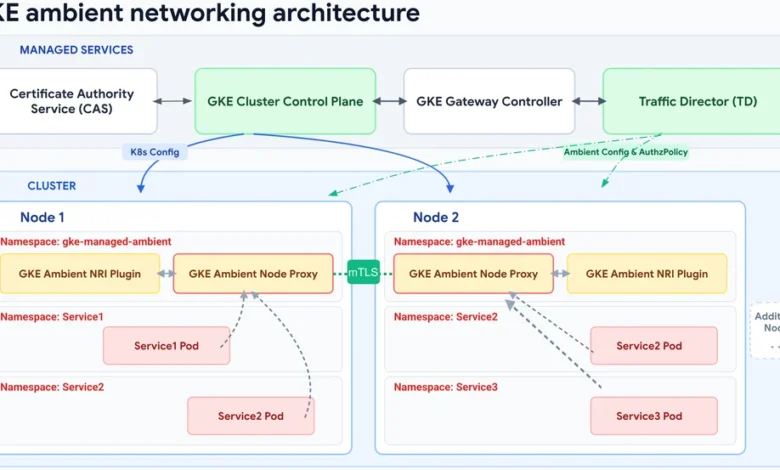
The newly GA ambient networking framework on GKE fundamentally reorganizes the division of labor within a Kubernetes cluster. Instead of embedding proxies within application pods, the architecture shifts networking responsibilities to shared per-node components and robust, managed control plane services.
At the center of this infrastructure is the ambient networking control plane, which orchestrates operations seamlessly across the entire cluster. This control plane is designed to abstract away the underlying complexity of secure communication tunnels and policy enforcement, giving operators a centralized window of control without requiring them to manually configure proxy lifecycles for individual workloads.
Concurrently, several node-level management components operate securely within the dedicated gke-managed-ambient namespace. These components are engineered to handle data-plane traffic redirection and security enforcement efficiently at the node boundary. By consolidating these operations at the node level rather than the pod level, clusters experience a dramatic reduction in redundant resource allocation. A single node-level proxy can efficiently manage traffic for multiple pods residing on that node, preventing the linear scaling penalties that previously plagued large deployments utilizing traditional sidecar models.
Core Functionality and Advanced Capabilities
The integration of these shared architectural components unlocks a robust suite of advanced capabilities tailored for modern enterprise GKE environments. Foremost among these is native support for zero-trust security postures. Through automated mutual TLS (mTLS) encryption, organizations can secure all in-cluster service-to-service communication transparently, without requiring application code modifications or individual sidecar configurations.
Additionally, ambient networking delivers comprehensive traffic observability and telemetry collection. Platform operators gain deep visibility into service health, latency metrics, and traffic flow patterns across the cluster. Because these telemetry functions are handled by the managed infrastructure rather than embedded application libraries or sidecars, performance overhead is kept to a strict minimum, ensuring that monitoring does not degrade application responsiveness.

Traffic routing and management capabilities are similarly enhanced. Operators can implement advanced traffic splitting, retries, timeouts, and fault injection policies uniformly across workloads. This decoupling ensures that developers can focus entirely on writing business logic while platform teams retain absolute governance over network policies, security compliance, and traffic reliability.
Tangible Benefits for GKE Operators and Enterprise Organizations
The transition to a sidecar-less architecture delivers immediate, quantifiable value for GKE operators across multiple operational dimensions. Most notably, the reduction in resource consumption translates directly into cost savings. In traditional sidecar environments, a significant percentage of a cluster’s total compute resources—often ranging from 10% to 30% or more, depending on the workload profile—is consumed solely by proxy sidecars rather than revenue-generating application workloads. By eliminating these redundant resource footprints, ambient networking optimizes cluster utilization and lowers the total cost of ownership (TCO) for running large-scale microservices.
Operational complexity is another critical area of improvement. Managing a fleet of Kubernetes clusters requires rigorous lifecycle management, and updating thousands of individual sidecars during security vulnerability disclosures has historically been a high-stress, time-consuming endeavor for platform teams. With ambient networking, updates and patches to the networking infrastructure are managed centrally via the node components and control plane, drastically shrinking maintenance windows and reducing administrative overhead.
Furthermore, the barrier to entry for adopting service mesh capabilities has been substantially lowered. Organizations that previously hesitated to implement a service mesh due to the steep learning curve, performance overhead, and management complexity of sidecars can now adopt these essential networking features with minimal friction. This democratization of advanced networking empowers smaller engineering teams to operate with the same level of security, observability, and reliability as hyper-scale technology enterprises.
Industry Implications and Future Outlook
The general availability of ambient networking for GKE signals a broader maturation of cloud-native networking strategies. As container orchestration platforms become increasingly ubiquitous in enterprise IT strategies, the industry is pivoting toward architectural models that prioritize efficiency, sustainability, and frictionless developer experiences.
Independent cloud architects and infrastructure analysts have frequently noted that the next generation of cloud computing must address the invisible tax of operational overhead. By removing the mandatory coupling between application containers and proxy sidecars, Google is setting a new benchmark for how managed Kubernetes services should handle service mesh capabilities. This move is expected to exert competitive pressure across the wider cloud ecosystem, accelerating the industry-wide transition toward sidecar-less, ambient service architectures.
Moreover, as organizations increasingly embrace zero-trust security frameworks mandated by regulatory bodies and internal compliance standards, the ability to enforce encryption and access control transparently at the infrastructure level becomes paramount. Ambient networking provides a streamlined pathway to achieving these security objectives without imposing heavy performance penalties or demanding exhaustive code refactoring from development teams.
Getting Started With Ambient Networking on GKE
Organizations looking to modernize their microservice architectures and eliminate the inefficiencies of traditional sidecars can begin evaluating ambient networking within their GKE environments immediately. Google has designed the onboarding process to be as straightforward as possible, aiming to remove historical cost and complexity barriers associated with service mesh adoption.
Platform engineers and developers interested in testing the capabilities, reviewing configuration guidelines, and understanding deployment prerequisites can consult the official documentation provided by Google Cloud at https://docs.cloud.google.com/kubernetes-engine/docs/concepts/ambient-overview.
Additionally, organizations evaluating the financial impact of the transition can review the associated cost structures and resource models via the official GKE service networking pricing page located at https://cloud.google.com/products/gke-service-networking/pricing?e=48754. As production workloads increasingly migrate to this streamlined architecture, ambient networking is poised to redefine best practices for cloud-native networking, offering a scalable, secure, and resource-efficient foundation for the next decade of application development.