AWS Lambda Adds Native GPU Support to Managed Instances for Serverless Machine Learning and High-Performance Computing

Amazon Web Services (AWS) has officially introduced native Graphics Processing Unit (GPU) support for EC2 G-series instances operating on AWS Lambda Managed Instances (LMI). This development marks a significant architectural evolution for serverless computing, enabling enterprises and developers to execute computationally intensive, GPU-accelerated workloads—such as machine learning inference, complex scientific modeling, media transcoding, and large-scale data rendering—without the traditional overhead of managing underlying hardware infrastructure.
By bridging the gap between high-performance hardware and serverless operational models, AWS aims to eliminate the complex provisioning, driver maintenance, and capacity planning historically required to deploy specialized accelerated computing assets.
Main Facts and Operational Mechanics
The newly launched capability allows users to deploy GPU-accelerated functions packaged as Open Container Initiative (OCI) container images. Once an image is referenced, the Lambda service assumes responsibility for automated provisioning, horizontal scaling, and native event integration. Crucially, engineering teams are no longer required to manually reconcile CUDA versions, configure GPU drivers, or orchestrate device plugins and cluster managers.
Under the hood, these functions leverage the infrastructure foundation of Lambda Managed Instances, inheriting Amazon EC2 pricing structures while preserving a serverless abstraction layer. Deployments support container images up to 32 GB, utilize up to 32 GB of NVMe ephemeral storage, and allocate between 2,048 MB and 32,768 MB of memory alongside 3 to 48 GB of accelerator memory. Furthermore, execution environments can handle up to 48 concurrent requests per environment, backed by extended function timeouts of up to 90 minutes for asynchronous and event-source-mapped invocations.
Background Context and Industry Evolution
For years, developers seeking to run GPU workloads faced a difficult architectural dichotomy. On one side, self-managed infrastructure on Amazon EC2 offered raw performance and hardware control, but required substantial engineering investment to configure drivers, write custom scaling logic, and maintain high availability. On the other side, specialized serverless platforms often operated outside native cloud ecosystems, lacking integration with standard event buses, identity management systems, and secure virtual private cloud (VPC) networking.

Simultaneously, cost efficiency remained a persistent industry challenge. Traditional GPU provisioning typically relies on dedicated instances. Because a single application workload rarely saturates an entire GPU continuously, organizations frequently found themselves paying for idle hardware capacity during low-traffic periods.
The integration of GPU support into Lambda Managed Instances addresses these operational hurdles directly. By consolidating multiple concurrent functions onto shared GPU instances and dynamically scaling based on real-time invocation volume, AWS is striving to optimize hardware utilization and reduce wasted compute expenditure for enterprise users.
Implementation Chronology and Practical Workflow
To demonstrate the viability of the new architecture, early adopters and technical evaluators have successfully deployed open-source Large Language Models (LLMs)—such as the instruction-tuned Qwen2.5-1.5B-Instruct model from Hugging Face—using curated vLLM base images provided by AWS.
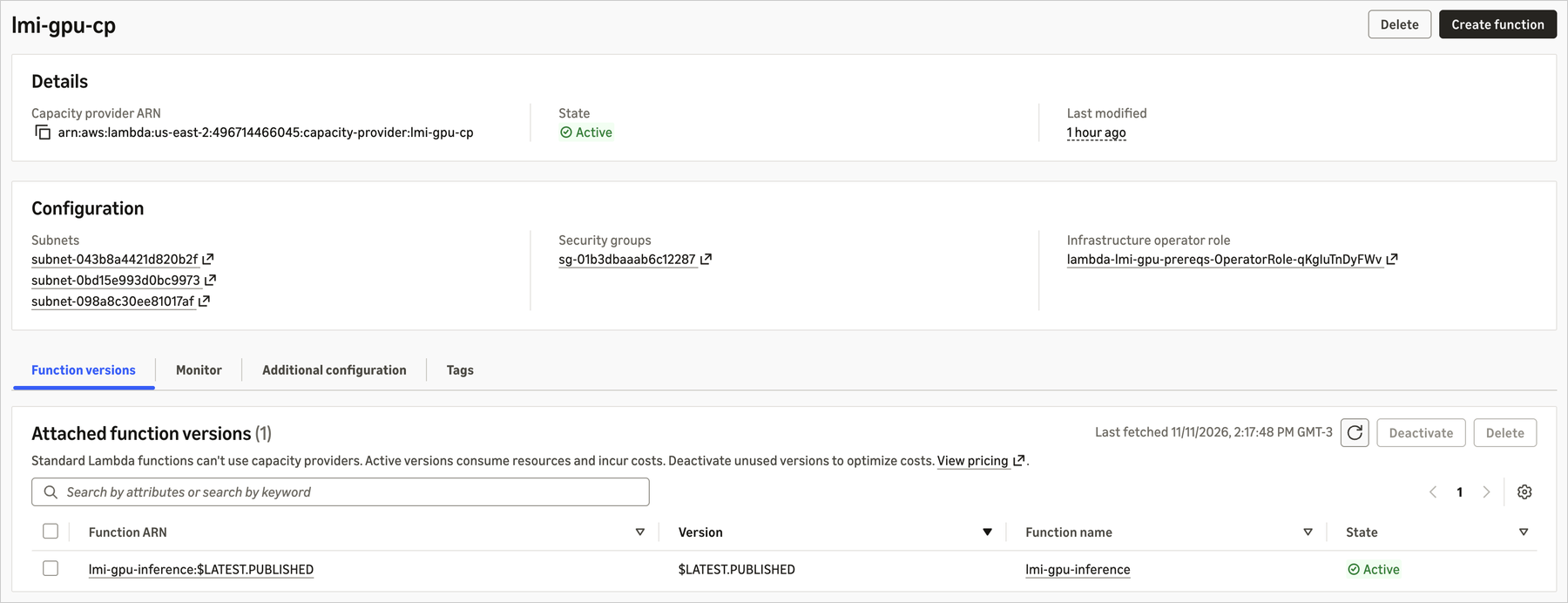
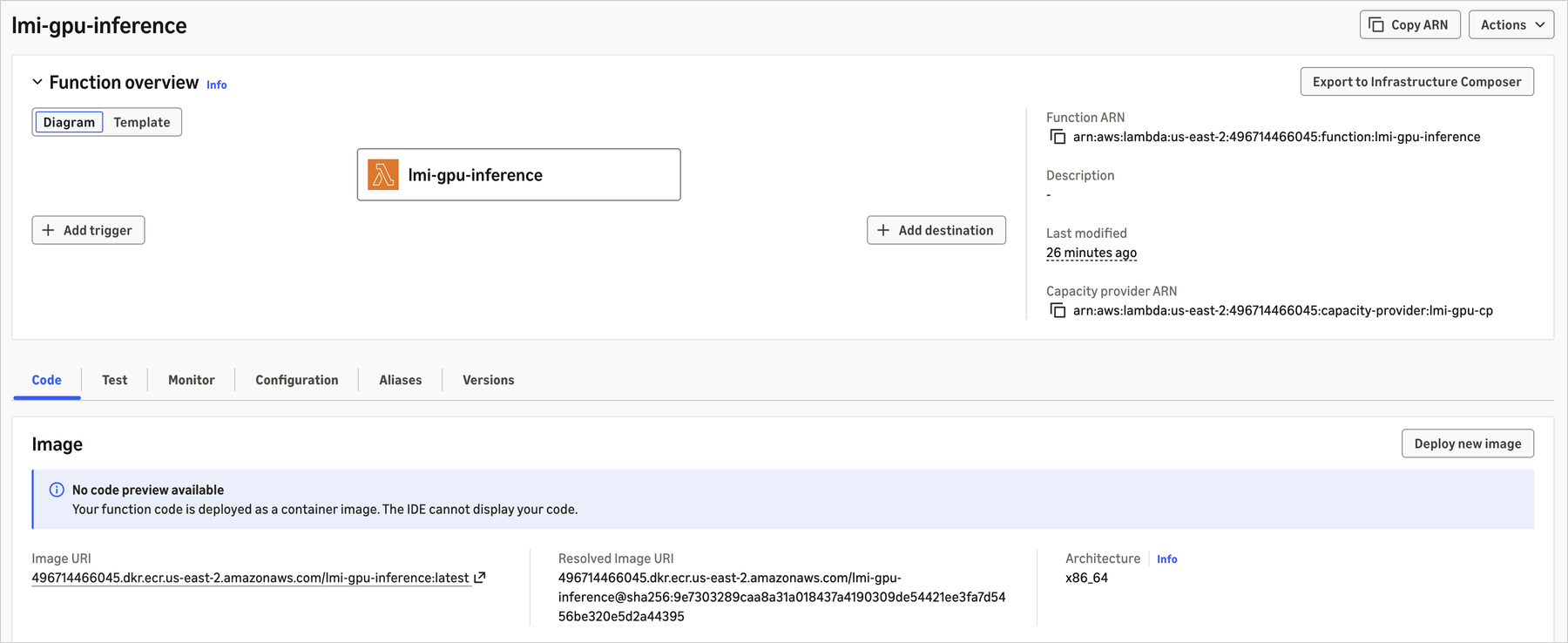
The deployment lifecycle follows a streamlined four-step chronology:
- Capacity Provider Creation: Administrators establish a dedicated capacity provider via the AWS Management Console or CLI, defining allowed instance types (such as g5.2xlarge, g6.2xlarge, or g6e.2xlarge), VPC subnets, security groups, and auto-scaling constraints to mitigate Insufficient Capacity Errors.
- Container Build and Push: Developers build an OCI image utilizing pre-configured AWS base environments—such as
vllm:cudaorpytorch:cuda—which bundle necessary frameworks like PyTorch, Transformers, and the CUDA toolkit without requiring custom server code. The image is subsequently stored in Amazon Elastic Container Registry (ECR). - Function Configuration: A Lambda function is created and linked to the capacity provider. Environment variables, such as
MODEL_ID, point to the desired model repository or an Amazon S3 bucket storing model weights. Seekable OCI (SOCI) lazy loading can be employed to enable execution to begin before the complete container image is downloaded, cutting startup times significantly. - Publishing and Invocation: Publishing a function version triggers initialization, model weight downloading, and engine warm-up during the deployment phase. Consequently, subsequent invocations via standard event sources or OpenAI-compatible application programming interfaces avoid cold-start delays.
Supporting Data and Technical Specifications
The infrastructure supports a broad array of Amazon EC2 G-series instances at general availability, including G4dn, G5, G6, G6f, Gr6, Gr6f, and G6e families. Pricing structures incorporate the underlying EC2 instance fee—which is fully compatible with existing Savings Plans and Reserved Instances—alongside a standard 9.75 percent management fee for GPU instances and baseline Lambda request fees.
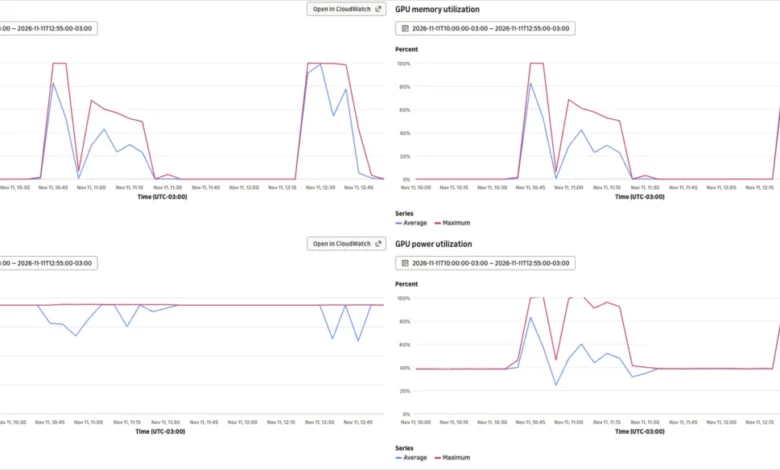
To ensure observability, the service integrates natively with Amazon CloudWatch, surfacing granular metrics including GPU utilization, GPU memory utilization, absolute memory usage, and GPU power consumption. These metrics provide teams with the telemetry required to fine-tune auto-scaling thresholds and analyze accelerator efficiency under concurrent load.
Broader Impact and Implications
The introduction of serverless GPUs is expected to accelerate the adoption of generative AI and machine learning features within application architectures that previously found dedicated GPU infrastructure economically unfeasible. By allowing developers to invoke complex models through standard AWS event triggers—including Amazon S3, Amazon SQS, Amazon API Gateway, and Amazon EventBridge—organizations can automate document processing, real-time media transcoding, and multi-step agentic workflows without maintaining persistent server fleets.
As enterprises continue to seek operational efficiencies in cloud expenditure, the capability to pay strictly for active compute cycles while maintaining the security, compliance, and elasticity of serverless architecture represents a foundational shift in how specialized hardware is consumed across the industry.