Stuff The Internet Says On Scalability For December 2nd, 2022 – High Scalability –

The Era of the Mainframe: Foundations of Digital Logic
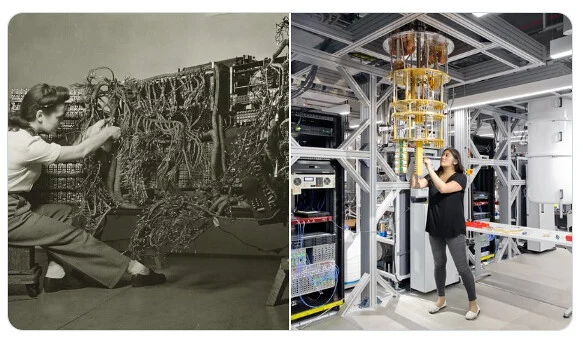
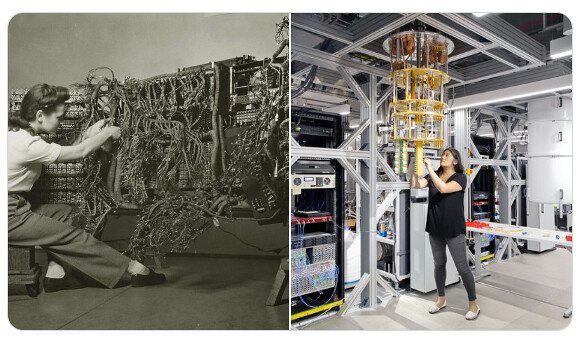
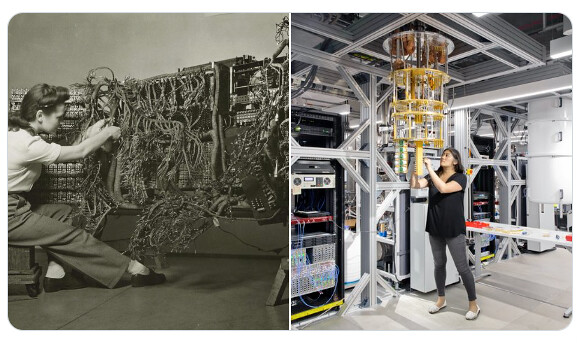
To understand the current state of quantum computing, one must first examine the constraints of the 1950s. In 1958, the computing landscape was dominated by systems like the IBM 700/7000 series. These machines were literal monoliths, occupying entire rooms and requiring massive power grids and specialized cooling systems to prevent the vacuum tubes from overheating. The "wiring" process captured in historical photography refers to the intricate, manual labor required to interconnect logical gates. Each connection was a physical manifestation of a binary decision: a switch was either on or off, representing a single bit of information.
The complexity of these machines was limited by the human capacity to assemble them. As the number of transistors grew, the "tyranny of numbers"—the increasing difficulty of soldering thousands of individual components—threatened to halt the progress of computing. This specific limitation led to the invention of the integrated circuit, which effectively moved the "wiring" from the macro-scale to the microscopic scale on a silicon wafer. This transition catalyzed the era of the microprocessor, leading to the exponential growth described by Moore’s Law.
The Quantum Pivot: Reimagining the Hardware Interface
Fast-forwarding to 2021, the image of an engineer wiring a quantum computer highlights a return to a surprising level of manual dexterity. Modern quantum computers, such as those developed by IBM, Google, and Rigetti, utilize superconducting qubits that must be kept at temperatures near absolute zero to maintain coherence.
The "wiring" seen in modern quantum facilities is not for the sake of basic logic flow, but for the distribution of microwave pulses that manipulate the quantum states of the qubits. Unlike classical bits, which are strictly binary, qubits exist in a state of superposition. The physical architecture required to control these states—massive dilution refrigerators, coaxial cables, and electromagnetic shielding—brings the industry full circle. We have moved from the room-sized mainframe of 1958 to the room-sized cryostat of 2024, yet the goal remains the same: scaling the system to perform operations that were previously deemed impossible.
Chronology of Computational Scaling
The trajectory of high-performance computing can be categorized into four distinct evolutionary phases:
- The Discrete Component Era (1945–1959): Defined by vacuum tubes, patch panels, and manual wiring. Systems were dedicated to specific, limited mathematical tasks such as ballistics and basic census data processing.
- The Integrated Circuit Revolution (1960–1979): The shift toward miniaturization. The ability to etch logic onto silicon allowed for the transition from room-sized computers to the personal computer movement.
- The Distributed and Cloud Era (1980–2015): Computation moved away from local hardware toward hyper-scale data centers. The focus shifted from raw clock speed to network throughput, latency, and massive parallelization.
- The Quantum-Classical Hybrid Era (2016–Present): The current frontier. Researchers are no longer seeking to replace classical computers but to integrate quantum co-processors capable of solving NP-hard problems, such as molecular simulation and cryptographic factoring, that classical systems cannot process in reasonable timeframes.
Supporting Data and Technical Implications
The transition from classical to quantum is not merely a change in hardware; it is a shift in complexity theory. A classical computer with $N$ bits can exist in one of $2^N$ states at any given moment. A quantum computer with $N$ qubits can exist in a superposition of all $2^N$ states simultaneously.
Current industry benchmarks indicate that while a classical supercomputer might take 10,000 years to solve a specific optimization problem, a quantum system—once error-corrected—could theoretically achieve the same result in minutes. However, the "noise" or decoherence rate remains the primary technical hurdle. Current quantum hardware suffers from high error rates, necessitating the development of sophisticated error-correction codes that consume a significant portion of the available qubit count. This is why the modern engineer spends as much time on signal integrity and thermal management as their 1958 predecessor spent on soldering iron reliability.
Official Industry Perspectives
Leading voices in the field, including IBM’s research division and academic institutions like MIT, have noted that the "wiring" stage of quantum development is a necessary phase in the maturation of the technology. As stated by research teams at the IBM Quantum Experience, the transition from "noisy" intermediate-scale quantum (NISQ) devices to fault-tolerant systems requires a fundamental rethinking of hardware interconnects.
Industry analysts observe that we are currently in a "hardware-heavy" phase, where the primary investment is not in software or algorithms, but in the physical infrastructure—the dilution refrigerators and the high-fidelity control electronics. This is reflective of the 1958 era, where the manufacturing process was the primary bottleneck of progress.
Broader Impact on Global Scalability
The implications of this architectural evolution are profound. In 1958, the primary impact was on national defense and scientific research. Today, the impact of high-performance computing—specifically the integration of AI and quantum-ready hardware—touches every facet of the global economy.
- Material Science: Quantum simulations are enabling the discovery of new catalysts for carbon capture and battery storage materials, processes that would require decades of trial-and-error in a traditional laboratory setting.
- Cryptography: The looming capability of quantum systems to break current RSA encryption standards has triggered a global shift toward post-quantum cryptography (PQC). The infrastructure we are building today must be resilient against the computational power of tomorrow.
- Optimization: Financial services, logistics, and supply chain management are increasingly reliant on the "scaling" principles pioneered in the early days of computing, now pushed to their absolute limits by advanced algorithms that require the high-throughput capabilities of modern data centers.
Conclusion: The Persistent Quest for Throughput
The image of the engineer wiring the quantum computer is a powerful reminder that computing is, at its heart, a physical discipline. While software engineers often focus on the abstraction layers, the reality of high-performance computing remains tied to the constraints of thermodynamics, material science, and electrical engineering.
Whether it is a 1958 IBM mainframe or a 2021 quantum processor, the mission remains the same: the mastery of physical matter to process information. As we continue to push the boundaries of what is possible, the lessons of the past—specifically the importance of modularity, reliability, and cooling—remain as relevant as ever. The history of computing is not a series of disconnected inventions, but a continuous, iterative process of refining how we interact with the fundamental logic of the universe. The transition from wires to qubits is not an end, but the beginning of a new chapter in human technical capability.