How ALLEN Secured Student Data and Scaled Zero Trust Across 5,000 Users with Chrome Enterprise Premium

Founded in 1988 in the bustling educational hub of Kota, Rajasthan, ALLEN has grown from a humble beginning into one of India’s premier coaching institutions. Over the decades, the organization has expanded its footprint significantly, currently serving over 400,000 students across more than 350 classroom campuses situated in 78 cities throughout the country. As ALLEN scaled its operations to meet the surging demand for competitive exam preparation, its digital infrastructure expanded in tandem. Today, the institution relies heavily on a complex ecosystem of SaaS applications and multi-cloud environments to deliver educational content, manage administrative workflows, and facilitate communication among its expansive user base.
However, this rapid digital transformation introduced profound cybersecurity and data governance challenges. With a workforce exceeding 5,000 individuals—comprising academic faculty, operational staff, software engineers, external contractors, and a massive population of Bring Your Own Device (BYOD) users—protecting sensitive information became an urgent operational priority. The IT and Cybersecurity Leadership Team at ALLEN recognized that traditional perimeter-based security models were no longer sufficient for an organization where the browser serves as the primary workspace. To safeguard its digital assets, the institution embarked on a strategic overhaul of its security architecture, ultimately standardizing on Chrome Enterprise Premium to establish a robust, browser-level Zero Trust framework.
The Imperative of Protecting Student Personally Identifiable Information
Operating at the scale of hundreds of thousands of students means that ALLEN handles vast amounts of sensitive data on a daily basis. Chief among these concerns is the protection of student personally identifiable information (PII), which flows continuously through the institution’s web applications and cloud services. In recent years, India’s regulatory landscape regarding data privacy has undergone a monumental shift, marked by the introduction and implementation of the Digital Personal Data Protection Act (DPDPA). Under the stringent mandates of the DPDPA, organizations that process digital personal data are held to rigorous accountability standards, facing severe penalties for data breaches or compliance failures.
For an institution as trusted as ALLEN, maintaining regulatory compliance is inextricably linked to preserving brand equity and student trust. A security incident involving compromised PII could have devastating consequences for the organization’s reputation and financial standing. Consequently, the cybersecurity team knew they needed a security solution that could operate directly at the endpoint where data ingestion and interaction occur: the web browser. Securing the browser meant intercepting potential threats before they could infiltrate the broader network or lead to unauthorized data exfiltration.
The Challenge of a Fragmented Browser Estate
Prior to the adoption of Chrome Enterprise Premium, ALLEN struggled with the operational inefficiencies and security blind spots inherent in a mixed-browser environment. Employees and contractors were utilizing a variety of web browsers across disparate operating systems, creating a fragmented digital estate. This diversity made consistent policy enforcement nearly impossible for the IT department. Visibility into user activity across different browsers was limited, leaving the institution vulnerable to emerging web-based threats, phishing campaigns, and accidental data leaks.
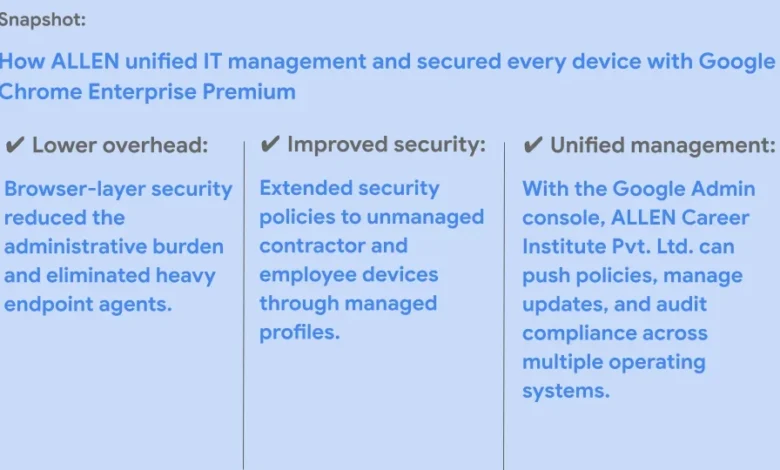
The leadership team initially explored several alternative solutions to achieve standardization across the enterprise. However, each option presented distinct roadblocks. Forcing users to migrate to an unfamiliar browser would have introduced steep learning curves and significant user friction, disrupting daily educational workflows and administrative tasks. Furthermore, many of the alternative security products under consideration carried prohibitively high overhead costs, requiring extensive hardware upgrades or complex software integrations that did not align with the institution’s fiscal strategy. ALLEN needed a streamlined approach that could unify security management without imposing operational burdens on its workforce or straining the IT budget.
A Phased Pilot and Rigorous Evaluation Process
Seeking a seamless path forward, ALLEN initiated a phased pilot of Chrome Enterprise Premium spanning several weeks. The deployment began within the Google Admin console, where the IT and cybersecurity teams rigorously evaluated the platform’s core management capabilities. During this initial testing phase, administrators focused on policy configuration, software deployment, extension controls, and comprehensive reporting mechanisms.
Once the core functionalities were validated and the team gained confidence in the visibility provided by the platform, the rollout was expanded to several hundred users. This pilot group represented a diverse cross-section of the organization’s user base, operating across various environments, including personal BYOD smartphones, corporate Windows laptops, and macOS systems. During this testing window, the institution deployed several key security features:
- Safe Browsing and URL filtering for immediate, real-time threat protection against malicious websites.
- Data Loss Prevention (DLP) rules designed to restrict unauthorized copy-and-paste actions, file downloads, and data uploads on sensitive SaaS applications.
- Context-aware access controls to restrict application entry based on the specific security posture of the accessing device.
The proof of concept yielded overwhelmingly positive results across all predefined evaluation criteria. The IT department observed consistent policy enforcement without gaps, a measurable reduction in risky-site visitations and hazardous download events, and remarkably minimal friction reported by end users. Furthermore, the centralized dashboard provided administrators with unprecedented visibility into managed user activity, transforming how the security team monitored organizational health.
Achieving a True Zero Trust Architecture
The decisive turning point in ALLEN’s security modernization journey occurred when leadership realized that Chrome Enterprise Premium could serve as the foundational backbone for a true Zero Trust architecture. In a modern educational institution where remote work, hybrid learning, and personal device usage are commonplace, traditional network perimeters have effectively dissolved. Zero Trust operates on the core principle of "never trust, always verify," ensuring that access to resources is continuously evaluated based on identity, device posture, and contextual signals.
With Chrome Enterprise Premium integrated into its daily operations, access decisions at ALLEN now occur dynamically in real time. For example, a faculty member logging in from a school-managed, fully patched laptop enjoys seamless, unrestricted access to all necessary teaching materials and administrative dashboards. However, if that same educator accesses the platform from a personal smartphone to review student submissions, the security controls automatically adapt. While the educator can view the materials securely, downloads, file transfers, and clipboard sharing remain strictly locked down. This dynamic adaptability delivers airtight data protection without disrupting daily instruction or diminishing the user experience.
Simplifying Infrastructure and Eliminating Legacy Tools
Before standardizing on Chrome Enterprise Premium, maintaining security across a diverse workforce required complex infrastructure, including the deployment of resource-heavy Virtual Desktops (VDIs) and a fragmented array of standalone security tools. These legacy solutions were not only expensive to maintain but also notoriously difficult
to scale, particularly when onboarding external contractors or accommodating the massive influx of BYOD users at the beginning of each academic term.
By shifting security controls directly into the browser, ALLEN successfully eliminated the need to install cumbersome, heavy security software on every individual computer. This architectural shift drastically simplified endpoint management. IT administrators can now seamlessly apply uniform security policies to personal devices utilized by contractors and temporary employees alike. Whether an employee operates on Windows, macOS, ChromeOS, iOS, or Android, all system updates, security policies, and audit reports are managed effortlessly from a single, centralized Google Admin console.
Smart Access Controls and Enhanced Data Protection
The integration of Chrome Enterprise Premium ensures that institutional resources are only accessed when conditions are verified as entirely safe. Every time an individual attempts to log into the network, the system evaluates critical risk factors, ensuring that unauthorized or compromised endpoints are automatically blocked from entering sensitive cloud environments.
In addition to intelligent access management, ALLEN leverages Chrome Enterprise’s native security features to protect end users while they navigate the web. Technologies such as Safe Browsing sandboxing, advanced site isolation, and automated background updates work in tandem to neutralize web-based threats before they can execute. These built-in safeguards have definitively disproven the long-standing misconception that robust enterprise security must inherently come at the expense of business agility and speed. Employees across the institution now conduct their daily tasks without security-induced interruptions, while the IT department maintains a clear, unified audit trail across every connected device. This balance of efficiency and security not only maximizes organizational productivity but also provides foundational support for ALLEN’s ongoing regulatory compliance initiatives under the DPDPA.
Broader Implications and Industry Impact
The successful digital transformation at ALLEN highlights a broader, industry-wide shift in how large organizations approach endpoint security in an increasingly cloud-native world. As educational institutions, enterprises, and public sector organizations alike transition away from legacy perimeter defenses toward browser-centric architectures, the demand for integrated solutions like Chrome Enterprise Premium continues to accelerate globally. Prominent international organizations, such as retail giant Mercari, have similarly reported dramatic efficiency gains and cost reductions exceeding 50 percent following the adoption of similar browser-based security paradigms.
For ALLEN, the transition represents a watershed moment in institutional resilience. By securing the point of interaction where users meet the cloud, the organization has future-proofed its digital infrastructure against sophisticated cyber threats while upholding its legal and moral obligations to protect student data. As the institution continues to expand its physical and digital footprint across India, its modern, browser-based Zero Trust framework ensures that academic excellence and digital safety will continue to advance hand in hand.
Related posts: