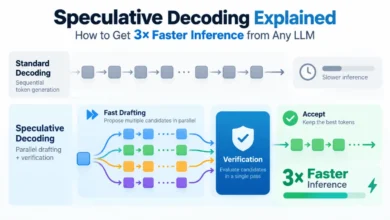
Autoregressive decoding has long been the standard mechanism for generating text with large language models (LLMs), yet it remains fundamentally inefficient due to its sequential nature. In traditional setups, a target model generates one token at a time, a process that requires loading a massive set of model weights into GPU memory for every single predicted token. While the computational power of modern GPUs is immense, the bottleneck often shifts to memory bandwidth, where the time spent transferring model weights from high-bandwidth memory (HBM) to the compute cores far exceeds the time spent on the actual arithmetic operations. Speculative decoding has emerged as a transformative architectural approach to bypass this limitation, significantly reducing latency by decoupling the token proposal process from the rigorous verification process.
The core premise of speculative decoding involves two distinct models: a "draft" model, which is typically a lightweight, high-speed architecture, and a "target" model, which is a larger, more precise model. The draft model acts as a precursor, predicting a short sequence of $n$ tokens in a fraction of the time it would take the target model to generate a single token. Once these candidate tokens are proposed, the target model performs a single, parallel forward pass to verify the entire sequence. If the target model agrees with the draft’s choices, multiple tokens are effectively "emitted" in the time it would normally take to produce one. If the target model disagrees, it identifies the divergence point, discards the incorrect draft tokens, and uses its own internal calculation to correct the sequence.
The Evolution of Inference Optimization
The concept of speculative decoding gained significant traction around 2023, primarily driven by researchers at Google and DeepMind who identified that LLM generation was increasingly constrained by memory throughput rather than raw compute capacity. As model sizes scaled into the hundreds of billions of parameters, the "one-token-at-a-time" paradigm became a major hurdle for real-time applications such as chatbots, code assistants, and automated agents.
Historically, LLM inference relied on simple greedy decoding or top-k sampling. However, the introduction of speculative techniques introduced a "Draft-and-Verify" workflow. In a typical implementation, the draft model generates a sequence of tokens—often between four to ten—which are then passed into the target model’s KV cache. The target model evaluates these candidates simultaneously using causal attention masks. This allows the model to compute probabilities for the entire draft string in one pass. This shift represented a major milestone in AI infrastructure, moving away from purely serial processing toward a hybrid model that balances speed and accuracy.
Mechanisms of Verification: Greedy vs. Sampling
The integrity of the output is a primary concern for practitioners. In greedy decoding—where the model always selects the highest-probability token—speculative decoding is functionally lossless. Because the draft model is only permitted to propose candidates that the target model would have chosen itself, the final output sequence remains identical to what a standard serial decode would produce.
In contrast, sampling-based speculative decoding introduces a more complex probabilistic framework. Because sampling is inherently stochastic, the verifier cannot simply match tokens. Instead, it utilizes an acceptance and correction rule. If the draft model proposes a token $x$, the target model accepts it with a probability defined by $min(1, p(x)/q(x))$, where $p$ is the target model’s probability distribution and $q$ is the draft model’s distribution. Should the token be rejected, the system samples a replacement from a corrected distribution, ensuring the final output remains statistically consistent with the target model’s original probability density function. This mathematical rigor is what allows speculative decoding to maintain high quality while significantly accelerating throughput.
Implementation and Performance Metrics
The practical application of these techniques is now available through major open-source libraries such as Hugging Face’s transformers. Developers can leverage the assistant_model parameter to offload token generation to a secondary, smaller checkpoint. In standard tests using models like SmolLM-1.7B as the target and SmolLM-135M as the assistant, observers frequently report speedups in the range of 1.5x to 2.5x in terms of tokens generated per second.
However, success is highly dependent on the "acceptance rate"—the ratio of draft tokens that the target model ultimately validates. Measuring this requires tracking the number of tokens drafted versus those accepted, normalized against the number of target model passes. Data scientists often utilize the following metrics to evaluate efficacy:
- Acceptance Rate: The raw percentage of draft tokens that match the target model’s output.
- Accepted Tokens Per Pass: A measure of how many tokens are effectively "cleared" during a single, expensive target model execution.
- Draft-to-Target Latency Ratio: The overhead cost of the draft model relative to the target model’s compute requirement.
If the acceptance rate drops too low, the computational cost of the draft model becomes a liability rather than an asset. Furthermore, cache management is critical. Every time a candidate is rejected, the system must perform cache bookkeeping to roll back the KV cache to the last known valid state. If the implementation is inefficient, these "rollbacks" can negate the performance gains achieved by the speculative draft.
Broader Implications and Strategic Challenges
The shift toward speculative decoding has profound implications for AI deployment. By enabling faster inference on existing hardware, organizations can reduce the total cost of ownership (TCO) for large-scale deployments. However, the strategy is not a universal solution. Speculation is most effective when the target model is significantly larger than the draft model and when the underlying hardware is memory-bandwidth bound.
In scenarios where the target model is already highly optimized—or where the batch size is so large that memory bandwidth is already fully saturated by the primary workload—speculative decoding may offer diminishing returns. Additionally, there is the challenge of "proposer variety." While a small autoregressive model is the standard choice, researchers are exploring alternative methods, including:
- N-gram Proposers: Using static, history-based n-grams to predict the next tokens, which requires zero additional model weights.
- Trained Heads: Specialized "heads" added to a model that predict multiple tokens at once, reducing the need for a secondary model.
- Feature Predictors: Utilizing hidden state projections to guess future tokens without running a full second model pass.
These alternatives represent the cutting edge of research, aiming to reduce the "memory footprint" of the draft process itself.
Future Outlook and Conclusion
The current state of speculative decoding demonstrates that we are transitioning from a focus on training efficiency to a focus on inference efficiency. As we look toward the next generation of AI services, the integration of these techniques into production engines is becoming standard practice. For instance, high-performance inference servers like vLLM and TensorRT-LLM have begun integrating advanced speculative kernels that handle cache manipulation at the hardware level, further reducing the latency overhead.
Ultimately, the goal is to create a seamless user experience where large, high-reasoning models respond with the same immediacy as smaller, less capable ones. By offloading the "guesswork" of language generation to faster, auxiliary models while maintaining the intellectual rigor of the target model through formal verification, the industry is successfully bridging the gap between accuracy and performance. While speculative decoding is not a panacea, it is an essential component of the modern inference stack, providing a robust, mathematically sound mechanism to maximize the utility of constrained computational resources. As hardware continues to evolve, the refinement of these algorithms will likely remain a central pillar of AI infrastructure development for the foreseeable future.