The Chief Technology Officer and Co-Founder of RansomwareHelp Has Been Charged with Wire Fraud Following an Extensive FBI Sting Operation

The digital landscape has long been plagued by the dual threats of ransomware extortion and the predatory entities that capitalize on the resulting panic. This week, federal authorities in Rhode Island unsealed an indictment that exposes a sophisticated, six-year-long fraud scheme operated by Juan Ricardo Palacio Escobar, a 52-year-old dual citizen of the United States and Colombia. As the chief technology officer and co-founder of RansomwareHelp, a Florida-based company, Palacio allegedly orchestrated a systematic deception, claiming to possess proprietary cryptographic tools capable of bypassing ransomware encryption. In reality, investigators found that the company was merely acting as an unethical middleman, paying hackers for decryption keys and charging desperate victims massive markups for "technical services" that were never actually performed.
The indictment, which follows a months-long investigation involving undercover FBI agents posing as both victims and threat actors, marks a significant turning point in the U.S. Department of Justice’s campaign to dismantle fraudulent cybersecurity firms that profit from the misery of ransomware victims.
The Anatomy of a Deception
RansomwareHelp positioned itself in the marketplace as a beacon of integrity, explicitly advising potential clients to "Do not pay the ransom!" The company’s marketing collateral was replete with pseudo-technical jargon, promising "100% data recovery" and claiming to employ a team of 80 experts in forensic analysis and reverse engineering. The website boasted of 28 years of industry experience and asserted that their proprietary algorithms could restore locked servers without the need for engaging with extortionists.

However, the reality, as uncovered by the FBI, was a stark contradiction. When contacted by victims, Palacio and his associates would initiate a "diagnostic assessment," for which they charged exorbitant fees. Behind the scenes, Palacio would reach out to the very ransomware groups he claimed to oppose. He would negotiate a price for the decryption key, secure the tool, and then present the victim with a bill that far exceeded the actual ransom demand.
Chronology of the FBI Sting Operation
The unraveling of the RansomwareHelp operation was the result of a meticulously planned federal sting. Investigators established a fictitious victim company and a corresponding "ransomware group" to monitor how the firm handled extortion demands.
The sting unfolded in a series of calculated steps:
- Initial Contact: The FBI’s fake victim company contacted RansomwareHelp, reporting a simulated ransomware infection.
- The Facade: RansomwareHelp responded with its standard script, reiterating its policy against paying ransoms and emphasizing its "advanced" cryptographic recovery capabilities.
- The Secret Negotiation: Shortly thereafter, Palacio contacted the FBI’s fake ransomware group, requesting the lowest possible price for a decryption key. The FBI provided a price of 0.2 Bitcoin (approximately $13,000 at the time).
- The Markup: Less than 48 hours later, Palacio informed his "client" that the diagnostic assessment was complete and that restoration would cost $13,260.
- The Double-Cross: In a move to maximize his margins, Palacio contacted the FBI’s fake hacker group again, successfully negotiating the price down to $4,000. He ultimately charged the victim $16,010—consisting of a $2,750 diagnostic fee and a $13,260 "recovery" fee—all while paying only a fraction of that amount to the actual attackers.
The Role of Remote Access and Data Erasure
The investigation also shed light on why RansomwareHelp insisted on gaining "unrestricted remote access" to victim networks. Paul Ihme, co-founder of the cybersecurity firm Soteria, highlighted that this practice was not for diagnostic purposes, but for the destruction of evidence.

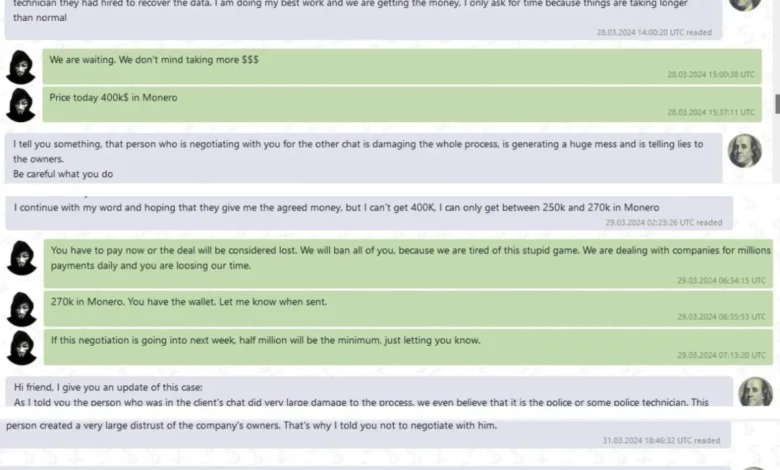
By using remote desktop software such as AnyDesk, the company was able to delete ransom notes left by attackers across the victim’s infrastructure. Ransom notes typically contain unique IDs, contact methods, and instructions for negotiating directly with the threat actors. By removing these, RansomwareHelp ensured the victim remained isolated, ignorant of the fact that the firm was already in contact with the attackers. In one instance, evidence showed RansomwareHelp pleading with the Lockbit ransomware group to not disclose the negotiation status to the client, fearing that the victim might bypass them and deal directly with the hackers to save money.
Industry Impact and Technical Farcicality
The technical claims made by RansomwareHelp were described by cybersecurity professionals as "patently farcical." In a 2024 proposal sent to an accounting firm, the company claimed to be using "510 preconfigured forensic servers" and "brute force processes" to crack encryption. Analysis by experts revealed that the firm was citing irrelevant password-hashing algorithms, such as SHA-256, to explain the decryption of symmetric encryption used in ransomware.
"If it were really true these guys could decrypt any ransomware out there, this guy would be a billionaire," Ihme remarked. "They were going after people who don’t have any technical knowledge, are desperate, and don’t have anyone advising them about how any of this stuff works."
The implication for the broader cybersecurity industry is profound. Small to medium-sized businesses (SMBs), which lack internal security teams, are often the primary targets of these fraudulent services. By preying on the urgency of these organizations, firms like RansomwareHelp not only defraud their clients of hundreds of thousands of dollars but also potentially jeopardize the data recovery process by delaying direct communication with attackers who might otherwise have provided a valid key.

A Pattern of Federal Prosecution
The case against Palacio is part of an intensifying crackdown by the U.S. government on "remediation" firms that engage in illicit collusion. The Department of Justice has recently pursued several high-profile cases involving similar fraudulent activity:
- Edward Dubrovsky (October 2026): An executive at Canadian firm Cybersteward, Dubrovsky was charged with cyber extortion and conspiracy. The case remains partially sealed, but it signals the government’s reach into international cybersecurity service providers.
- Zohar Pinhasi (October 2026): The CEO of MonsterCloud was charged with wire fraud for allegedly paying $8 million to hackers while billing his clients $19 million for the same services.
- Angelo Martino (July 2026): A Florida-based negotiator sentenced to 70 months in prison for actively conspiring with the Blackcat/ALPHV group. Unlike the other defendants, Martino was accused of providing confidential client strategy information to the hackers to help them squeeze more money out of victims.
Broader Implications and Moving Forward
The emergence of these cases suggests that the "ransomware remediation" sector—once a loosely regulated gray market—is coming under intense federal scrutiny. Legal experts suggest that companies should exercise extreme due diligence when vetting third-party responders.
The consequences for victims are significant. Not only are they subject to financial loss, but they also risk the permanent loss of proprietary data if a fraudulent firm mishandles the negotiations. The FBI’s recent actions serve as a warning: the demand for professional help during a ransomware crisis is legitimate, but the industry is currently rife with entities that prioritize profit over the stability and security of their clients.
As the legal proceedings against Juan Ricardo Palacio Escobar move forward, the case will likely serve as a foundational warning to the industry. For the cybersecurity community, the message is clear: transparency in the negotiation process and technical legitimacy are the only safeguards against the predatory practices that have, until now, operated largely in the shadows. For businesses, the advice from law enforcement remains consistent—engage only with reputable, established cybersecurity firms and, whenever possible, involve federal authorities at the earliest stages of an incident.