Abbott Laboratories Investigates Dual Cybersecurity Incidents Amidst Extortion Claims and Data Breach Allegations


Abbott Laboratories, a global healthcare leader, is currently grappling with two distinct cybersecurity incidents, confirming unauthorized access to internal legacy Exact Sciences systems within its Cancer Diagnostics business and simultaneously investigating a separate claim of a breach affecting its LabCentral portal, allegedly resulting in the theft of company data. These incidents highlight the escalating and complex cyber threats facing the critical healthcare and medical technology sectors.
The Cancer Diagnostics Breach: ShinyHunters’ Extortion Threat
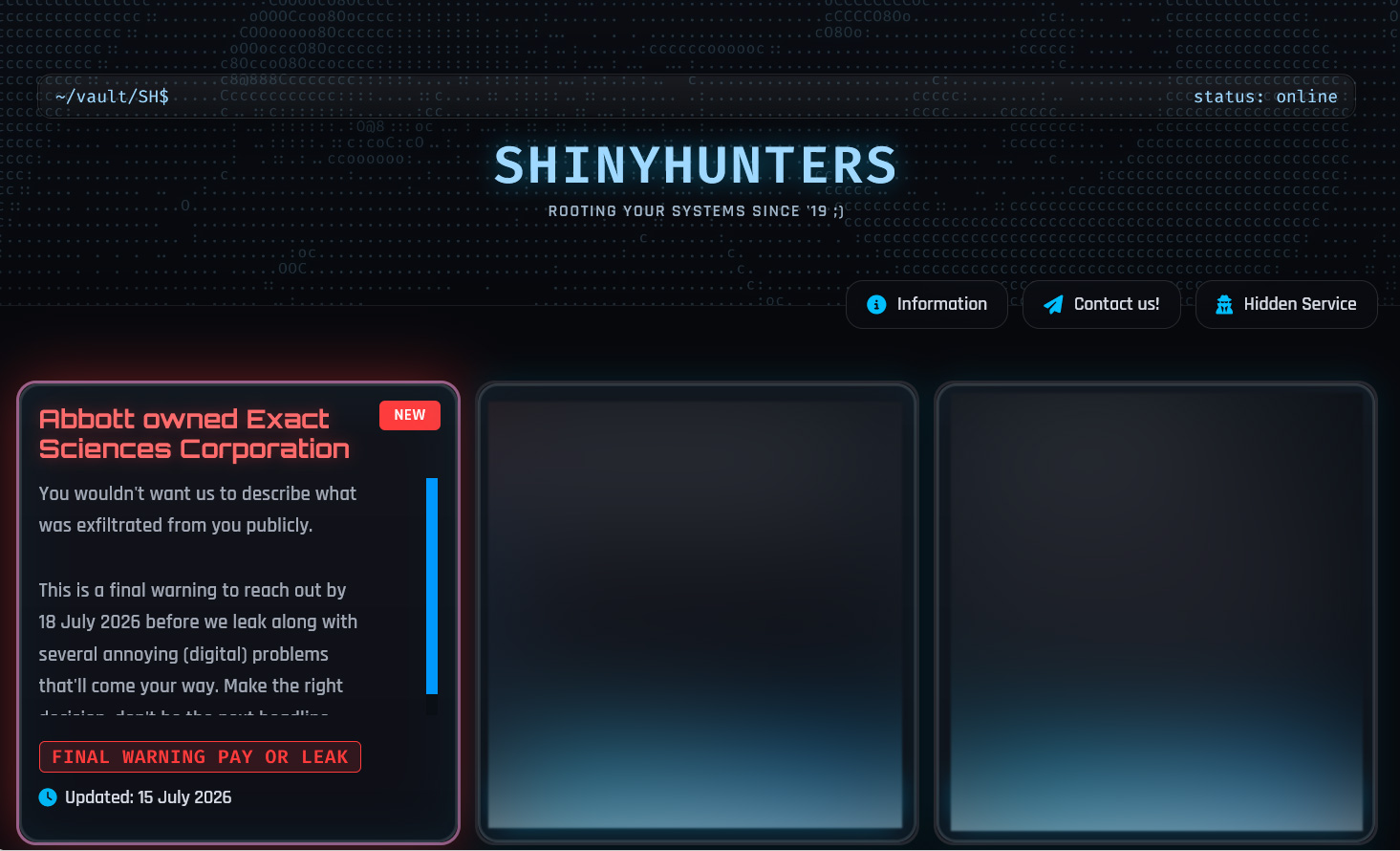
The first incident came to light following an announcement by the notorious ShinyHunters extortion gang, which added Abbott to its data leak site. The group initially threatened to publish purportedly stolen data after July 18, 2026, if negotiations with the company did not commence, a deadline subsequently extended to July 21, 2026. This public pressure tactic is a hallmark of the ShinyHunters group, known for its aggressive approach to data exfiltration and extortion.
Upon inquiry from BleepingComputer regarding the alleged ShinyHunters incident, Abbott directed the publication to an official statement on its website. The company acknowledged the compromise, stating, "Abbott is investigating a cyber incident in which there was unauthorized access to a limited number of internal systems in our Cancer Diagnostics business only." The statement further assured that "This does not impact any business operations, product or product availability, manufacturing or lab operations, or our ability to serve patients." Abbott emphasized that the security incident had not affected any other Abbott businesses or systems, clarifying that the compromised legacy Exact Sciences systems are distinct and separate from Abbott’s broader IT infrastructure.
According to ShinyHunters, their access was reportedly gained through a sophisticated vishing (voice phishing) attack targeting several Abbott employees in mid-June. This social engineering tactic, which involves tricking individuals over the phone into revealing sensitive information or performing actions, allegedly allowed the threat actors to compromise a Microsoft Entra single sign-on (SSO) account. With this compromised SSO credential, the group claimed to have subsequently gained unauthorized access to internal systems.
ShinyHunters has a documented history of conducting social engineering campaigns since last year, specifically targeting employees’ Microsoft Entra, Okta, and Google SSO accounts. Their typical modus operandi involves leveraging initial SSO account access to then exfiltrate data from a wide array of connected SaaS applications. These often include critical business platforms such as Salesforce, Microsoft 365, Google Workspace, SAP, Slack, Adobe, Atlassian, Zendesk, and Dropbox, among others. This strategy allows them to maximize data collection from a single point of entry, exploiting the interconnectedness of modern enterprise IT environments.

When pressed for details on the allegedly stolen data, ShinyHunters claimed to have exfiltrated information from various Abbott systems, including Microsoft Entra, ServiceNow, SharePoint, Databricks, and Coupa. The scope of the claimed data theft is extensive, encompassing internal documents, contracts, and customer information. More alarmingly, the threat actor asserted that it had stolen over 30 million rows of customer personally identifiable information (PII) from multiple datasets. This PII reportedly includes names, email addresses, phone numbers, physical addresses, dates of birth, and more than one million Social Security numbers. Furthermore, the group claimed to have obtained over 22 million client notes containing sensitive doctor-patient conversations, more than 20 million medical orders, and numerous customer agreements and non-disclosure agreements (NDAs).
However, BleepingComputer has not independently verified these claims regarding the volume or nature of the stolen data. The discrepancy between the threat actor’s claims and Abbott’s initial assessment of "limited number of internal systems" and no material impact underscores the challenge in accurately assessing the full scope of a breach in its early stages.
ShinyHunters’ Growing Focus on Medtech
The targeting of Abbott Laboratories by ShinyHunters is not an isolated incident but rather part of a discernible trend of the extortion group increasingly focusing its efforts on medtech companies. Over the past year, several prominent organizations in the healthcare technology sector have fallen victim to the group’s activities. These include Medtronic, a leading medical device company, OneMedical, a primary care provider, and AdaptHealth, a provider of home healthcare equipment. Investigations by BleepingComputer also revealed that ShinyHunters was responsible for the iRhythm data breach and subsequently targeted Stryker shortly after that company recovered from a destructive Iranian data-wiping attack. This pattern suggests a strategic shift by the group, indicating a recognition of the high value of data held by medtech firms, the critical nature of their operations, and potentially, a perceived vulnerability in their cybersecurity postures.
Alleged Breach at LabCentral Customer Portal: ShadowByt3$’s Claims
Simultaneously, Abbott is contending with a separate cybersecurity claim from another threat actor, identified as ShadowByt3$. This group contacted BleepingComputer, asserting that it had successfully breached Abbott’s Core Laboratory diagnostics business through its LabCentral customer portal.
ShadowByt3$ claimed to have accessed the LabCentral portal by utilizing compromised customer credentials, identifying what they described as a "weak point" within the environment. The threat actor stated that the initial breach occurred on July 4, 2026, after which they systematically exfiltrated files by targeting API endpoints over a period of time.
Unlike the ShinyHunters incident, ShadowByt3$ explicitly stated that no customer data was stolen in this particular breach. However, they claimed to have obtained sensitive business documents and intellectual property. The alleged stolen data includes critical operational and regulatory documentation such as CE manufacturing certificates, operation manuals, technical specifications, regulatory documentation, product requirement archives, calibrator value assignments, and assay files, along with other product documentation related to Abbott’s laboratory diagnostic systems. As purported proof of the intrusion, ShadowByt3$ provided BleepingComputer with screenshots and a file listing.
In response to these claims, Abbott confirmed to BleepingComputer that it was aware of the "potential" cyber incident involving LabCentral. However, the company disputed the threat actor’s characterization of the data’s sensitivity. An Abbott spokesperson clarified, "LabCentral is an externally facing third-party hosted portal used by Abbott’s core laboratory diagnostics business. It houses publicly available technical product reference documents, including operating manuals, troubleshooting checklists and product specifications, and does not contain proprietary/sensitive customer or business information." This statement suggests that while an intrusion might have occurred, the impact on sensitive data or intellectual property might be less severe than claimed by ShadowByt3$.
As of the current reporting, neither ShinyHunters nor ShadowByt3$ has publicly released the data they claim to have stolen from Abbott, indicating ongoing negotiations or a strategic delay.
Abbott’s Broader Response and Industry Implications
In the wake of these incidents, Abbott Laboratories has affirmed its commitment to robust incident response protocols. The company stated it immediately activated its incident response procedures upon learning of the first incident, engaging specialized cybersecurity experts to assist with investigations and remediation efforts. Furthermore, law enforcement agencies have been notified, indicating the seriousness with which Abbott is treating these breaches.
The company’s repeated assurances that these incidents do not impact any business operations, product or product availability, manufacturing or lab operations, or its ability to serve patients are crucial for maintaining public and investor confidence. Abbott also stated that it does not anticipate either incident will have a material impact on its business or financial results, a key metric for stakeholders.
These incidents, however, underscore the persistent and evolving threat landscape facing the healthcare and medical technology industries. Healthcare organizations are prime targets for cybercriminals due to the immense value of patient data (PII, PHI, financial information), the critical nature of their services, and often, the complex, interconnected, and sometimes legacy IT infrastructures that are challenging to secure comprehensively. A single patient record can fetch a significant price on the black market, making healthcare data highly attractive to cybercriminals. According to various industry reports, the healthcare sector consistently experiences some of the highest costs associated with data breaches, often due to the extensive regulatory compliance requirements and the sensitive nature of the data involved.

The use of vishing and the compromise of SSO accounts, as claimed by ShinyHunters, highlights a critical vulnerability in many organizations: the human element. Even with advanced technical defenses, employees can be tricked into inadvertently providing access, making robust security awareness training and multi-factor authentication (MFA) crucial lines of defense. The fact that the initial breach for the Cancer Diagnostics business targeted "internal legacy Exact Sciences systems" also points to the challenges of integrating and securing disparate IT environments following mergers and acquisitions, where older systems might not meet the same security standards as newer infrastructure.
For the LabCentral incident, the claims by ShadowByt3$ of exfiltrating technical specifications and product documentation, even if not classified as proprietary by Abbott, could still pose risks. Such information, even if publicly available, could potentially be used by competitors for reverse engineering or by malicious actors to identify vulnerabilities in Abbott’s products.
Conclusion: A Persistent Cybersecurity Challenge
Abbott Laboratories’ current situation serves as a stark reminder of the persistent and multifaceted cybersecurity challenges faced by major corporations, especially those in critical sectors like healthcare. The dual nature of these incidents—one involving a high-profile extortion group with claims of extensive PII theft and the other concerning a separate actor targeting technical documentation—illustrates the diverse motivations and tactics employed by cybercriminals.
As investigations continue, the full extent of the impact of these breaches will become clearer. Beyond the immediate financial and operational implications, the long-term effects on reputation, patient trust, and regulatory scrutiny will be closely watched. These events will undoubtedly prompt Abbott, and likely other organizations in the medtech space, to further enhance their cybersecurity defenses, review third-party vendor risks, and reinforce employee security awareness programs to mitigate future threats in an increasingly hostile digital environment. The ongoing vigilance and adaptation to new attack vectors remain paramount for safeguarding sensitive data and maintaining operational integrity in the face of sophisticated cyber adversaries.