OpenAI GPT-6 Astra is Now Generally Available on Amazon Bedrock, Bringing Advanced Multimodal and Reasoning Capabilities to Enterprise Workflows

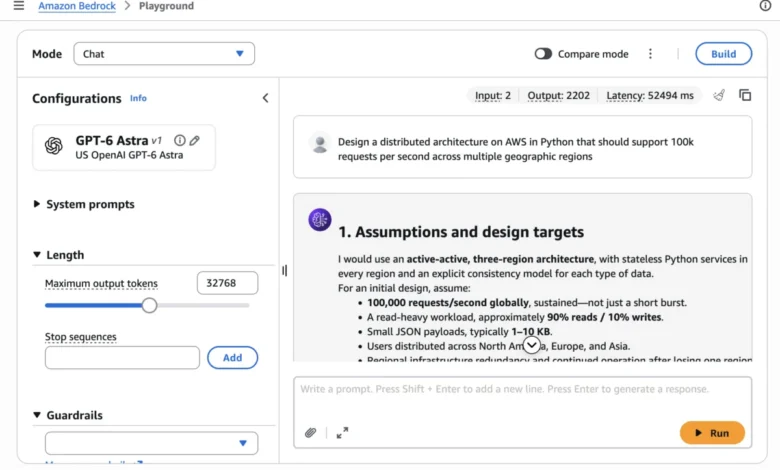
The crisp autumn air of mid-September in New York City has historically signaled a period of intense activity across the technology sector, and Amazon Web Services (AWS) is no exception. This week marks a significant milestone in enterprise cloud computing and artificial intelligence integration with the official general availability of OpenAI’s flagship frontier model, GPT-6 Astra, on Amazon Bedrock. This strategic deployment bridges OpenAI’s most sophisticated foundational model to date with the robust security, scalability, and governance framework that enterprise organizations demand from cloud infrastructure.
For developers, system architects, and corporate decision-makers, the integration represents a major step forward in how large language models (LLMs) can be deployed within secure, compliant corporate environments. By leveraging the comprehensive capabilities of Amazon Bedrock, enterprises can now integrate advanced reasoning, professional-grade content generation, and sophisticated computer and browser-use automation directly into their mission-critical workflows.
Main Facts of the Integration
The arrival of GPT-6 Astra on Amazon Bedrock introduces a series of powerful capabilities designed to address the most demanding corporate use cases. As OpenAI’s most capable model to date, GPT-6 Astra is engineered to deliver deeper, more nuanced reasoning and judgment than its predecessors. This makes it exceptionally well-suited for complex cognitive tasks that require multi-step logic, strategic analysis, and high-level problem-solving.
One of the most notable technical specifications of the new offering is its massive context window, which supports up to 1 million input tokens. This expansive capacity allows organizations to feed entire codebases, multi-volume legal contracts, extensive financial audits, or vast repositories of internal documentation directly into the model. Users can then prompt the system to analyze, synthesize, and reconcile competing inputs across disparate documents without suffering from the context-loss limitations that plagued earlier generations of AI models.
Furthermore, GPT-6 Astra introduces advanced computer and browser-use functionalities. Unlike traditional models that merely process text and generate responses, Astra is capable of interacting directly with software interfaces and web browsers. This enables automated workflows where the AI can execute complex, multi-application tasks—such as gathering data from legacy web portals, populating enterprise resource planning (ERP) systems, and validating outputs against compliance standards.
Businesses can access GPT-6 Astra through standard, supported Amazon Bedrock application programming interfaces (APIs). Additionally, administrators can configure enterprise-grade environments such as ChatGPT Work and Codex to utilize the model directly on Amazon Bedrock. To support these deployments, OpenAI has rolled out new enterprise plugins for ChatGPT Work, extending Astra’s browser-automation capabilities across widely used business applications.

Chronology and Development Timeline
The integration of advanced OpenAI models into AWS ecosystems follows a rapid and deliberate trajectory of collaboration between cloud providers and frontier AI labs. Over the past several years, the race to democratize access to generative AI while maintaining enterprise-grade safety has reshaped the software development lifecycle.
The foundation for this week’s announcement was laid as enterprises increasingly demanded access to cutting-edge reasoning models without sacrificing data privacy or incurring the high overhead of managing custom infrastructure. Throughout the preceding generations of foundational models, AWS systematically built Amazon Bedrock as a unified hub, allowing customers to choose from a diverse selection of high-performing models via a single API.
As OpenAI developed GPT-6 Astra throughout the year, engineering teams worked in parallel to ensure that the model could interface seamlessly with AWS’s security architectures. The culmination of this development cycle arrived this September, shifting the model from preview and testing phases into general availability. This rapid transition underscores the growing maturity of cloud-AI pipelines, where enterprise-ready infrastructure is deployed concurrently with or immediately following frontier model releases.
Supporting Data and Security Architecture
Deploying advanced artificial intelligence in enterprise environments invariably raises critical questions regarding data governance, intellectual property protection, and regulatory compliance. To mitigate these concerns, the integration of GPT-6 Astra on Amazon Bedrock is backed by the comprehensive security controls long established within the AWS ecosystem.
A cornerstone of this architecture is data privacy assurance: inference data processed through Amazon Bedrock is strictly partitioned and is not utilized to train or fine-tune OpenAI’s foundational models. This guarantees that proprietary corporate code, sensitive financial records, and confidential customer communications remain strictly within the deploying organization’s secure perimeter.
Furthermore, enterprises can leverage established AWS tools—such as AWS Identity and Access Management (IAM), AWS CloudTrail, and VPC configurations—to govern model access, enforce strict permission boundaries, and maintain detailed audit logs of all model invocation activities. These mechanisms ensure that organizations can harness the full predictive and generative power of GPT-6 Astra while remaining fully compliant with stringent regulatory frameworks such as GDPR, HIPAA, and SOC 2.
Industry Implications and Enterprise Impact
The introduction of GPT-6 Astra on Amazon Bedrock carries profound implications for software development, business process automation, and enterprise strategy. Industry analysts note that the primary bottleneck in enterprise AI adoption has shifted from model capability to workflow integration and security compliance. By combining OpenAI’s most advanced reasoning engine with AWS’s enterprise-grade infrastructure, organizations can now automate complex, cognitive-heavy tasks that previously required extensive human intervention.

For software development teams, the combination of a 1-million-token context window and advanced coding assistants like Codex running on Bedrock allows for unprecedented automation in legacy code modernization, automated testing, and cross-platform refactoring. Developers are no longer restricted to analyzing isolated snippets of code; they can now evaluate entire software architectures simultaneously, identifying security vulnerabilities, performance bottlenecks, and architectural inconsistencies in seconds.
In professional services, finance, and legal sectors, the deep reasoning and professional-quality writing capabilities of GPT-6 Astra streamline document review and synthesis. Tasks that historically required teams of analysts days or weeks to complete—such as cross-referencing regulatory changes across thousands of pages of compliance documentation—can now be executed with remarkable accuracy and speed.
Broader Context and Future Outlook
As the technology sector enters the final quarter of the year, the general availability of GPT-6 Astra on Amazon Bedrock sets a new benchmark for what enterprises expect from cloud-based artificial intelligence. The convergence of massive context windows, advanced multi-application browser automation, and rigorous cloud security signals a maturing market where AI is transitioning from an experimental novelty to a core operational engine.
Industry observers anticipate that this launch will accelerate the deployment of autonomous AI agents within corporate environments. Rather than acting merely as passive conversational assistants, models equipped with Astra’s capabilities are positioned to function as active participants in complex business workflows—managing data pipelines, executing software tasks, and providing data-driven judgment under strict human oversight.
As organizations worldwide begin integrating GPT-6 Astra into their production environments, the focus will increasingly shift toward measuring productivity gains, refining agentic workflows, and scaling automated operations securely. Through this collaboration, AWS and OpenAI have provided enterprises with the technological foundation necessary to tackle their most ambitious digital transformation initiatives.
Related posts: