AWS Announces Major Architectural Evolution for Amazon EventBridge with Enhanced Custom Event Buses

When cloud architectures expand beyond a single operational boundary, managing event-driven workflows has historically introduced substantial operational overhead. Today, Amazon Web Services (AWS) announced a significant evolution of its serverless routing infrastructure with the rollout of enhanced custom event buses for Amazon EventBridge. Designed specifically to resolve the architectural friction that organizations face when scaling event-driven applications across multiple teams and accounts, the new offering replaces complex multi-bus workarounds with a single, highly scalable, and centralized event backbone.
The launch addresses a long-standing architectural compromise in cloud computing. While multi-account strategies are considered a core tenet of modern security and organizational isolation, forcing disparate teams to route events across accounts using convoluted cross-account rules and bus-to-bus configurations has frequently defeated the minimalist goals of serverless design. The newly introduced capability permits enterprises to deploy a unified, organization-wide event bus equipped with native event ordering, simplified subscriber resource models, and an aligned pricing structure designed for massive scale.
The Operational Challenge of Multi-Account Event Routing
In the early stages of adopting serverless patterns, organizations typically construct applications using a single custom event bus housed within a lone AWS account. This centralized paradigm functions efficiently under the purview of a single development team where context is shared and resource ownership is unambiguous. However, as cloud adoption matures across an enterprise, organizational scaling mandates structural decentralization.
AWS best practices dictate the adoption of multi-account frameworks to enforce strict security boundaries, isolate blast radiuses, and grant autonomous operational control to individual product teams. To facilitate communication between these isolated environments, engineers previously had to construct elaborate webs of cross-account permissions and multi-bus routing rules.
This patchwork approach created severe visibility gaps for platform engineering teams, who struggled to audit who was subscribing to specific events. Furthermore, the compounding financial costs of multi-bus and cross-account routing charges escalated rapidly. Compounding these administrative hurdles, teams requiring strict event-sequencing guarantees were routinely forced to construct complex queuing workarounds or migrate to entirely separate messaging technologies, adding unnecessary technical debt to their stacks.

Core Features of the Enhanced Architecture
To combat these systemic complications, the enhanced custom event bus introduces several foundational capabilities aimed at streamlining enterprise-grade event-driven architectures.
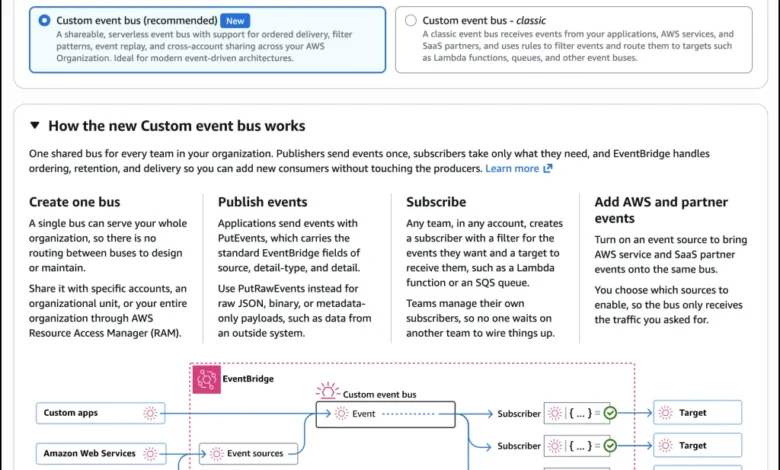
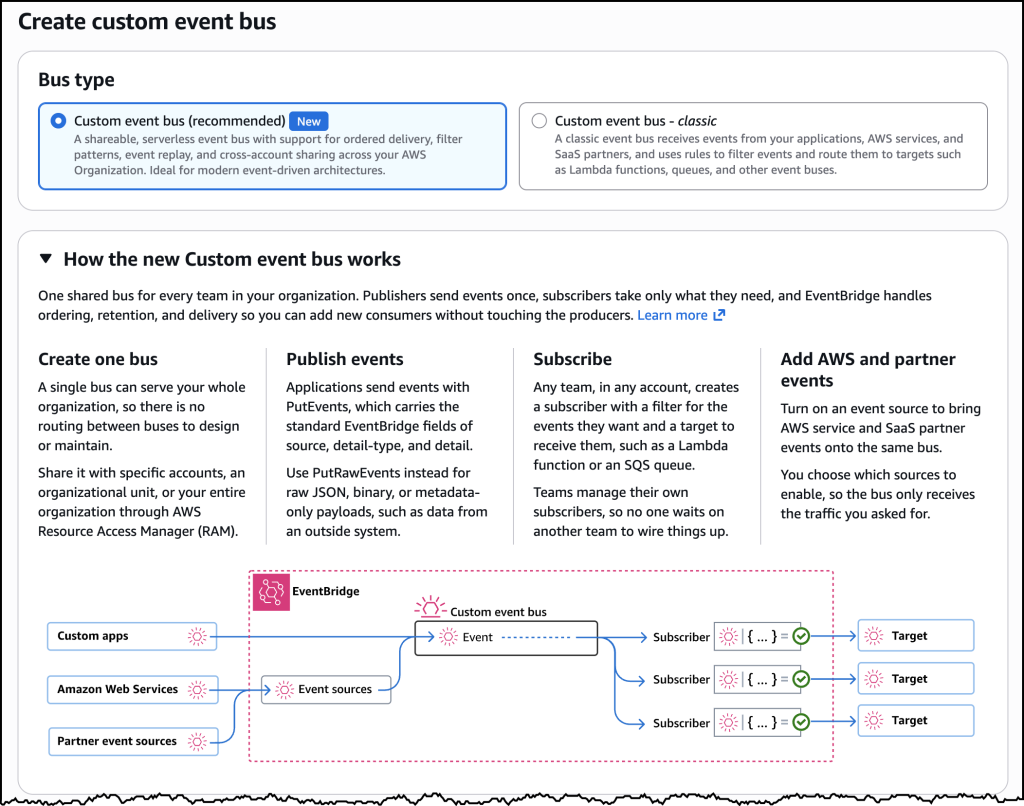
At the center of this release is organization-wide resource sharing. By integrating natively with AWS Resource Access Manager (AWS RAM), platform operators can provision a single event bus and authorize consumption across entire AWS organizations, specific organizational units, or individual account IDs and IAM roles. This eliminates the manual overhead of managing cross-account resource policies or building custom routing bridges. Publishers emit messages to the central infrastructure without needing to know which downstream systems or teams are consuming them, while subscribers independently manage their own ingestion parameters.
To accommodate large-scale enterprise integration, the updated architecture features a default quota of 10,000 subscribers per individual event bus, with provisions for higher limits upon request. This high threshold successfully mitigates the fragmentation that previously forced system architects to partition workflows across artificial boundaries.
Balancing Asynchronous Design with Strict Event Ordering
Event-driven architectures fundamentally thrive on decoupled, asynchronous processing models where absolute message sequencing is largely irrelevant. Yet, real-world enterprise applications frequently encounter domain logic where temporal order is critical. For instance, in modern logistics, supply chain, and fleet management applications, spatial telemetry and driver location updates must be ingested and processed in strict chronological sequence. Out-of-sequence events can cause routing engines to render operational decisions based on stale or contradictory positional data.
The enhanced custom event bus resolves this tension by natively supporting both asynchronous and ordered patterns on a single infrastructure resource. Publishers can attach an optional EventGroupId payload attribute to outgoing messages. EventBridge guarantees that events sharing the same identifier are delivered in strict sequential order to subscribers configured for ordered processing. Simultaneously, other consumers on the identical bus can ingest the same event stream asynchronously without performance bottlenecks.

To reinforce this capability, AWS has introduced synchronous invocation support for downstream targets such as AWS Lambda. In synchronous mode, EventBridge confirms successful target processing before acknowledging the event, removing the historical necessity of placing intermediate message queues—such as Amazon SQS—between the event bus and compute layers merely to guarantee reliable, ordered execution.
Unified Management and Advanced Event Processing
Administrative efficiency is further enhanced through the introduction of the unified Subscriber resource. Historically, configuring event filtering, target mapping, retry policies, and dead-letter queues required managing a fragmented constellation of discrete rules and target definitions across multiple resources. The new Subscriber resource aggregates these parameters into a single, cohesive management unit.
Additionally, the platform incorporates variable start time parameters, simplifying the onboarding of newly deployed consumers and accelerating the event replay procedures required for disaster recovery or application hydration.
To address data integrity challenges, the platform now offers native content-based deduplication. When enabled, EventBridge automatically inspects event payloads, generating cryptographic hashes of meaningful attributes to identify and discard duplicate retries arriving within a five-minute window. This brings true exactly-once delivery semantics to data sources that lack native idempotency tokens, relieving developers from writing custom deduplication logic.
For data transformation, consumers can leverage integrated JSONata expressions to reshape payloads dynamically before they reach downstream targets. This permits teams to extract specific fields, normalize nomenclature, or compute derived values on the fly. Furthermore, for organizations utilizing Apache Avro or Protocol Buffers serialization standards, EventBridge can automatically deserialize binary payloads into standard JSON, allowing comprehensive filtering across the entire event body without requiring consumers to write custom parsing code.
A Scalable Economic Model
Financial predictability has also been addressed through a revised throughput pricing structure. The enhanced custom event bus transitions away from legacy per-event pricing models toward an ingress-and-egress throughput framework. Under this model, publishers bear the cost for data ingested into the system, while subscribers pay for data delivered. This direct correlation eliminates the compounded routing penalties characteristic of multi-bus legacy architectures, making large-scale data distribution economically viable for growing enterprises.
AWS leadership has emphasized continuity for existing infrastructure. Legacy implementations will remain fully supported, appearing within the management console under the designation "Custom event bus – classic." These legacy instances will continue to process workloads without requiring immediate migration, allowing organizations to adopt the enhanced architecture incrementally at their own operational pace.
Industry Implications and Future Outlook
Industry analysts view the release as a vital maturation step for serverless enterprise computing. As organizations increasingly migrate mission-critical transactional workloads to event-driven paradigms, the demand for rigorous governance, auditability, and deterministic data flow has grown acute. By abstracting the administrative complexity of multi-account routing into a managed, policy-governed service, AWS has effectively lowered the barrier to entry for enterprise-wide event mesh topologies.
Platform engineers and system architects are expected to leverage these capabilities to dismantle monolithic messaging silos, reduce infrastructure footprints, and enforce cleaner domain-driven design principles across their cloud estates.
The enhanced custom event bus is generally available today across a broad footprint of global AWS regions, including US East (N. Virginia, Ohio), US West (Oregon), multiple European hubs (Ireland, Frankfurt, Stockholm, Spain), and key Asia-Pacific markets (Hong Kong, Malaysia, Mumbai, Singapore, Sydney, Thailand, Tokyo). Organizations can provision the new architecture immediately via the AWS Management Console, the AWS Command Line Interface (AWS CLI), or programmatic EventBridge APIs.
Related posts: