Black Forest Labs Unveils FLUX 3: A Multimodal AI Breakthrough Ushering in a New Era of Generative Content and Robotics


Black Forest Labs has ignited the artificial intelligence landscape with the unveiling of FLUX 3, a groundbreaking multimodal model that transcends the limitations of its predecessors by generating not only still images but also dynamic video content. Launched on Thursday, this latest iteration from the German AI powerhouse marks a significant leap forward in generative AI, consolidating its reputation for pushing the boundaries of what’s possible. Unlike previous models that specialized in single modalities, FLUX 3 has been meticulously trained on a unified system encompassing images, video, and audio simultaneously, a sophisticated approach known as true multimodality.
This integrated training methodology allows FLUX 3 to understand and generate content across different data types in a cohesive manner, rather than relying on disparate tools pieced together. The most striking advancement is FLUX 3’s video generation capability, producing clips up to 20 seconds in length. Crucially, the accompanying audio is not merely a static overlay but is intelligently generated and synchronized with the on-screen action, encompassing dialogue, sound effects, and ambient noise to create a more immersive and realistic experience.
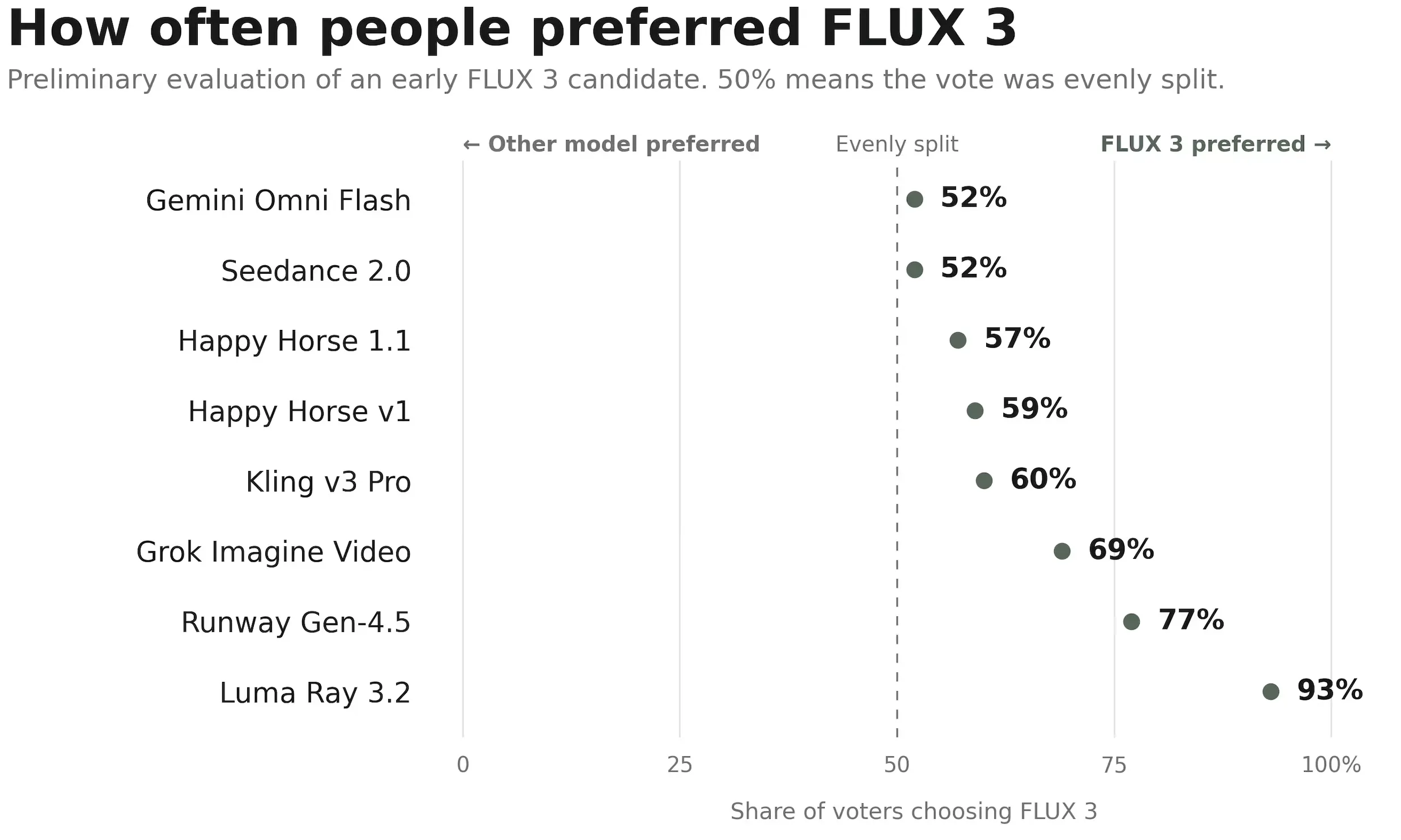
Early evaluations have placed FLUX 3 at the forefront of generative video technology. In head-to-head comparisons, human reviewers exhibited a strong preference for FLUX 3’s output, favoring it over Runway Gen-4.5 in a remarkable 77% of cases. Its performance against Luma Ray 3.2 was even more dominant, with FLUX 3 emerging victorious in 93% of comparisons. While slightly trailing leading models like Gemini Omni and Seedance in some subjective assessments, FLUX 3 still outperformed them in 52% of evaluations, demonstrating a competitive edge across a spectrum of sophisticated AI video generation platforms. It is important to note that these figures stem from preference tests, where evaluators select the more convincing output, rather than a rigid scoring rubric, offering a qualitative measure of perceived quality.
A Legacy of Image Generation Excellence
Black Forest Labs, previously renowned for its prowess in still image generation, has seamlessly integrated this expertise into FLUX 3. The model continues to excel in producing static imagery, showcasing remarkable versatility and an ability to generate a wide array of styles beyond photorealism. This dual capability—excelling in both still and moving image generation—underscores the efficacy of its multimodal training approach.
The company’s strategic vision, as articulated by co-founder and CEO Robin Rombach, extends beyond mere content creation. "A model that only learns images can only generate images," Rombach stated, highlighting the inherent limitations of unimodal systems. Black Forest Labs’ fundamental hypothesis is that by training a model to predict video, it inherently learns the underlying physics governing motion—concepts like weight, contact, and timing. This deeper understanding, they believe, is crucial for developing AI systems capable of interacting with and navigating the physical world.

FLUX-mimic: Bridging the Gap Between AI and Robotics
This ambitious vision is being realized through FLUX-mimic, a revolutionary project developed in collaboration with Zurich-based mimic robotics. FLUX-mimic leverages FLUX 3’s advanced video-prediction engine, augmented by a lightweight "decoder." This decoder acts as a translator, converting the model’s internal understanding of motion into tangible robot movements.
The implications of FLUX-mimic are profound, particularly for industries grappling with complex manipulation tasks. Automotive manufacturer Audi is already exploring its potential, testing the system for intricate operations such as fitting flexible door seals—a task that has historically posed significant challenges for conventional automation. The ability of FLUX-mimic to handle such delicate and adaptable manipulations signifies a major advancement in robotic dexterity and AI-driven automation.
Stephan-Daniel Gravert, co-founder of mimic robotics, expressed enthusiasm for the partnership, stating, "Audi represents the kind of manufacturing partner we built FLUX-mimic for." Christoph Schneider from Audi confirmed the system’s efficacy, noting that the robots are now capable of "solving complex soft-body manipulation work" that was previously beyond the reach of older robotic systems. Black Forest Labs reports that the full FLUX-mimic system exhibits an impressive reaction time of approximately 101 milliseconds, a speed that closely approximates human visual reflexes, paving the way for more fluid and responsive human-robot interaction.
The Evolution of the FLUX Lineage
The emergence of FLUX 3 is not an isolated event but rather the culmination of a deliberate and rapid evolution within the AI generative model space. Black Forest Labs was founded in August 2024 by a team of veteran researchers instrumental in the development of the foundational Stable Diffusion models at Stability AI. This pedigree immediately positioned them as formidable competitors in the AI art and content generation arena.
Their initial open-source releases, Flux Dev and Schnell models, quickly garnered acclaim, particularly in the wake of what many perceived as Stability AI’s underwhelming Stable Diffusion 3. These early FLUX models seized the "best open source image generator" title, a position many in the AI art community had anticipated for Stability AI’s subsequent releases.
The momentum continued with the release of FLUX 1.1 Pro in October of an unspecified year (implied to be within the early stages of the company’s trajectory), which went on to dominate the Artificial Analysis image arena. While this model was not open-source, it solidified Black Forest Labs’ position at the cutting edge of image generation technology.
A subsequent release, FLUX.2 in November 2025, did not achieve the same level of widespread popularity as its predecessors. The open-source leadership, initially held by the original FLUX models, was eventually challenged and then surpassed by Alibaba’s Z-Image Turbo in late 2025. Z-Image Turbo notably matched FLUX’s quality while operating efficiently on lower-end consumer graphics cards, leading to commentary on platforms like CivitAI that it represented "what SD3 was supposed to be."
FLUX 3: A Strategic Re-entry and Future Outlook
FLUX 3 represents Black Forest Labs’ strategic comeback, and importantly, it is not yet fully open-source. The video and action generation capabilities are currently accessible through APIs and a select group of partners, including mimic robotics, signaling a phased rollout strategy. The image generation component is slated for release "in the coming weeks," according to Black Forest Labs.
The company plans to release an open-weight Dev version of FLUX 3, intended for local use, but this is not expected until later in 2026. This tiered release strategy suggests a focus on controlled deployment and partnerships for the more advanced multimodal features, while gradually expanding accessibility for the core image generation capabilities.
The sustained innovation from Black Forest Labs, particularly with FLUX 3’s multimodal advancements, underscores a broader trend in AI development: the drive towards more integrated and sophisticated models that can understand and generate content across diverse data types. This multimodal paradigm promises to unlock new applications, from more realistic virtual environments and advanced content creation tools to more capable and intuitive robotic systems that can better interact with the complexities of the physical world. The company’s journey from its founding to the unveiling of FLUX 3 illustrates a dynamic and competitive AI landscape, where rapid iteration and groundbreaking multimodal capabilities are becoming the new benchmarks for success. The implications for industries ranging from entertainment and design to manufacturing and robotics are vast, pointing towards a future where AI plays an increasingly integral and multifaceted role.
Related posts: