CoreWeave’s 24.7% Surge Revives the AI Trade as Cloud Provider Posts $3.66 Billion in Third-Quarter Revenue

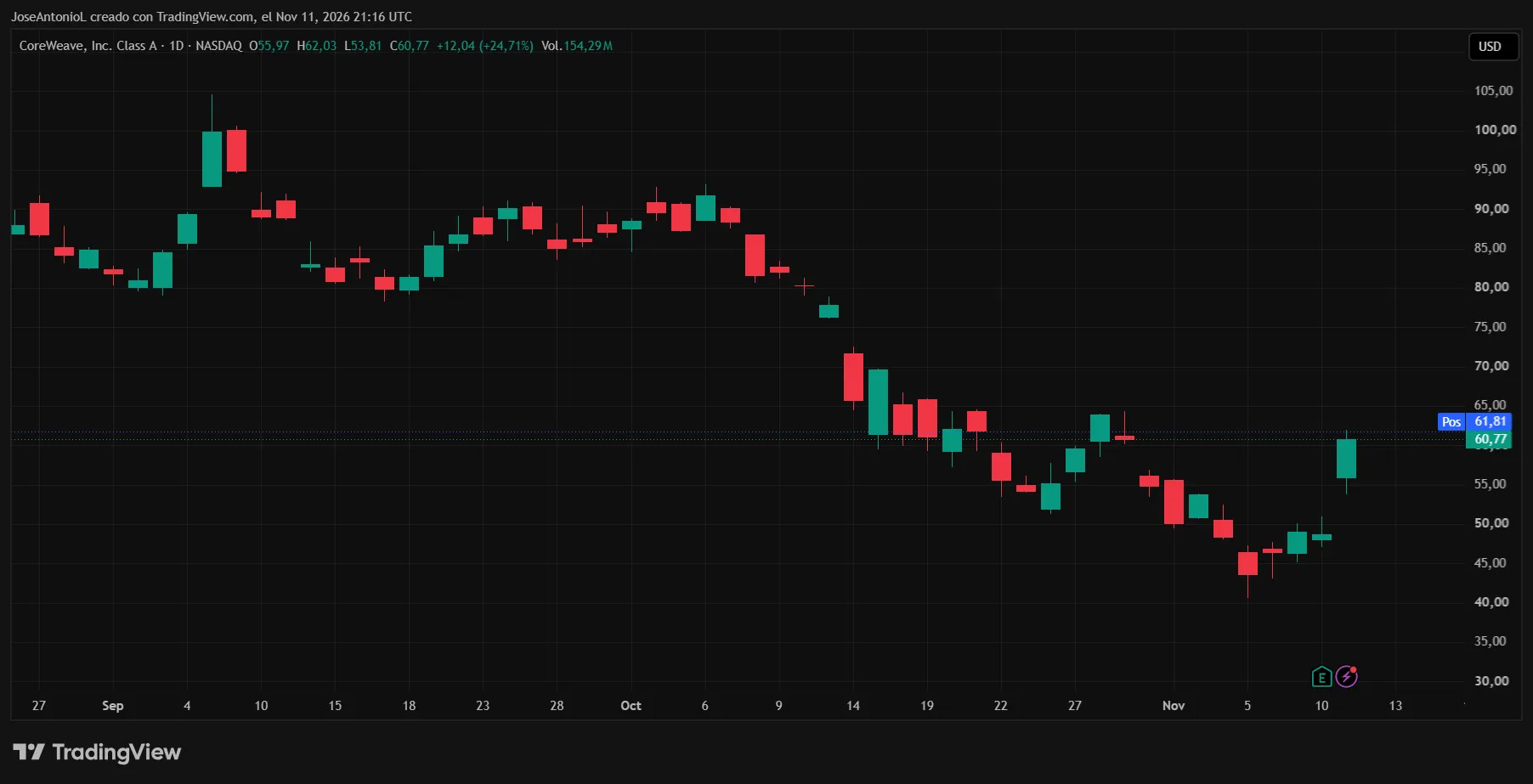
The artificial intelligence sector experienced a significant market recalibration on Wednesday, led by a remarkable 24.7% surge in the stock price of Nvidia-backed specialized cloud provider CoreWeave. The sharp upward movement served as a much-needed catalyst, helping to revitalize the broader AI trade following weeks of persistent selling pressure, market skepticism, and intense scrutiny over capital
expenditure returns. CoreWeave’s explosive rally was triggered by its stellar third-quarter earnings report, which underscored staggering, unabated demand for the expensive, specialized computing hardware that forms the backbone of the global generative AI boom.
The cloud infrastructure provider reported a third-quarter revenue of $3.66 billion, representing a staggering 168% increase compared to the same period a year prior. Building on this momentum, the company dramatically raised its fiscal guidance, pushing its 2026 sales forecast to a range of $13 billion to $13.3 billion. This robust financial performance immediately rippled across the technology sector, lifting shares of its primary silicon benefactor, Nvidia, alongside a slew of other critical AI infrastructure players including Nebius, IREN, Oracle, and Applied Digital. The tech-heavy Nasdaq Composite responded positively, gaining 1.6% for the trading session as investors recalibrated their growth expectations.
For market analysts and institutional investors monitoring Nvidia’s unprecedented trajectory, CoreWeave occupies a uniquely revealing position within the ecosystem. Functioning essentially as a downstream barometer, CoreWeave provides a transparent window into what transpires immediately after the world’s most valuable chipmaker successfully offloads its advanced processors.

Understanding the Neocloud Business Model and Operational Roots
To fully comprehend CoreWeave’s rapid rise and its systemic importance to the AI trade, one must examine the operational blueprint of the "neocloud." Unlike legacy cloud hyperscalers such as Amazon Web Services, Microsoft Azure, or Google Cloud—which maintain diversified revenue streams encompassing enterprise software, consumer storage, and web hosting—neoclods are hyper-focused, purpose-built engines designed expressly to deliver high-performance computing (HPC) power.
CoreWeave’s business model centers on a capital-intensive pipeline: the company procures massive shipments of advanced Nvidia graphics processing units (GPUs), installs these power-hungry chips into advanced data centers, and subsequently rents out that raw computational power to cutting-edge AI labs, model developers, and tech giants, including OpenAI and other premier enterprise clients.
Interestingly, CoreWeave’s corporate genesis is deeply intertwined with the digital asset industry. The firm initially launched operations as an Ethereum cryptocurrency mining enterprise. This crypto-native background provided its founding and engineering teams with invaluable, early expertise in managing, cooling, and maintaining dense clusters of power-hungry hardware under intense operational loads. When the cryptocurrency landscape shifted and the generative AI explosion took hold, CoreWeave possessed the technical agility and physical infrastructure necessary to pivot seamlessly, transforming its mining rigs into advanced AI data factories almost overnight.
The Web of Interconnectivity: Unpacking Nvidia’s Deep Ties to CoreWeave
The commercial and financial relationship between Nvidia and CoreWeave extends far beyond a standard supplier-customer dynamic, weaving a complex web of mutual investment and strategic alignment that has occasionally drawn scrutiny from market skeptics.
The partnership entered a new phase in January, when Nvidia injected an additional $2 billion into CoreWeave shares at a fixed price of $87.20 per share. This strategic injection was designed to accelerate a massive, multi-year infrastructure buildout aimed at establishing more than five gigawatts of specialized AI data center capacity by the year 2030. Furthermore, the two corporations formalized an agreement to integrate next-generation Nvidia technology directly into CoreWeave’s hardware stack, including the deployment of upcoming platforms like the Rubin architecture and Vera central processing units. Consequently, CoreWeave serves not merely as a high-volume customer, but as a critical live showcase and testing ground for Nvidia’s future product roadmap.

Nvidia’s financial commitment is further underscored by a foundational multi-year agreement. Notably, Nvidia maintains a $6.3 billion initial purchasing arrangement to absorb CoreWeave’s unused computing capacity through April 2032, contingent upon specific contract conditions. While this agreement functions as an essential financial backstop for CoreWeave—guaranteeing a buyer for capacity that might experience temporary lulls in commercial demand—it also grants Nvidia direct access to localized cloud infrastructure built entirely around its proprietary chips.
This multi-layered integration has ignited intense debate on Wall Street regarding market transparency. Financial critics and industry commentators frequently point to these overlapping mechanisms—where Nvidia sells chips to hardware buyers, invests directly in those same hardware buyers, and commits to purchasing the resulting computing services—as a prime example of "circular finance." While proponents view this symbiosis as a masterclass in strategic ecosystem building, skeptics argue that such interconnected arrangements obscure the true, organic baseline of end-user enterprise demand, complicating traditional valuation metrics.
Financial Breakdown: Backlogs, Prepayments, and Market Implications
Despite debates surrounding circular financing, CoreWeave’s third-quarter disclosures provided tangible proof of massive, committed enterprise expenditure. The company revealed an astronomical revenue backlog totaling $132.5 billion. This figure represents legally contracted business agreements and service level commitments that CoreWeave expects to fulfill and recognize as revenue over the coming years, rather than speculative or unverified sales pipelines.
During the earnings call, CEO Michael Intrator highlighted the historical nature of the period, emphasizing that the company achieved a sequential revenue expansion exceeding $1 billion within a single quarter—a milestone that validated the aggressive capital expenditure strategies pursued by the firm and its backers.
Moreover, CoreWeave reported anticipated customer prepayments and cash deposits expected to approach $9 billion over the forthcoming three months. In an economic environment where the astronomical cost of constructing AI data centers has forced many infrastructure developers to rely heavily on expensive debt financing, securing substantial upfront cash injections drastically mitigates immediate liquidity pressures. This prepayment model allows CoreWeave to self-fund a significant portion of its aggressive data center expansion without succumbing to unfavorable borrowing rates or restrictive credit markets.
Industry Reactions and the Broader Tech Outlook
The investment community’s reaction to CoreWeave’s blowout earnings was swift and pronounced. Analysts from Bernstein characterized the period as "about the best quarter we could have asked for," highlighting the extraordinary velocity at which enterprise customers are locking down compute resources. However, the firm also issued a measured caveat, noting that neocloud providers like CoreWeave remain uniquely vulnerable to any future balancing or softening of the acute global hardware shortages that have defined the AI hardware market over the past several years.
This underlying risk factor remains a central debate among macro-economists and technology strategists. While CoreWeave’s staggering revenue growth and towering backlog offer undeniable evidence that corporate clients are actively opening their wallets to secure computational dominance, fundamental questions persist regarding long-term profitability. The rapid depreciation schedule of advanced hardware, escalating electricity and grid-connection constraints, potential construction bottlenecks, and the looming threat of technological obsolescence—where newer processor iterations abruptly devalue existing GPU fleets—all represent structural challenges for the neocloud sector. Should the supply of AI computing capacity eventually outpace enterprise demand, rental pricing pressures could severely compress operating margins across the industry.
For now, however, Wednesday’s market action demonstrated that the appetite for AI infrastructure remains remarkably resilient. By proving that high-priced computing power continues to command extraordinary market rates, CoreWeave has successfully steered the conversation away from generalized panic and back toward fundamental business execution, injecting a renewed sense of confidence into the global technology landscape.