GitHub Issues Navigation Performance Revolutionized Through Client-Side Architecture Modernization

GitHub has achieved a significant leap forward in user experience by undertaking a comprehensive redesign of the navigation architecture underpinning its widely-used Issues feature. This ambitious engineering effort, detailed in a recent GitHub engineering blog post, has dramatically reduced perceived latency for developers, a critical demographic that relies heavily on swift and responsive tools for project management and collaboration. The core of this transformation lies in a strategic shift of computational load from the server to the client-side, employing advanced techniques such as client-side caching, predictive prefetching, and service worker-based request handling. These innovations have collectively boosted the rate of "instant navigation" experiences – where users perceive no delay – from a modest 4% to an impressive 22%. This substantial improvement directly addresses a pervasive challenge in the development of large-scale web applications: mitigating the delays inherent in repeated network requests and client initialization that plague frequently executed workflows.
The impetus for this architectural overhaul stemmed from observing the typical usage patterns of GitHub Issues users. Developers frequently navigate between various views, including lists of issues, individual issue pages, and related project boards or pull request integrations. In these high-frequency navigation scenarios, information that had been previously retrieved and displayed could logically be reused rather than necessitating a fresh fetch from backend services with each click. To break free from these recurrent network dependencies, the GitHub engineering team embraced a "local-first" philosophy. This approach prioritizes rendering data immediately from the user’s browser using locally available information, while background processes discreetly fetch newer or updated data as needed. This sophisticated client-side architecture leverages multiple layers of storage. IndexedDB, a robust browser API, is employed for persistent storage, ensuring that data remains available even after the browser is closed and reopened. For data that is accessed most frequently during an active user session, an in-memory cache is utilized to provide near-instantaneous retrieval.
The technical implementation of this client-first strategy involved several key components. Client-side caching, a fundamental technique, allows the browser to store copies of data that has been previously fetched from the server. When a user navigates back to a page or view they have recently visited, the application can serve this cached data directly, bypassing the need for a network request. This dramatically accelerates the perceived load time. Predictive prefetching takes this a step further by anticipating user behavior. Based on common navigation patterns and the structure of the application, the system proactively fetches data that is likely to be needed in the near future, even before the user explicitly requests it. This "pre-warming" of data means that when the user does decide to navigate to a particular view, the data is often already present in the cache, leading to an instant experience.
Service workers, a powerful feature of modern web browsers, play a crucial role in this new architecture. These are essentially scriptable proxy servers that run in the background, separate from the main browser thread. They intercept network requests made by the web application and can respond to them from the cache, serve updated content, or even perform background synchronization. In the context of GitHub Issues, service workers act as an intelligent gatekeeper. When a user requests data, the service worker first checks if a valid, up-to-date version of that data is available in the local cache. If it is, the cached data is immediately returned to the user. If the cached data is stale or unavailable, the service worker can then pass the request on to the backend server for retrieval. This dual capability ensures both speed and data freshness.
The strategic adoption of the "stale-while-revalidate" caching model is central to this system. When a user revisits content, the application can immediately display the locally stored, potentially slightly outdated (stale) data. Concurrently, it initiates a background process to fetch the latest version of the data from the server. Once the new data arrives, the cache is updated, and the user’s view can be refreshed if necessary, ensuring data consistency without imposing waiting times. This approach strikes an effective balance between responsiveness and the need for accurate, up-to-date information.
To further enhance cache effectiveness, GitHub implemented a "preheating" strategy. This involves proactively populating the cache with data that is likely to be required based on observed user navigation patterns. For instance, if a user is viewing a list of issues, the system might preheat the cache with data for the most recently updated issues or those associated with the currently active project. This intelligent preloading ensures that when the user decides to delve deeper into a specific issue or related component, the necessary data is already readily available.
This sophisticated client-side architecture has not gone unnoticed within the broader developer community. BareStack, a company focused on developer tooling and infrastructure, offered a nuanced perspective on the role of prefetching in their commentary on the GitHub announcement. They highlighted that while prefetching is effective for data-rich, read-heavy applications like GitHub Issues with relatively small data graphs, its efficacy can diminish in applications with larger, more complex data graphs where read and write operations frequently collide. In such scenarios, prefetched views might need to be re-fetched upon landing due to data modifications. BareStack suggested that a more universally reusable pattern involves a "shell-first render" combined with "cache-hit hydration" rather than solely relying on prefetching itself. This implies prioritizing the immediate rendering of the application’s basic structure (the shell) and then populating it with data from the cache if available, which is a core tenet of GitHub’s approach.
Oguz Guven, another commentator, pointed to a deeper implication of GitHub’s engineering achievement: a shift in focus from optimizing for extreme edge cases (P99 tail latency) to improving the overall distribution of quality across all user experiences. This perspective underscores a maturation in engineering practices, where the goal is not just to fix the slowest experiences but to elevate the performance for the vast majority of users, leading to a more consistent and positive user journey.
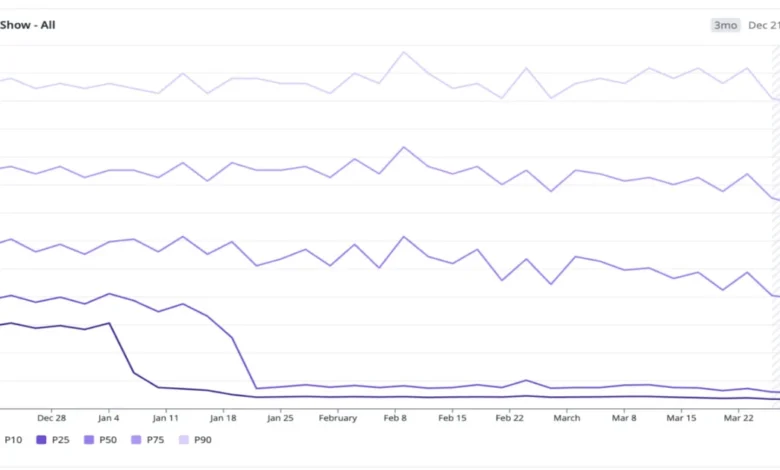
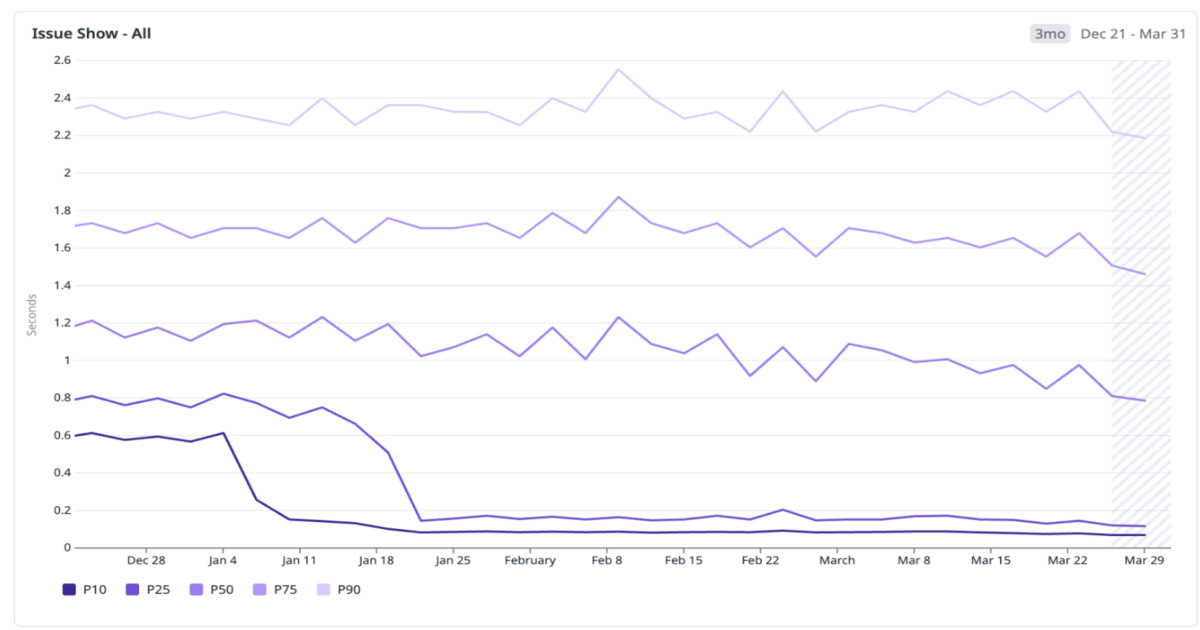
The impact of these changes on navigation latency distributions is substantial. Prior to the redesign, the 10th percentile (P10) latency, representing the fastest 10% of navigation experiences, was approximately 600 milliseconds. This has been dramatically reduced to just 70 milliseconds. Similarly, the 25th percentile (P25) latency saw a significant drop from 800 milliseconds to 120 milliseconds. The median latency, a crucial indicator of typical user experience, improved from a substantial 1,200 milliseconds (1.2 seconds) to a much more palatable 700 milliseconds (0.7 seconds). Even the higher percentiles, such as P75 (1,800 ms to 1,400 ms) and P90 (2,400 ms to 2,100 ms), have shown considerable improvement, indicating a widespread enhancement in navigation speed across the entire user base.
/filters:no_upscale()/news/2026/07/github-issues-navigation/en/resources/1clientside-1783811916296.jpeg)
Alexander Lelidis, a senior software engineer at GitHub who was involved in this project, articulated a profound understanding of latency’s impact, stating, "Latency isn’t just a metric. It’s a context switch." This statement encapsulates the user’s perspective: a delay isn’t merely a numerical value; it represents a break in their flow, a moment where they are disengaged from their task and forced to wait. By minimizing these "context switches," GitHub has aimed to create a more seamless and productive environment for developers.
The architectural transformation was not without its complexities. Balancing the desire for immediate responsiveness with the imperative of data freshness required careful design considerations. Instead of enforcing a strict requirement for the absolute latest server state before rendering any content, GitHub empowered the system to display available local data instantly, with asynchronous updates occurring in the background. This pragmatic approach minimizes user waiting times while ensuring that the system remains synchronized with backend data sources.
The journey to this optimized navigation architecture likely followed a phased approach, characteristic of large-scale software development. While specific dates for the project’s inception and various development stages are not publicly detailed in the initial announcement, it can be inferred that such a significant overhaul would have spanned several months, if not longer. This would typically involve initial research and prototyping, followed by iterative development, extensive testing, and a gradual rollout to users. The initial phase would likely focus on identifying the most impactful areas for improvement, such as the high-frequency navigation paths within Issues. Subsequent phases would involve implementing the core caching and prefetching mechanisms, followed by the integration of service workers and rigorous performance benchmarking. The observed improvement from 4% to 22% instant navigation suggests a significant culmination of these efforts.
The implications of this modernization extend beyond just the GitHub Issues product. The principles and techniques employed – client-first architecture, sophisticated caching strategies, predictive prefetching, and the strategic use of service workers – represent best practices that can be applied to a wide array of modern web applications. As user expectations for speed and responsiveness continue to rise, platforms that can effectively minimize latency will gain a competitive advantage. This development from GitHub serves as a valuable case study, demonstrating how a deep understanding of user workflows and a commitment to innovative engineering can lead to substantial improvements in user experience and developer productivity. The focus on distribution quality, as noted by observers, signals a maturing approach to performance optimization, aiming for a consistently excellent experience for all users, rather than just addressing the most severe outliers. This holistic view of performance is likely to become increasingly important as web applications become more complex and integral to daily professional workflows.