Google Announces General Availability of Expanded Semantic Model Support in Knowledge Catalog to Solve AI Hallucination and Governance Challenges

The modern enterprise has increasingly embraced artificial intelligence agents, deploying conversational assistants to streamline operations, forecast sales, and generate executive summaries. Yet, a persistent and costly vulnerability continues to plague these deployments: the alarming rate of AI hallucination when confronted with complex business metrics. Consider a common executive scenario where a vice president of sales queries an AI assistant for the net revenue of top enterprise accounts during the previous quarter. Within seconds, the agent returns a sleek, highly polished visualization. Unfortunately, the underlying numbers are fundamentally flawed, having inadvertently counted canceled orders as valid revenue while drawing raw data from an unvalidated staging table.
This failure does not stem from a deficiency in the underlying large language model itself, nor does it reflect an inability to translate natural language into a functional database query. Rather, the breakdown occurs because the artificial intelligence agent fundamentally lacks a coherent understanding of the enterprise’s unique business logic. In most organizations, this essential business understanding already exists, meticulously codified within semantic models housed across platforms such as Looker, dbt, Snowflake, Databricks, or SAP systems. However, because each of these definitions remains strictly isolated within its respective tool, every autonomous agent is forced to guess at the correct parameters—frequently resulting in costly discrepancies.
To confront this systemic enterprise challenge head-on, Google has officially announced the general availability of expanded semantic model support within its Knowledge Catalog platform. This latest enterprise release is engineered to bridge the persistent gap between isolated data systems and generative artificial intelligence. By unifying semantic models from a diverse array of disparate tools into a single, cohesive context graph, Knowledge Catalog ensures that every enterprise AI agent operates from the exact same trusted definitions. Furthermore, when overlapping or conflicting metric definitions exist across multiple tools, the platform preserves both definitions alongside their complete provenance, empowering data stewards to reconcile discrepancies before erroneous data ever reaches the eyes of end-users.
Background Context and the Evolution of Enterprise Data Silos
The fragmentation of corporate data has long stood as one of the most stubborn hurdles in enterprise information technology. Over the past decade, organizations aggressively migrated their operations to the cloud, adopting best-of-breed analytics, data warehousing, and transformation platforms to satisfy departmental needs. While this decentralized approach empowered individual business units, it simultaneously created isolated silos of information. The finance department might calculate customer lifetime value using one set of parameters in a dbt model, while the sales operations team measures the same metric differently using Looker LookML, and the enterprise resource planning system relies on SAP Core Schema Notation.
When organizations began integrating generative AI assistants and custom enterprise agents into their workflows, these legacy data silos transformed from a manageable organizational annoyance into an active operational risk. Autonomous agents designed to improve efficiency suddenly found themselves navigating a labyrinth of conflicting definitions. Without a centralized mapping of how data elements relate to one another, agents routinely pulled from unvetted tables, misapplied join keys, and miscalculated vital Key Performance Indicators.
Recognizing that enterprises could not safely scale their AI deployments without a single source of truth for business logic, cloud providers and data governance experts began conceptualizing unified metadata frameworks. Google’s development of the Knowledge Catalog represents a significant maturation of this concept, moving beyond traditional data cataloging—which typically focused merely on discovering where data lives—into active context governance. By capturing not just the data schemas, but the semantic definitions, business glossaries, and lineage relationships, the platform addresses the root cause of AI hallucinations in business intelligence.
Technical Architecture of the Unified Context Graph
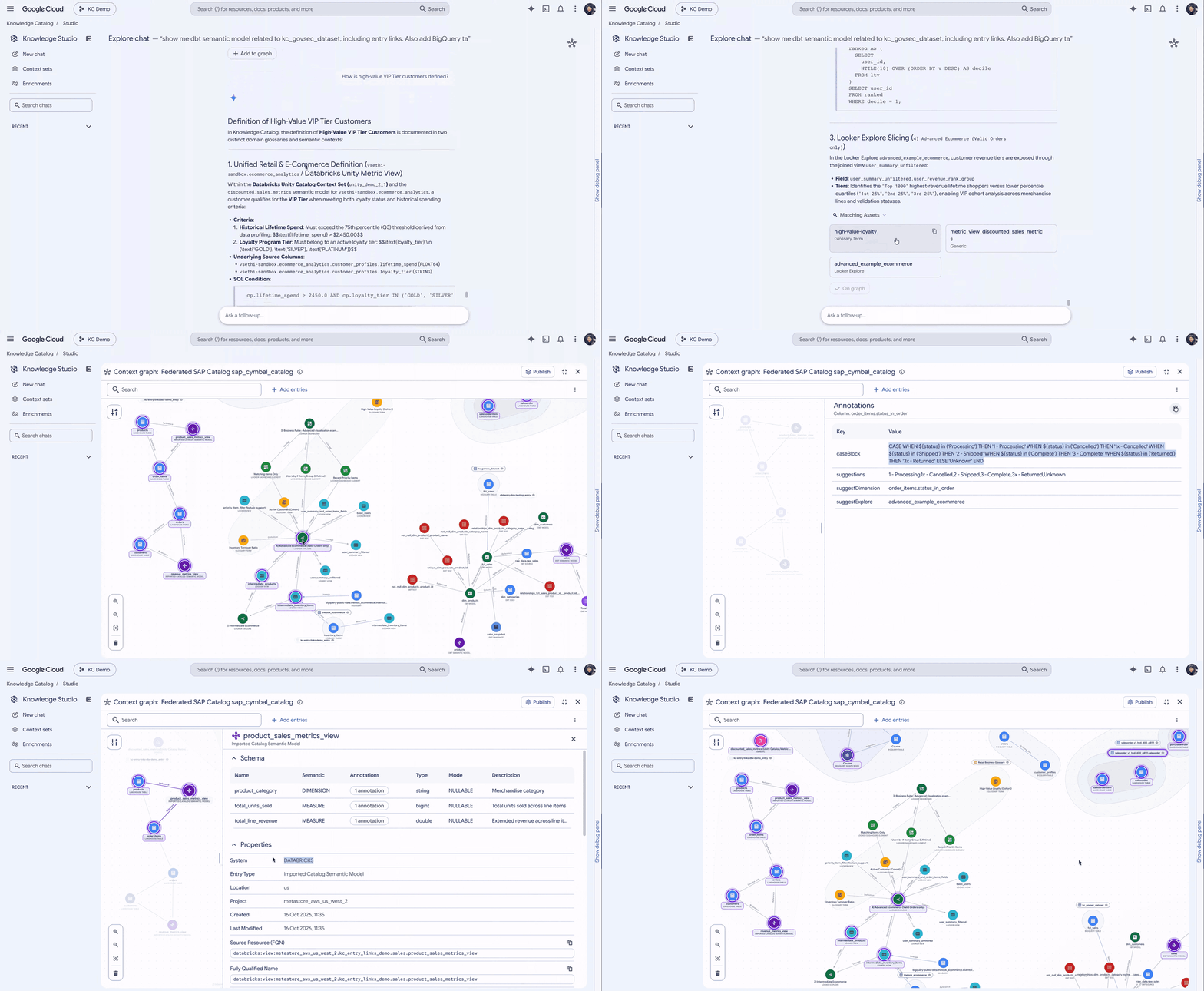
At the core of Google’s newly expanded offering is the unified context graph. This architecture constructs a dynamic, highly connected map of an organization’s entire data and semantic estate. Within this graph, physical tables, semantic models, glossary terms, and formal data products serve as nodes. The relationships connecting them—such as data lineage, explicit associations, schema keys, join paths mined from historical query patterns, and joins formally declared within semantic models—act as the edges.
With the latest general availability update, Knowledge Catalog natively ingests semantic models and metric definitions from a comprehensive roster of industry-standard platforms. These include Looker LookML, BigQuery Graph alongside BigQuery measures, dbt MetricFlow, Snowflake Semantic Views, Databricks Metric Views, and SAP Core Schema Notation. Crucially, this integration is achieved without requiring enterprises to migrate massive volumes of data or rewrite existing business logic into proprietary languages.
When these disparate sources are ingested, they land directly within the context graph adjacent to pre-existing data governance and usage signals. Consequently, when an AI agent receives a prompt, it does not have to guess. It seamlessly traverses the graph from the initial business concept to the trusted formula and verified join paths in a single traversal operation. Because every integrated source maps onto the same unified graph structure, a LookML join, a dbt exposure, a Snowflake relationship, and an SAP association can be evaluated side by side. Each connection retains a direct link back to the underlying physical tables.
Crucially, the system is designed to prevent silent overwrites. When overlapping or contradictory definitions exist across different departments, the context graph maintains them side by side, explicitly labeling each with its precise origin. This transparency provides data stewards with the comprehensive visibility required to resolve conflicts and establish definitive enterprise standards.
Empirical Performance Improvements and Benchmarking Data
To quantify the operational value of grounding artificial intelligence in a unified context graph, Google conducted extensive internal benchmarking. The results underscore a dramatic enhancement in both the reliability and efficiency of AI agents utilizing Knowledge Catalog.
According to internal performance evaluations, grounding AI agents within the Knowledge Catalog context graph increases their analytical accuracy by nearly 400 percent compared to ungrounded agents. In practical terms, this dramatic reduction in error rates transforms conversational AI from a speculative novelty into a dependable enterprise tool capable of supporting executive decision-making.
In addition to accuracy gains, the architectural efficiency of context-grounded queries delivers substantial technical benefits. Benchmarks indicate that agents utilizing Knowledge Catalog achieve up to a 33 percent reduction in latency. By providing a pre-computed, verified path from the user’s natural language query to the exact semantic model and join keys, the system eliminates the extensive iterative processing and trial-and-error querying that ungrounded models typically require.
Furthermore, this streamlined query generation translates directly into computational savings. Tests reveal that grounded agents consume up to 75 percent fewer tokens during operation. For enterprise organizations deploying large language models at scale across thousands of concurrent users, optimizing token consumption yields significant cost reductions, mitigating the heavy financial overhead often associated with enterprise generative AI rollouts.

Introduction of Knowledge Studio and Practical Management Tools
Alongside the general availability of expanded semantic model support, Google has advanced Knowledge Studio into preview. Operating as the centralized command center for the enterprise context estate, Knowledge Studio provides data administrators, engineers, and stewards with an intuitive interface to explore, analyze, and govern their unified context graphs.
Through Knowledge Studio, administrators can interact directly with the context graph using natural language prompts, visually inspecting complex semantic definitions and traversing connection paths via an interactive graph canvas. Once data stewards validate the accuracy of specific assets, metrics, and definitions, they can package them into reusable configurations known as context sets. These context sets can be tailored to specific business domains, regional operations, or functional use cases within the organization, serving as the immutable bedrock that Gemini and custom-built enterprise agents consume in production environments.
Industry Implications and Future Outlook
The commercial rollout of expanded semantic model support in Knowledge Catalog arrives at a pivotal moment for enterprise technology adoption. As the initial wave of enthusiasm surrounding generative AI matures into a demand for rigorous return on investment, corporate leadership faces mounting pressure to ensure that automated systems are secure, auditable, and mathematically reliable.
Industry analysts note that data governance has historically been viewed as a defensive compliance measure—a necessary chore focused on security policies, access controls, and regulatory adherence. However, platforms that integrate metadata, semantics, and context graphs effectively reposition data governance as an offensive operational enabler. By ensuring that large language models speak the native, vetted language of the enterprise, tools like Knowledge Catalog remove the primary technical barrier preventing widespread adoption of autonomous financial and operational analytics.
Looking ahead, the ability to ingest semantics across disparate analytical ecosystems—spanning cloud data warehouses, data lakehouses, and traditional enterprise resource planning platforms—signals a broader industry shift toward open, interoperable governance standards. As organizations increasingly adopt multi-cloud and hybrid architectures, the demand for centralized context management is projected to accelerate rapidly.
For the enterprise sales vice president navigating the pressures of a quarterly business review, the practical outcome of these technological advancements is straightforward: when an AI assistant is asked to calculate net revenue, the resulting chart will reflect the correct figures, backed by verified formulas, audited data quality checks, and organizational trust.
Related posts: