Amazon Announces ECS Gateway: A New Paradigm for Container Ingress Management at Scale

Managing containerized applications at enterprise scale has long presented a friction point for platform engineering teams, particularly when configuring and maintaining ingress networking. Traditionally, every time a new microservice is deployed on Amazon Elastic Container Service (Amazon ECS), platform operators must provision, configure, and synchronize a complex web of supporting infrastructure. This includes Application Load Balancers (ALBs), AWS Certificate Manager (ACM) certificates, AWS WAF web ACLs, and intricate security groups. As workloads scale, managing this per-service overhead often throttles deployment velocity, increases operational toil, and introduces the persistent risk of configuration drift across organizational environments.
To address these systemic challenges, Amazon Web Services (AWS) has officially announced the launch of Amazon ECS Gateway, a new account-level resource designed to fundamentally streamline ingress networking for containerized workloads. By shifting the burden of dynamic provisioning and infrastructure lifecycle management to ECS itself—while keeping all underlying resources created directly within the customer’s account—the service aims to restore agility to platform teams without sacrificing granular security or cost efficiency.
Main Facts and Core Architecture of ECS Gateway
Amazon ECS Gateway introduces a clean, distinct separation of responsibilities between centralized platform engineering teams and individual application developers. Platform teams establish the foundational gateways, defining security baselines, network configurations, and infrastructure roles, while application teams can seamlessly attach their services to these established pathways without wrestling with low-level networking primitives.

At its technical core, ECS Gateway leverages host-based routing via Application Load Balancers, allowing up to 25 distinct containerized services to share a single ALB. This consolidation dramatically optimizes infrastructure costs compared to legacy patterns that often mandated dedicated load balancing resources per service. Furthermore, Amazon ECS completely automates the lifecycle of the underlying infrastructure: it provisions the initial ALB when the first connected service requires capacity, scales out additional ALBs as thresholds are reached, and gracefully decommissions them when workloads scale down or terminate.
Upon successful provisioning, each registered service instantly receives a unique DNS hostname and a fully functional endpoint, eliminating the historical lag associated with manual DNS and listener rule orchestration.
Chronology and Implementation Workflow
The journey toward ECS Gateway has been shaped by years of enterprise feedback regarding the complexities of container routing, load balancing quotas, and multi-tenant cluster architectures. The resulting feature set has been engineered to integrate smoothly into existing deployment pipelines, whether managed via the AWS Management Console, the AWS Command Line Interface (CLI), or modern AI-assisted coding tools utilizing the AWS MCP Server and associated plugins.
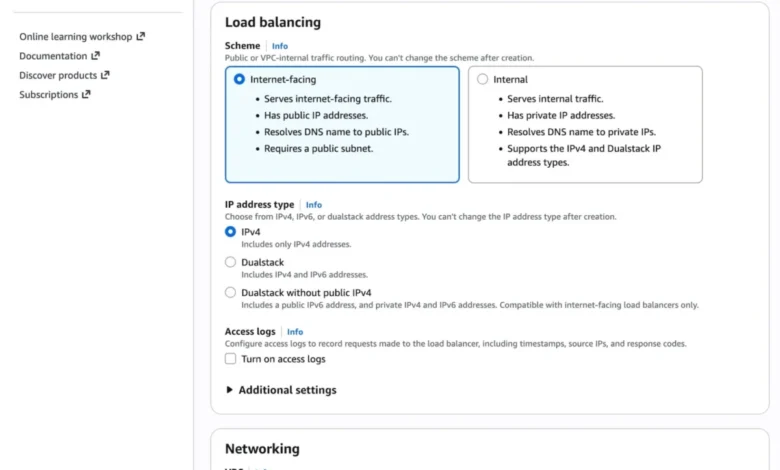
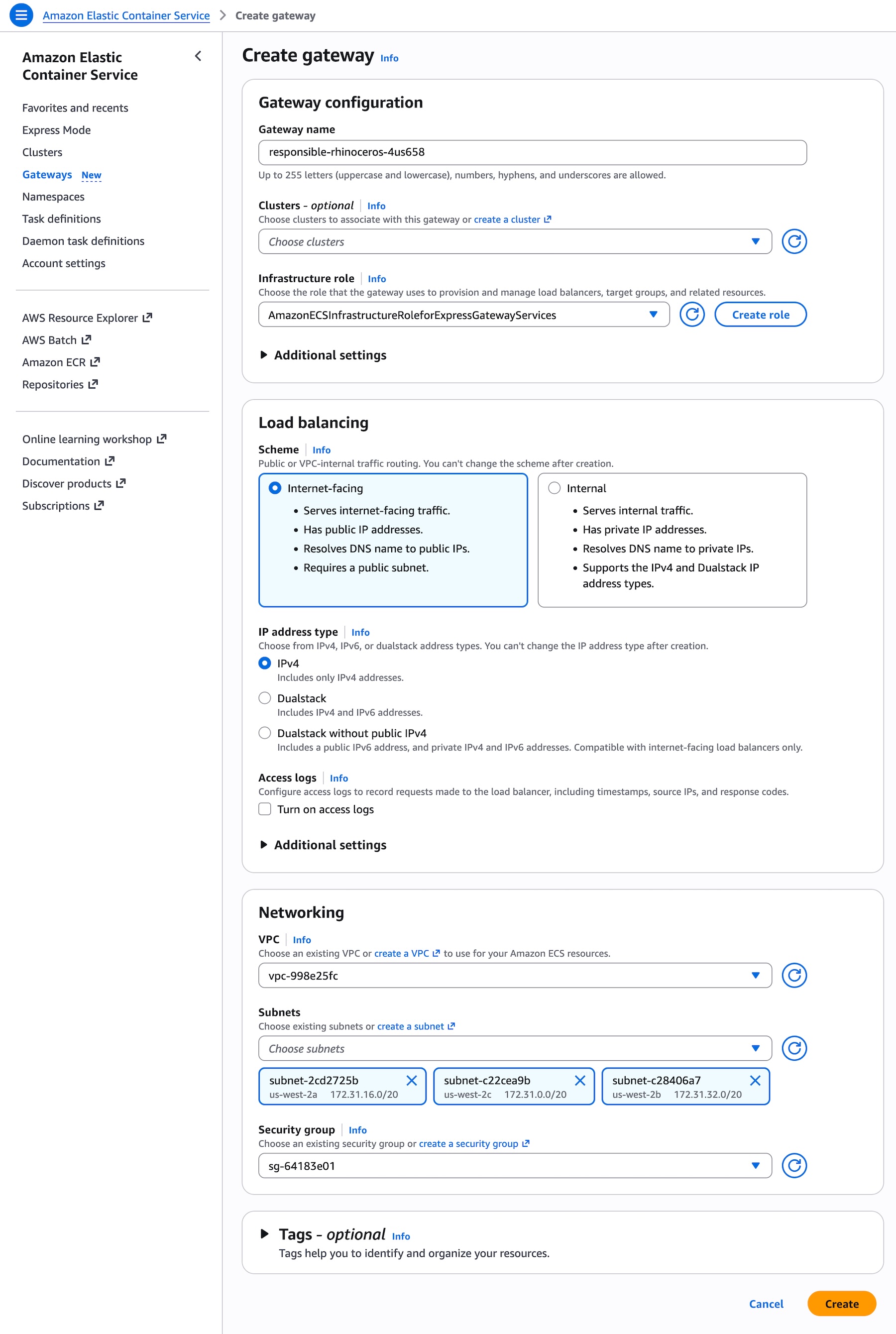
To operationalize ECS Gateway, platform teams begin in the Amazon ECS console or via the AWS CLI by invoking the CreateGateway command. This step requires a unique gateway name, an IAM infrastructure role that grants ECS permission to manage networking resources within the target account, and a comprehensive configuration object specifying subnet IDs, IP address types (such as IPv4), and routing schemes (either internet-facing public or VPC-internal). Once initialized, the gateway remains dormant until services actively connect via specialized gateway connectors.

aws ecs create-gateway
  --name enterprise-prod-gateway
  --infrastructure-role-arn arn:aws:iam::123456789012:role/ECSGatewayRole
  --configuration '
    "HostSharedAlb":
      "networkConfiguration":
        "subnets": [
          "subnet-080779f9bd887757a",
          "subnet-03d5b2fead6bc6258",
          "subnet-0861210a397d31252",
          "subnet-06539e194023cb77a"
        ],
        "ipAddressType": "ipv4"
      ,
      "scheme": "internet-facing"

  '
Following gateway creation, operators establish a many-to-many relationship by associating the gateway with one or more ECS clusters using the AssociateGatewayWithCluster API. A single gateway can scale to associate with up to 10,000 clusters, while an individual cluster can support up to five distinct gateway associations. This architectural flexibility empowers organizations to segregate traffic effectively—for instance, maintaining separate public-facing and internal gateways on the same underlying cluster infrastructure.
aws ecs associate-gateway-with-cluster
--gateway enterprise-prod-gateway
--cluster arn:aws:ecs:us-east-1:123456789012:role/my-production-cluster
Application teams then participate in the workflow by updating their service definitions. By incorporating a gateway connector during CreateService or UpdateService operations, developers can opt into the shared ingress architecture. Crucially, AWS has built ECS Gateway to support incremental adoption. Organizations with existing legacy load-balancer configurations can run both ingress paths concurrently, validating the new gateway connection before safely deprecating and removing older load balancer definitions.
aws ecs create-service
  --cluster my-production-cluster
  --service payment-processing-service
  --task-definition payment-processing-service:3
  --gateway-connectors '[ "portName": "api", "filters": "accessTypes": ["PUBLIC"], "healthCheck": ... ]'
Supporting Data, Limits, and Operational Mechanics
Under the hood, when a service deployment is initiated, Amazon ECS evaluates the available gateways associated with the target cluster. Compatibility is determined automatically based on access type filters, VPC alignment, and Availability Zone coverage matching the service’s configured subnets.
Upon establishing a connection, ECS handles the heavy lifting:
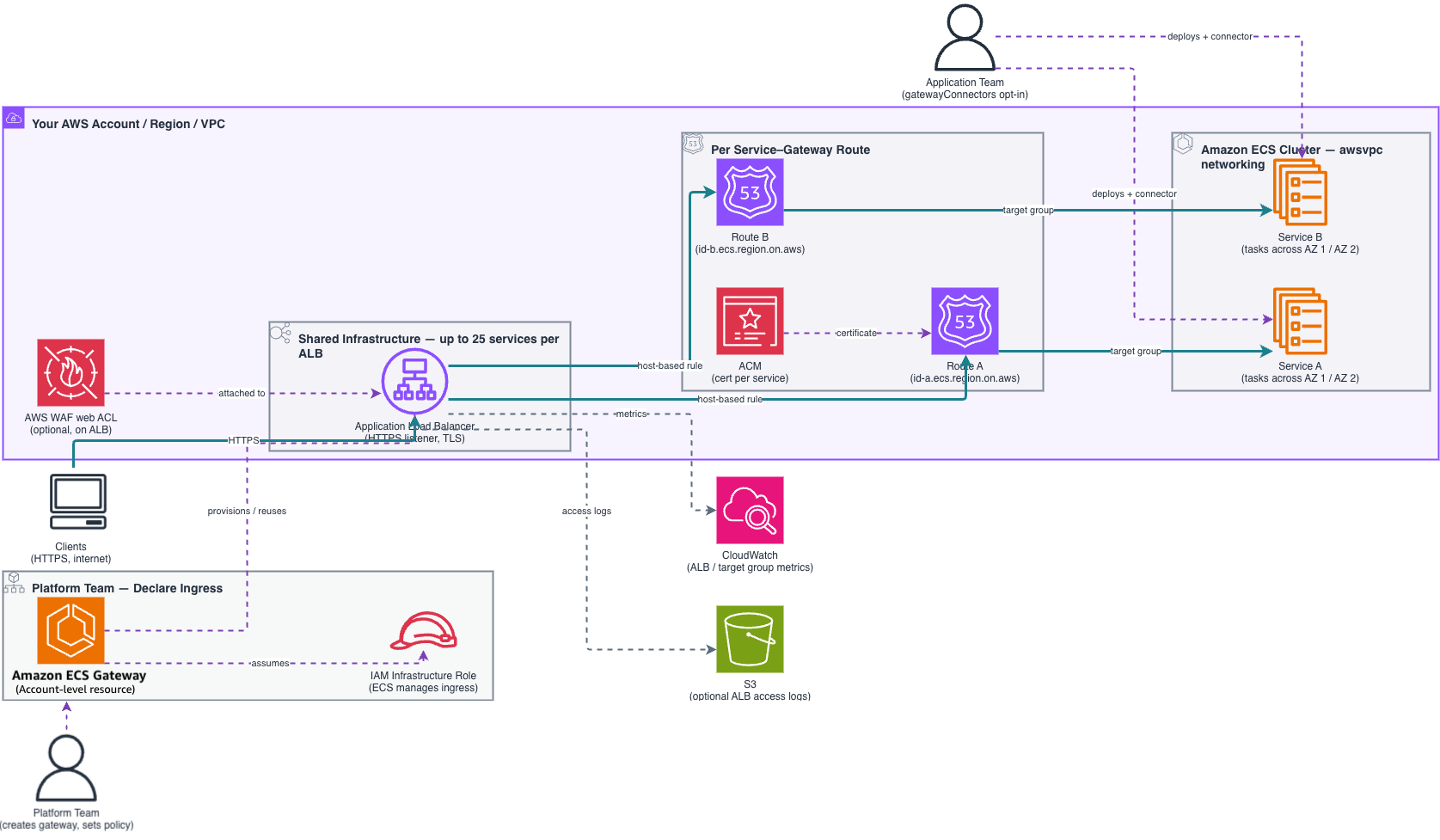
- Allocates the service to an ALB with available capacity (up to the configured
maxAlbCountquota). - Provisions a dedicated ACM certificate for secure transport.
- Generates a unique DNS hostname.
- Automatically updates listener rules to route incoming traffic matching that hostname directly to the service’s target group.
- Configures service-level security groups to permit inbound traffic exclusively from the corresponding ALB security group.
Once these automated tasks complete, the gateway route transitions to an ACTIVE status, and the microservice endpoint is fully live. The system also intelligently handles continuous operational lifecycles, automatically cleaning up listener rules, target groups, and DNS mappings when services are scaled down, updated, or deleted, thereby preventing orphan resources from lingering in the AWS account.
Official Responses and Industry Context
While AWS product engineering teams have emphasized the developer velocity gains of ECS Gateway, independent cloud architects and DevOps specialists have noted its profound implications for financial governance and compliance. By maximizing resource utilization—specifically through the density of up to 25 services sharing a single Application Load Balancer—organizations can significantly curb baseline cloud expenditure associated with idle or underutilized load balancer infrastructure.
Furthermore, the strict segregation between platform governance and application delivery aligns closely with modern platform engineering principles, often referred to as "Platform-as-a-Product." In this model, platform teams act as internal providers of secure, pre-packaged infrastructure primitives, while application developers consume those primitives self-service style without requiring deep networking expertise or administrative privileges over core AWS accounts.
Broader Impact and Strategic Implications
The introduction of Amazon ECS Gateway arrives at a time when container orchestration platforms face increasing scrutiny regarding operational complexity and total cost of ownership. While platforms like Kubernetes offer rich extensibility through custom ingress controllers and gateway APIs, configuring and maintaining those layers often demands specialized Kubernetes expertise and ongoing maintenance overhead.
By delivering a natively managed, highly scalable gateway construct directly within Amazon ECS, AWS provides a compelling alternative for organizations heavily invested in fully managed container services. It bridges the gap between the simplicity of serverless architectures and the architectural control of traditional container deployments.
Availability and Pricing Structure
Amazon ECS Gateway is generally available starting today across all commercial AWS Regions where Amazon ECS is supported.
AWS has structured the pricing model to ensure transparency: there is no direct or additional software charge for utilizing the ECS Gateway feature itself. Instead, customers incur costs solely for the underlying infrastructure resources provisioned within their accounts as services connect to gateways. This includes standard hourly charges and capacity units for Application Load Balancers, Amazon CloudWatch logs and metrics generated by the routing layers, AWS Certificate Manager certificate management fees (where applicable), and standard AWS data transfer rates.
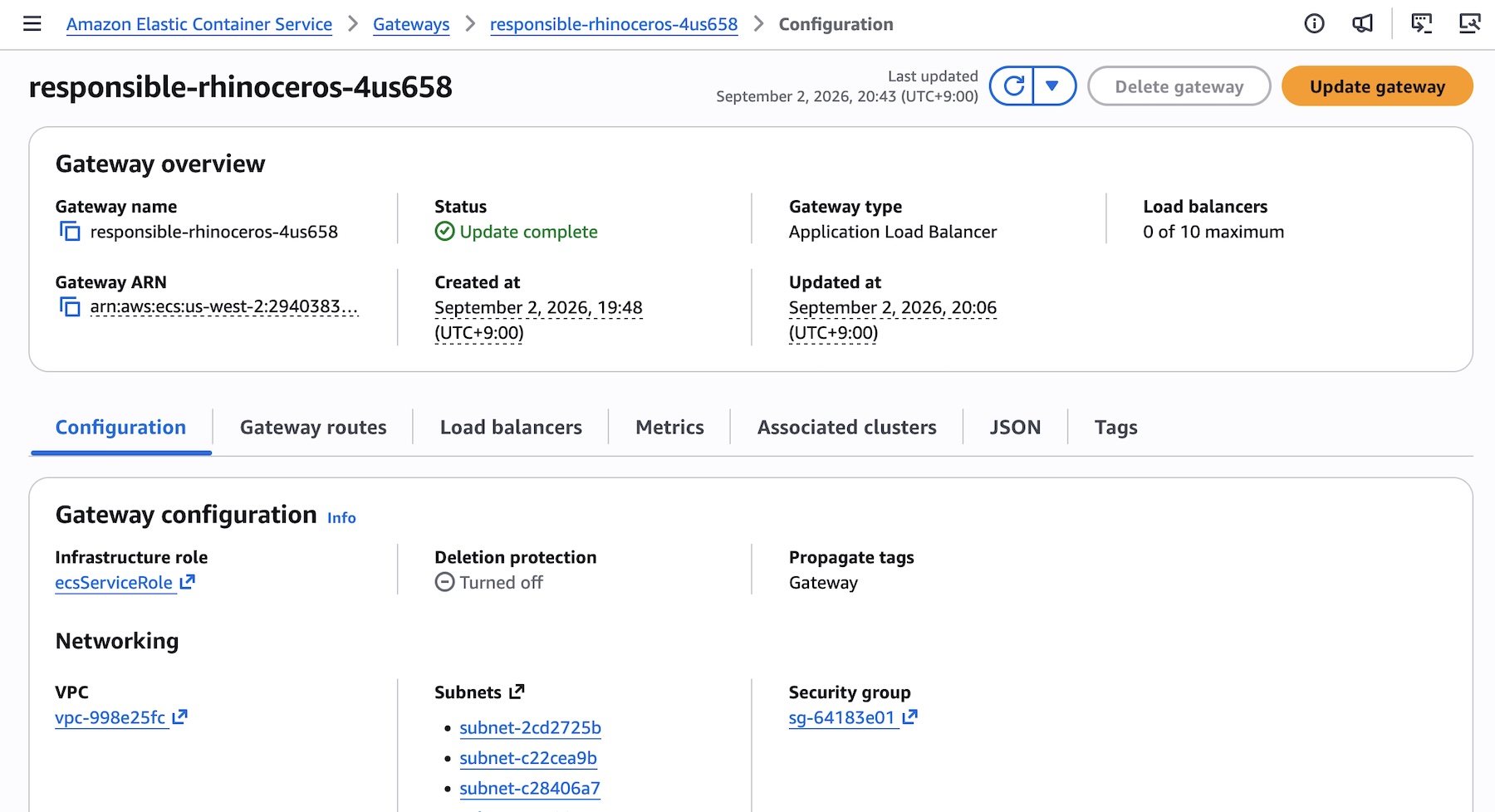
Organizations looking to modernize their container networking topologies can begin experimenting with the feature immediately via the Amazon ECS console or automation pipelines, with official support channels and AWS re:Post communities open for technical feedback and migration assistance.
Related posts: