Google Cloud Launches Managed Reinforcement Learning Fine-Tuning Service to Unlock Advanced Customization for Gemini Models

Google Cloud has officially announced the rollout of a fully managed Reinforcement Learning Fine-Tuning (RLFT) service, marking a significant milestone in how enterprises and developers customize foundational artificial intelligence models. Historically, reinforcement learning—a keystone of modern Large Language Model (LLM) post-training—has presented immense technical barriers. It has traditionally demanded massive training clusters, deep infrastructure investments, and direct access to model internals. For proprietary systems like Google’s Gemini family, external customers were previously locked out of these internal mechanics, restricting them to standard prompting and supervised fine-tuning (SFT).
The newly introduced RLFT service bridges this gap. By packaging the complex training apparatus into a managed cloud offering, Google Cloud allows enterprise users to bring their own prompts and reward functions while the platform manages the heavy lifting of infrastructure provisioning and model internal mechanics. This development shifts the paradigm of model adaptation from static, human-labeled datasets to dynamic, reward-driven optimization, opening up complex generative AI applications across industries ranging from gaming to automated software development.
Background Context: The Evolution of LLM Customization
To understand the significance of Google Cloud’s new offering, one must examine the evolution of model post-training over the past several years. When large language models first captured global enterprise interest, customization was largely limited to prompt engineering—crafting specific text inputs to guide a model’s behavior. While powerful, prompting has inherent limitations, such as context window constraints and susceptibility to drifting or prompt injection.
To achieve deeper behavioral alignment, the industry adopted Supervised Fine-Tuning (SFT). SFT involves training a model on a curated dataset of "gold standard" input-output pairs, effectively teaching the AI by example. However, SFT hits a wall when dealing with tasks that are easy to evaluate but agonizingly difficult or expensive to pre-demonstrate. For instance, while a human can easily verify whether a generated SQL query returns the correct dataset, writing out thousands of ideal SQL queries for a complex, proprietary database schema is prohibitively labor-intensive.
Enter Reinforcement Learning (RL). Popularized by techniques like Reinforcement Learning from Human Feedback (RLHF), RL allows a model to explore various response paths, evaluate them against a scoring mechanism, and iteratively adjust its internal weights to favor higher-scoring outcomes. Until now, deploying RL pipelines required specialized machine learning engineering teams, massive GPU clusters, and open-source base models where code could be altered at the gradient level. Google Cloud’s RLFT service democratizes this methodology, abstracting the infrastructure layer so that domain experts can optimize models using simple logic-based reward functions.
How the Managed RLFT Service Operates
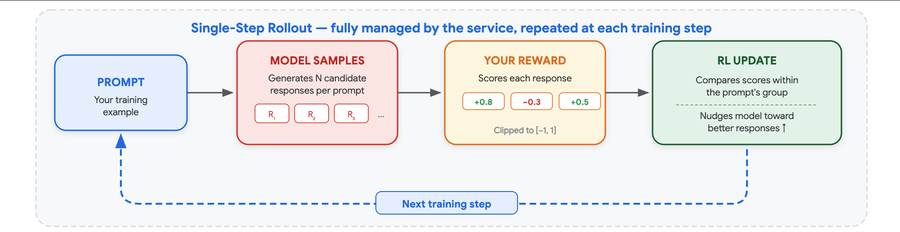
At its core, the RL Fine-Tuning service operates on a continuous feedback loop designed to optimize Gemini without requiring external access to the model’s foundational architecture. During each training step, the service prompts the Gemini model to generate multiple candidate responses. These candidates are then evaluated by a customer-defined reward function—a program or script written by the user that scores the quality, accuracy, format, or tone of the output.
Once the responses are scored, the service updates the model’s parameters, increasing the statistical likelihood of generating higher-scoring responses in the future. Crucially, the training algorithm incorporates mechanisms to prevent the model from drifting too far from its original Gemini baseline, preserving its general reasoning capabilities, linguistic fluency, and safety guardrails.
Google Cloud emphasizes that while the reinforcement learning mechanics are fully managed and automated behind the scenes, the ultimate responsibility—and the primary determinant of success—lies in the reward function. Users own the logic that dictates what constitutes a "good" versus a "bad" response. This shifts the engineering focus from curating massive datasets to writing precise, programmatic scoring criteria.
Strategic Decision Framework: When to Deploy RLFT
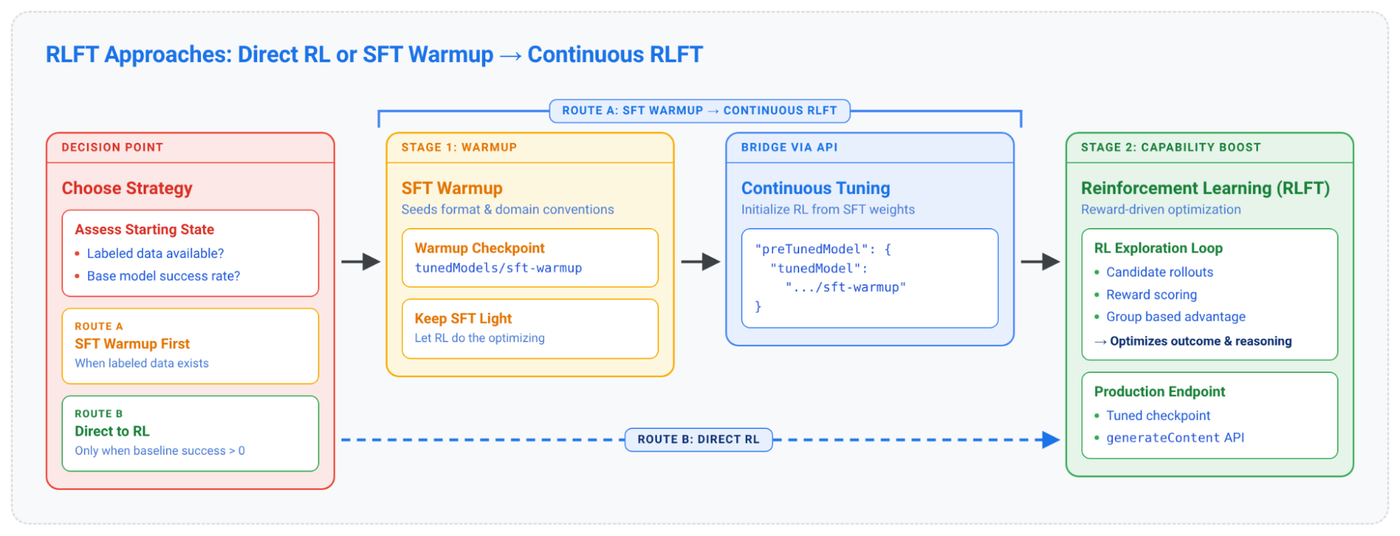
Industry analysts and Google Cloud architects recommend a deliberate, phased approach to model customization. Organizations should exhaust traditional methods like advanced prompting and supervised fine-tuning before turning to reinforcement learning. SFT remains the ideal choice when a task has clear, demonstrable single-best answers and abundant training data.
However, RLFT becomes the superior choice under specific operational conditions:
- When a response can be easily graded or verified, but authoring the ideal answer beforehand is prohibitively expensive or complex.
- When Supervised Fine-Tuning has plateaued on key metrics such as factual accuracy, structural validity, or brand tone.
- When a task inherently features multiple valid answers, and a single reference target in an SFT dataset would unfairly penalize alternative, creative, or equally correct solutions.
Rather than competing methodologies, SFT and RLFT function as complementary tools in the modern enterprise AI toolkit. SFT can be used to establish a strong baseline of capability and formatting discipline, while RLFT can subsequently refine the model to master complex domain-specific logic and constraints.
High-Impact Enterprise Use Cases
Early adopters and internal testing across diverse industry verticals have highlighted several prominent use cases where the RLFT service delivers exponential value compared to traditional fine-tuning approaches.
AI-Powered Non-Player Characters (NPCs) in Video Games
Developing conversational NPCs that react dynamically to player choices while staying true to character lore is notoriously difficult. With RLFT, developers can score NPC responses based on adherence to personality profiles, quest logic, and contextual appropriateness, allowing the Gemini model to naturally learn engaging, consistent dialogue behavior without manual scripting of every interaction branch.
Structured Entity Extraction
Extracting precise data from unstructured documents—such as invoices, medical records, or legal contracts—often results in formatting errors under standard SFT. By using an execution-based reward function that verifies whether the extracted JSON schema matches strict database requirements, developers can train Gemini to achieve near-error-free structured outputs.
Content Moderation and Policy Compliance
Enterprise content moderation requires nuanced judgment that static classification rules often miss. RLFT enables companies to score model-generated policy enforcement explanations against complex corporate compliance guidelines, systematically reducing false positives and improving adherence to safety standards.
Code Generation Measured by Execution
Writing code via language models often leads to syntax errors or logical bugs that pass surface-level text checks. With RLFT, the reward function can automatically execute generated code snippets in a secure sandbox, returning a positive or negative score based on test-suite pass rates. This allows Gemini to autonomously learn robust coding practices through trial and error.
Automated Presentation Slide Generation
Generating professional slide decks from raw text documents requires balancing textual summarization with structural HTML or layout constraints. RLFT can evaluate rendered slide outputs against aesthetic and structural guidelines, teaching Gemini to produce clean, presentation-ready code.
Best Practices and Getting Started
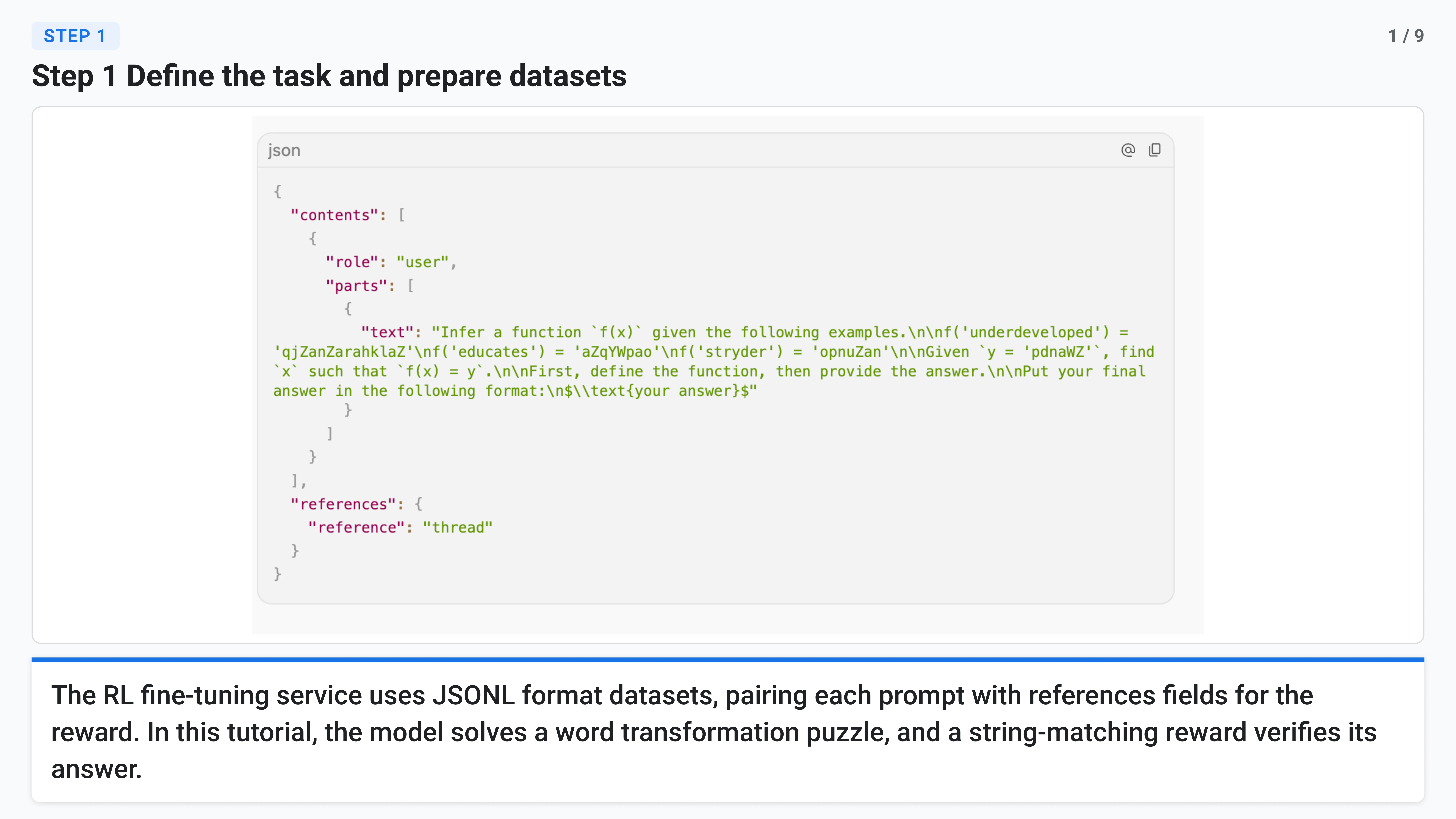
For organizations looking to deploy the RLFT service, Google Cloud outlines a streamlined onboarding process designed to minimize friction. Users begin by establishing a clear evaluation dataset and defining a programmatic reward function that encapsulates their business objectives.
Within the managed console, administrators can monitor training and validation reward curves in real-time. A critical best practice highlighted by cloud engineers is selecting model checkpoints based on validation reward saturation rather than simply taking the final training step, thereby preventing overfitting to the training distribution. By relying on default hyperparameter configurations provided by the service, teams can focus their engineering efforts entirely on refining their scoring logic and evaluation metrics.
Broader Industry Implications and Future Outlook
The launch of Google Cloud’s managed RLFT service signals a broader maturation in enterprise artificial intelligence adoption. As foundational models become increasingly commoditized, competitive advantage will no longer stem from raw model access alone, but from an organization’s ability to imbue proprietary intelligence and domain-specific logic into AI systems efficiently.
By lowering the technical barriers to reinforcement learning—a domain previously restricted to elite academic and corporate research laboratories—Google Cloud is empowering a wider ecosystem of developers to build self-improving AI applications. As businesses increasingly demand models that can reason, verify, and adapt autonomously, managed RLFT architectures represent a crucial step toward fully autonomous, goal-driven enterprise artificial intelligence systems.
Related posts: