Enterprise organizations running heavy legacy workloads on VMware platforms have long sought frictionless pathways to migrate, modernize, or establish secondary disaster recovery sites in public clouds. Historically, achieving this meant either adapting to fully managed hyperscaler services that altered operational playbooks or enduring the heavy lifting of maintaining custom data center architectures. Addressing this industry-wide challenge, Google Cloud has officially announced the general availability of its new, self-managed VMware solution on dedicated Google Cloud bare metal infrastructure. Part of the broader Google Cloud Modernize portfolio, this release introduces a new paradigm of architectural flexibility, granting enterprise administrators absolute, root-level authority over the entire VMware Cloud Foundation (VCF) stack running natively within Google’s high-performance cloud environment.
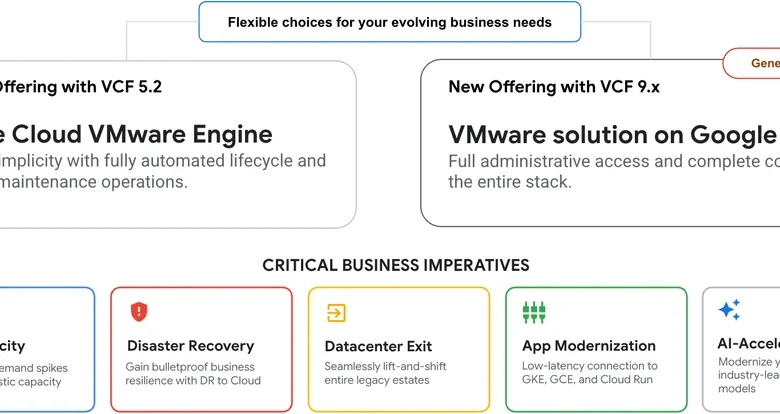
This newly launched deployment model directly complements Google’s existing managed service offerings, such as Google Cloud VMware Engine (GCVE). While managed services cater to organizations prioritizing turnkey simplicity and offloaded maintenance, the new self-managed option is specifically tailored for enterprises with deeply ingrained operational practices. These organizations often require direct, uninterrupted control over their virtualization layers, strict adherence to proprietary maintenance windows, and custom integration loops with complex third-party monitoring, security, and management toolchains. By bridging the gap between on-premises levels of control and cloud-scale agility, Google Cloud is positioning itself as an exceptionally versatile destination for mission-critical enterprise workloads.
The Catalyst of VMware Cloud Foundation 9.x and Broadcom’s Strategic Alignment
A primary technological catalyst behind this self-managed deployment option is the launch of VMware Cloud Foundation 9.x by Broadcom. The evolution of the VCF platform introduces a highly unified control plane designed for end-to-end stack deployment and rigorous lifecycle management. For enterprise customers, this means they can directly harness Broadcom’s latest software innovations while fully maximizing their existing capital investments in VCF licensing through standard Bring Your Own License (BYOL) portability frameworks.
Industry analysts note that licensing portability is a critical economic vector for large-scale enterprise migrations. Rather than forcing organizations to forfeit existing software investments or navigate complex, punitive re-licensing terms, the VCF license portability model allows enterprises to bring their current subscriptions directly to Google Cloud. They can execute workloads entirely unchanged, maintain complete administrative sovereignty over dedicated Z3 bare metal, and subsequently apply existing Google Cloud commitments and volume discounts to optimize long-term operational expenditures.
Abhay Kumar, Global Head of Hyperscalers at the VMware Cloud Foundation Division within Broadcom, emphasized the strategic alignment driving the release. Customers consistently demand the operational velocity and scalability of Google Cloud, Kumar observed, but they frequently push back against the prospect of re-architecting complex VMware environments or abandoning time-tested operational protocols. Through this newly deployed solution, enterprises can combine VCF license portability with dedicated bare metal execution, achieving cost optimization without compromising administrative authority.
Contrasting Deployment Models: Google Cloud VMware Engine versus the New VMware Solution
To accommodate the diverse operational maturities and architectural requirements of its global customer base, Google Cloud now supports two distinct, robust pathways for running VMware workloads. Understanding the operational divergence between these models is essential for enterprise IT leadership formulating long-term cloud migration strategies.
Google Cloud VMware Engine (GCVE) remains the optimal choice for organizations prioritizing turnkey operations, operational simplicity, and offloaded maintenance schedules. Powered historically by VMware Cloud Foundation 5.2, GCVE grants administrators role-based vCenter administrative privileges while Google’s engineering teams handle automated patching, backend hardware updates, and infrastructure monitoring. The underlying hardware relies on specialized VMware Engine node families, ensuring a streamlined, highly automated cloud experience where the infrastructure fades seamlessly into the background.
Conversely, the newly released VMware solution on Google Cloud is engineered specifically for teams requiring architectural flexibility, full stack customization, and direct ownership. Built on top of VMware Cloud Foundation 9.x, this self-managed model delivers absolute root-level administrative access across every component of the stack, including ESXi hypervisors, vCenter instances, NSX Manager networking planes, and associated VCF management utilities. Lifecycle management, patching schedules, and component updates are driven directly by the customer or their chosen managed service partners using native VCF Operations Management toolchains. Hardware execution relies on dedicated Compute Engine (GCE) bare metal instances, such as the high-capacity Z3 node families.
High-Performance Architecture on Dedicated Z3 Bare Metal Instances
Performance and latency remain paramount concerns for enterprises migrating transactional databases, high-throughput enterprise resource planning (ERP) systems, and real-time analytics engines to the cloud. To address these rigorous demands, the self-managed VMware solution is deployed natively on dedicated Google Compute Engine Z3 bare metal instances, specifically utilizing configurations like the z3-highmem-192-highlssd-metal node. Powered by advanced 4th Generation Intel Xeon Processors (Sapphire Rapids) clocked at 2.2 GHz, these bare-metal nodes deliver exceptional computational density and raw throughput.
Operating natively within Google Cloud alongside standard Google Compute Engine (GCE) instances and Google Kubernetes Engine (GKE) clusters, the architecture unlocks unprecedented network performance. Enterprises benefit from ultra-high bandwidth and minimal network latency when bridging virtualized VMware environments with native Google Cloud platform services. This architectural proximity enables seamless transactional data flows into advanced analytics and artificial intelligence engines, including BigQuery, the Gemini platform, Cloud Run, and various native machine learning pipelines.
Storage architecture within the platform is equally robust, anchored by VMware vSAN hyperconverged infrastructure powered by high-performance, all-flash NVMe storage drives embedded directly within the Z3 nodes. These enterprise-grade drives can be dynamically leveraged for advanced NVMe memory tiering, significantly accelerating input/output operations per second (IOPS) for demanding workloads. Furthermore, recognizing that enterprise storage strategies frequently span multi-vendor arrays, the solution natively supports NetApp volumes as external datastores.
Pravjit Tiwana, Senior Vice President and General Manager of Cloud Storage at NetApp, highlighted the collaborative value of this integration. The integration provides enterprises with unprecedented control, choice, and architectural freedom, Tiwana noted. By incorporating NetApp volumes as an external datastore, NetApp and Google Cloud are empowering organizations to migrate complex data estates with absolute confidence, ensuring they retain the granular performance, data management, and governance capabilities upon which their businesses depend.
Total Cost of Ownership (TCO) Optimization and Economic Efficiency
The convergence of VMware Cloud Foundation 9.1 software capabilities with Google Cloud’s high-density Z3 bare-metal infrastructure yields quantifiable economic benefits and streamlined total cost of ownership (TCO) profiles for enterprise buyers. By decoupling the underlying physical hardware lifecycle from the upper virtualization and management layers, organizations gain unprecedented agility. IT teams can rapidly provision, expand, or contract bare-metal capacity within minutes in response to shifting business demands, all while preserving their established operational frameworks.
Early enterprise adopters have validated these economic models. Scott Ronan, Senior Director of Platforms, Databases, and Cloud at GXO Logistics, shared insights from early assessments of the platform. According to Ronan, separating the hardware lifecycle from the virtualization layer grants the organization the ability to scale bare-metal capacity instantaneously while retaining absolute administrative control. This operational structure successfully bridges the elasticity and financial predictability of the cloud with the strict governance required of enterprise-grade core infrastructure platforms.
Furthermore, commercial flexibility is bolstered through deep billing integration. Enterprises can apply existing Google Cloud committed use discounts (CUDs) and enterprise agreement commitments directly to the bare-metal infrastructure consumption. When combined with VCF license portability, organizations effectively eliminate the double-taxation penalty often associated with legacy cloud migrations, maximizing the return on investment for both software subscriptions and cloud compute spend.
Ecosystem Support and Partner-Managed Service Delivery
Recognizing that many enterprise IT departments prefer external management or require specialized professional services during complex data center exits, Google Cloud has cultivated a robust ecosystem of certified global partners. These organizations possess dual expertise across Google Cloud infrastructure and VMware Cloud Foundation architectures, offering turnkey professional services, migration execution, and ongoing managed operations.
Featured partners delivering comprehensive support for the self-managed VMware solution include global technology leaders such as Accenture, Advanced Business Computing, Cognizant, Devoteam, HCLTech, IBM Consulting, Infosys, Insight, LiverX, ModernZ, Pellera, Quantiphi, Tata Consultancy Services (TCS), Wipro, and Xtravirt. These partners provide end-to-end consulting, deployment architecture design, automated migration runbooks, and ongoing managed support contracts tailored to the precise regulatory and operational requirements of individual enterprise clients.
Broader Industry Implications and Future Outlook
The launch of the self-managed VMware solution on Google Cloud marks a mature phase in the evolution of multi-cloud enterprise strategy. For years, public cloud providers pursued strategies that implicitly or explicitly required enterprises to refactor applications or adopt fully standardized, provider-managed proprietary stacks. While effective for cloud-native greenfield projects, this approach frequently stalled multi-million-dollar data center exits involving complex, tightly coupled legacy enterprise architectures.
By providing a first-class, fully supported pathway for native VCF execution on dedicated bare metal, Google Cloud and Broadcom are acknowledging that enterprise modernization is not a monolithic journey. Organizations require nuanced architectural stepping stones that respect sunk capital, specialized compliance mandates, and deeply ingrained operational muscle memory.
As enterprises increasingly face macroeconomic pressures to optimize IT expenditure while accelerating digital transformation initiatives, flexible deployment models that honor existing software investments will likely capture significant market share. The availability of this solution across 22 global Google Cloud regions at launch—with aggressive regional expansions slated for upcoming quarters—signals a major strategic push to capture large-scale enterprise migration pipelines. For CIOs and IT infrastructure leaders seeking to balance the unyielding demands of cloud agility with the stringent governance of self-managed virtualization, the new VMware solution on Google Cloud establishes a compelling, highly scalable foundation for the enterprise decade ahead.