How Pine59 Scaled Location Intelligence and MLOps Infrastructure Using Google Cloud Managed Service for Apache Airflow and Airflow 3

The modern data-driven enterprise operates in an ecosystem where the volume and velocity of information dictate competitive advantage. Managing vast, complex data pipelines requires an orchestration layer capable of scaling dynamically alongside expanding computational workloads. When an organization processes millions of granular data points daily to power predictive artificial intelligence and machine learning models, modernizing its underlying technology stack transcends a mere operational upgrade—it becomes a vital strategic necessity.
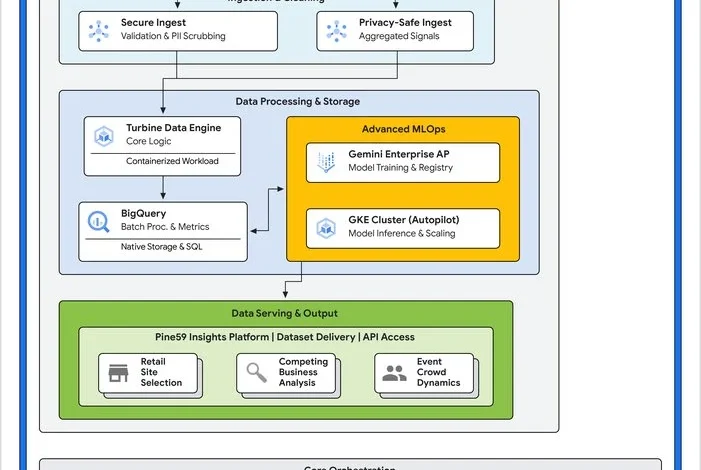
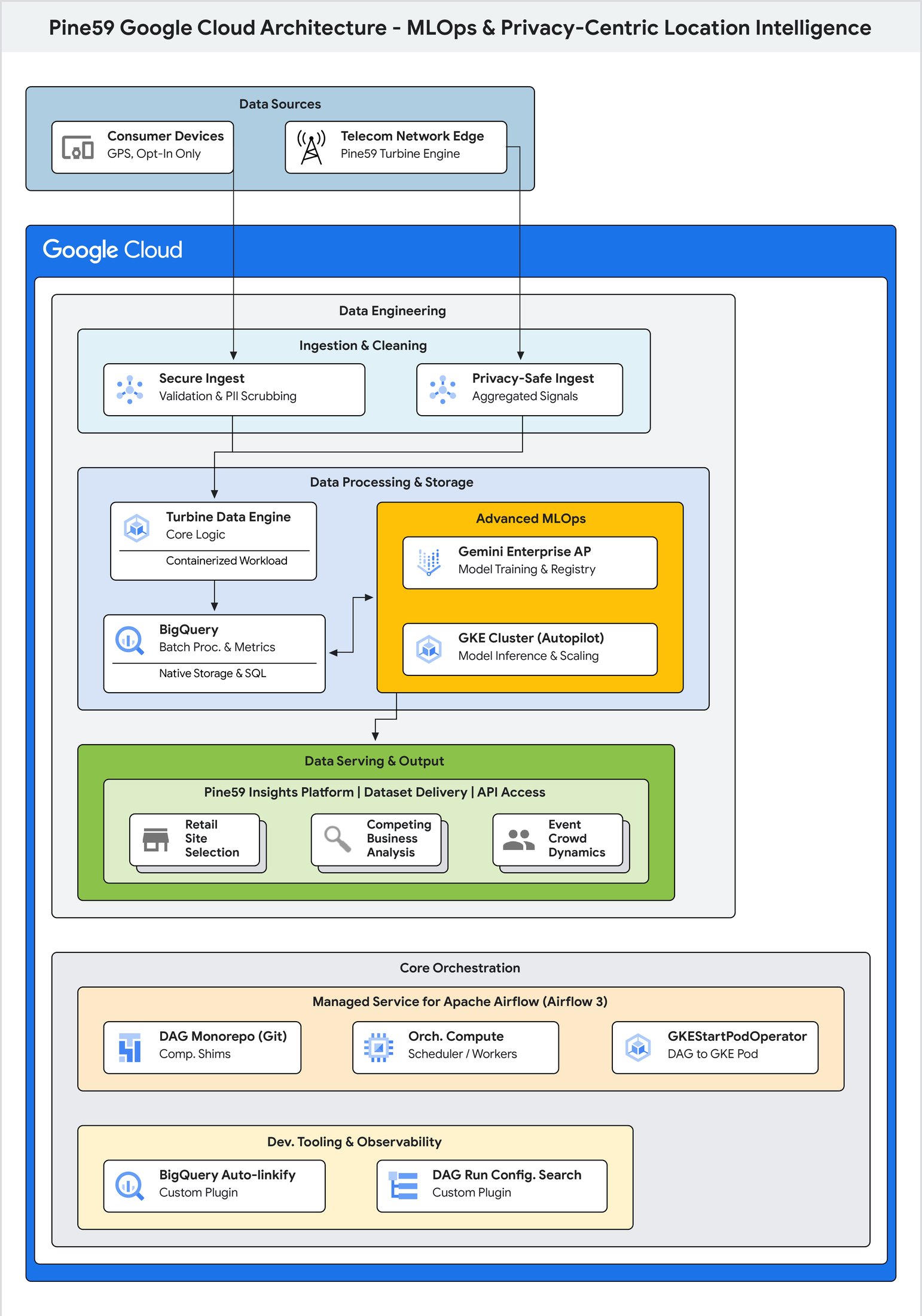
Pine59, a prominent provider of sophisticated location intelligence data, recently confronted this scaling imperative. The company delivers analytical metrics derived from extensive data pipelines, with production cadences ranging from rapid hourly updates to comprehensive quarterly overviews. Among its most demanding computational tasks is its flagship "Daily Foot Traffic" metric, which meticulously computes analytical data for as many as 14 million distinct geographical locations within a single production job. To successfully manage this staggering volume of information, Pine59’s entire technical architecture runs natively on Google Cloud. The heavy data-processing workloads are executed within BigQuery, while the overarching coordination and synchronization of tasks are managed by Google Cloud’s Managed Service for Apache Airflow—formerly known as Cloud Composer—running the newly available Apache Airflow 3 architecture.
As the enterprise experienced accelerated growth in its data ingestion volumes and expanded its portfolio of machine learning (ML) workloads, engineering leadership at Pine59 recognized the need to modernize its shared monorepo. This repository houses hundreds of interconnected directed acyclic graphs (DAGs) that dictate the flow of data across multiple projects. By undertaking a proactive modernization initiative, the company sought to radically enhance its MLOps capabilities, optimize developer workflows, and drastically accelerate pipeline execution speeds. This comprehensive transition highlights the profound impact that modern, managed cloud orchestration tools can have on enterprise-grade data engineering operations.
Background and Context of the Infrastructure Evolution
For years, Pine59 relied on a collaborative monorepo structure containing code, configuration files, and tooling spanning numerous discrete projects to power its core metric production pipelines. While this architecture served the company well during its early growth phases, the rapid accumulation of data and the increasing complexity of downstream machine learning models began to strain legacy operational limits. Tasks within large DAG runs would occasionally experience bottlenecks, leading to delays during peak processing surges. Furthermore, standard Kubernetes operators utilized for machine learning inference tasks required architectural refinement to prevent resource contention between heavy data processing and model execution.
Recognizing these emerging bottlenecks, Pine59’s engineering team elected to conduct a rigorous stress-test of production workloads against the newly released Managed Airflow (Gen 3) architecture running Apache Airflow 3. The initial exploratory results provided unequivocal evidence of superior performance. The Generation 3 environment delivered immediate and substantial improvements in task scheduling efficiency, overall processing speed, and platform stability. Buoyed by these promising empirical metrics, Pine59 initiated a full-scale migration plan to transition its entire production ecosystem to the new environment.
The Chronology and Execution of the Migration Strategy

The transition to Managed Airflow (Gen 3) and Apache Airflow 3 was executed through a structured, multi-phase engineering strategy designed to minimize disruption to live analytical services. The timeline of this infrastructure overhaul involved preliminary evaluation, architectural decoupling of MLOps components, and the deployment of custom developer tooling.
In the initial exploratory phase, Pine59 benchmarked existing production workloads against the Airflow 3 environment. Following the successful validation of speed and stability improvements, the engineering team turned its focus toward optimizing the separation of concerns within the MLOps pipeline. Historically, standard Kubernetes operators handled both general pipeline orchestration and heavy machine learning inference tasks within a unified operational framework. Under the modernized Gen 3 architecture, the team established a dedicated Google Kubernetes Engine (GKE) cluster explicitly optimized for model inference. This cluster was subsequently integrated seamlessly into the Pine59 data pipelines, creating a distinct boundary between lightweight workflow orchestration and heavy computational ML execution.
To facilitate a smooth transition for the engineering staff and prevent disruptions across hundreds of interdependent DAGs, the team deployed a specialized compatibility shim layer within the shared monorepo. This "compat" module dynamically abstracts execution logic between different iterations of Apache Airflow, effectively streamlining the operator migration process and allowing developers to update legacy codebases incrementally without breaking existing production schedules.
Enhancing Enterprise MLOps and Developer Workflows
A core pillar of Pine59’s migration strategy was the optimization of its advanced MLOps capabilities. Because the company’s pipelines feed complex predictive models that dictate high-value business insights, ensuring the reliability and isolation of inference workloads is paramount. By leveraging the highly optimized and abstracted infrastructure layer provided by Managed Airflow (Gen 3), Pine59 successfully decoupled data movement and transformation from model scoring. This structural clarity ensures that data processing and machine learning inference can scale independently, establishing Managed Airflow as a resilient, highly scalable backbone for enterprise artificial intelligence operations.
Beyond infrastructural and MLOps enhancements, the migration to Apache Airflow 3 provided an immediate boon to internal developer velocity and user interface observability. Managing hundreds of interconnected DAGs necessitates robust monitoring tools and clear visibility into task execution states. Pine59’s engineering personnel leveraged Airflow 3’s advanced plugin authoring system, finding the framework exceptionally intuitive and extensible.
To maximize internal productivity, the team rapidly developed and deployed several custom plugins directly integrated into the new Airflow user interface. These custom extensions improved observability, streamlined debugging processes, and provided developers with tailored administrative controls suited specifically to Pine59’s proprietary location intelligence workflows. The combination of an enhanced UI, simplified plugin creation, and the compatibility shim layer significantly reduced the cognitive load placed on data engineers, allowing them to focus on feature delivery rather than infrastructure maintenance.
Quantifiable Performance Gains and Empirical Data
The migration from Managed Airflow (Gen 2) utilizing Apache Airflow 2.11 to Managed Airflow (Gen 3) running Apache Airflow 3.1 yielded measurable, highly quantifiable performance improvements across all key operational metrics.
The most transformative enhancement observed by Pine59 was the dramatic reduction in task queue latency. In the legacy Gen 2 environment, concurrent data processing surges frequently caused tasks to remain trapped in a queued state, creating cascading delays throughout the dependency tree. In contrast, the Gen 3 environment virtually eliminated queue latency, enabling tasks to transition into the running state almost instantaneously upon meeting their prerequisite conditions.
Comparative historical data compiled from more than 300 runs of identical enterprise DAGs vividly illustrates this divergence. Aggregate metrics tracking the combined "queued" and "running" duration demonstrated a profound reduction in wait times under the new architecture. When paired with internal code optimizations applied to individual DAGs during the migration process, the compound performance gains translated into staggering reductions in total execution duration.
For instance, Pine59’s flagship Daily Foot Traffic pipeline—which computes analytical data for up to 14 million distinct locations in a single job—previously required nearly 38 minutes to complete its full lifecycle. Following the migration to Managed Airflow (Gen 3) and the implementation of accompanying workflow optimizations, the exact same computational workload now executes in less than 26 minutes. This represents an efficiency gain of nearly 32% in total processing time, freeing up valuable computational resources and accelerating the delivery of critical location intelligence metrics to downstream clients and predictive models.
Broader Industry Implications and Future Outlook
Pine59’s successful transition serves as a compelling case study for data-intensive enterprises grappling with the operational overhead of scaling legacy orchestration layers. As organizations increasingly integrate complex machine learning models into their core product offerings, the traditional boundaries between data engineering, pipeline orchestration, and MLOps continue to dissolve.
The strategic choice to adopt fully managed, cloud-native orchestration frameworks allows engineering organizations to shift their primary focus from reactive server maintenance and infrastructure troubleshooting to proactive feature innovation and algorithmic refinement. By harnessing the performance headroom provided by Apache Airflow 3 and Google Cloud’s Managed Service for Apache Airflow, Pine59 has insulated its technical foundation against future growth, ensuring that its location intelligence platform can continue to expand its geographical coverage and analytical depth without compromising speed or reliability.
Industry analysts note that as data volumes continue their exponential upward trajectory, companies utilizing fragmented or outdated orchestration tools will increasingly face operational bottlenecks. Initiatives such as Pine59’s migration demonstrate that proactive infrastructure modernization yields immediate dividends in developer productivity, computational efficiency, and operational resilience. For engineering teams currently spending disproportionate amounts of time managing server instances and resolving queue congestion, the architectural pathway charted by Pine59 offers a clear blueprint for sustainable, enterprise-scale data and artificial intelligence operations.
Related posts: