The transformation of commercial real estate is no longer confined to architectural aesthetics or prime locations; it is increasingly defined by the invisible digital infrastructure that governs how individuals interact with physical spaces. For decades, building security was a static, reactive discipline centered on physical barriers, brass keys, and manual logbooks. However, the rapid proliferation of the Internet of Things (IoT) has catalyzed a shift toward connected access management, a technological layer that integrates security, operational efficiency, and tenant experience into a single, cohesive ecosystem. As facilities managers and building owners navigate the post-pandemic landscape, the adoption of these systems has moved from a luxury "smart" feature to a fundamental requirement for modern commercial operations.
The Evolution of Entry: A Chronology of Access Control
To understand the current state of connected access, one must look at the trajectory of building security over the last half-century. The evolution has been marked by three distinct eras of technology, each building upon the limitations of its predecessor.
In the pre-digital era, stretching through the late 20th century, security was entirely mechanical. Access was managed through physical keys, which were easily lost, duplicated, or unreturned. Tracking who entered a building required a security guard and a paper ledger, a system prone to human error and impossible to audit in real-time.
The second era, beginning in the 1980s and 1990s, saw the introduction of electronic access control systems (EACS). This introduced RFID (Radio Frequency Identification) cards and "fobs." While this allowed for the revocation of credentials without changing locks, these systems were largely "siloed." The data lived on local servers, and the hardware at the door rarely communicated with other building systems like HVAC or lighting.
The third and current era is defined by the "Connected Access" model. Beginning in the mid-2010s and accelerating rapidly into the 2020s, this era leverages cloud computing, mobile credentials, and IoT connectivity. In this stage, the door is no longer just a barrier; it is a data point. According to industry analysts, the global smart building market—driven heavily by these access technologies—is projected to grow from approximately $96 billion in 2023 to over $200 billion by 2030, representing a compound annual growth rate (CAGR) of over 10%.
The Technical Framework of Connected Systems
A connected access system differs from traditional electronic locks through its networked architecture. Rather than treating each entry point as an isolated island of hardware, a connected system links every door, elevator, and turnstile into a unified software dashboard. This architecture typically relies on several key components:
- Cloud-Based Management: Centralized software allows administrators to manage multiple properties from a single interface, regardless of geographical location.
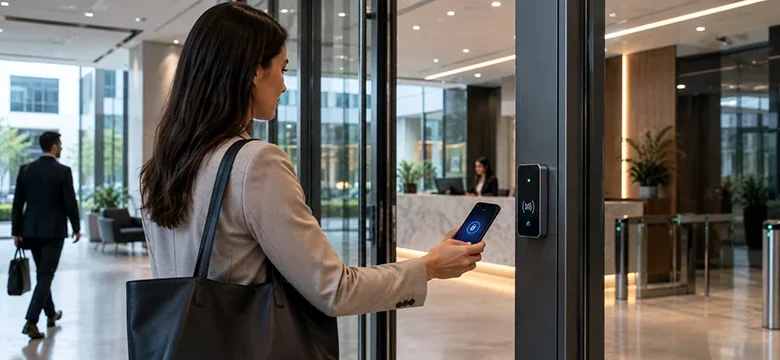
- Mobile Credentials: Utilizing Bluetooth Low Energy (BLE) or Near Field Communication (NFC), smartphones replace physical cards, offering encrypted, non-transferable access.
- Edge Intelligence: Modern controllers at the door can make split-second decisions even if the primary network connection is lost, ensuring that security is never compromised by an internet outage.
- API Integration: Open Application Programming Interfaces (APIs) allow the access system to "talk" to other software, such as tenant experience apps, visitor management systems, and even payroll software.
By moving the "brain" of the system to the cloud, building owners can eliminate the need for expensive on-site servers and the specialized IT staff required to maintain them. This shift toward Software-as-a-Service (SaaS) models in physical security is one of the primary drivers of adoption in the commercial sector.
Quantifying the Benefits: Safety, Efficiency, and ROI
The move toward connected access is driven by more than just a desire for modern gadgets; it is a response to the shifting economic and safety requirements of the commercial sector. Data from McKinsey & Company suggests that buildings utilizing integrated smart technologies can see a 15% to 20% increase in operational efficiency.
From a safety perspective, the advantages are immediate. In the event of a security breach or a localized emergency, a connected system allows for a "global lockdown" initiated with a single command. Conversely, in a fire emergency, the system can automatically release specific doors to facilitate a safe evacuation while simultaneously providing first responders with a real-time list of who is still inside the building based on the latest access logs.
Beyond safety, the operational data harvested from these systems is invaluable. Traditionally, building managers had to guess how many people were using specific floors or amenities. Today, access logs provide a granular look at occupancy patterns. If data shows that a particular wing of an office building is only used at 20% capacity on Fridays, facilities managers can adjust the climate control and cleaning schedules for that area, leading to significant reductions in energy waste and labor costs.
The Tenant Experience and the Frictionless Workplace
In the competitive landscape of commercial real estate, the tenant experience is a primary differentiator. The "frictionless" office is a concept where employees and visitors can move from the parking garage to their desks without ever touching a door handle or waiting in a reception line.
Connected access systems facilitate this through automated visitor management. When a guest is invited to a meeting, they receive a temporary QR code or mobile credential via email. Upon arrival, they scan their phone at the lobby kiosk, the system notifies the host of their arrival, and the elevators are automatically programmed to take them to the correct floor. This level of automation reduces the administrative burden on front-desk staff and provides a professional, high-tech first impression for visitors.
Industry experts note that this convenience also extends to the "hybrid" work model. With employees coming and going at irregular hours, a connected system allows for flexible permissioning. A contractor may be granted access only between 9:00 AM and 5:00 PM on Tuesdays, with their digital key automatically expiring the moment their contract ends. This eliminates the "ghost credential" problem, where former employees or contractors retain physical keys or active badges long after they should have been returned.
Strategic Implementation and Cybersecurity
Transitioning a legacy commercial building to a connected access model requires a strategic approach. Security professionals generally recommend a phased rollout, often starting with a pilot program in a high-traffic area or a single department. This allows the facility team to identify potential bottlenecks and ensure that the network infrastructure can handle the increased data load.
A critical consideration in any IoT rollout is cybersecurity. As physical security devices become part of the corporate network, they become potential entry points for cyberattacks. To mitigate this, modern systems employ end-to-end encryption and regular firmware updates. Choosing vendors that adhere to high standards—such as SOC 2 compliance or those utilizing the Open Supervised Device Protocol (OSDP)—is essential for protecting both the physical and digital integrity of the building.
Furthermore, the issue of "fail-safes" must be addressed. A common concern among building owners is what happens during a power failure or a total network collapse. Modern connected systems are designed with local battery backups and "offline" modes that allow the hardware to continue functioning based on the last known permission set, ensuring that tenants are never locked out of their own workspace during a technical glitch.
The Broader Impact: Smart Cities and Sustainability
The rise of connected access in commercial buildings is a microcosm of the broader "Smart City" movement. As more buildings become digitally aware, they can begin to share data with city-wide infrastructures. For instance, aggregated occupancy data from a cluster of commercial buildings could help municipal transit authorities optimize bus and train schedules based on real-time demand.
From a sustainability standpoint, the integration of access control with Building Management Systems (BMS) is a powerful tool for achieving ESG (Environmental, Social, and Governance) goals. Lighting and HVAC systems typically account for the majority of a commercial building’s carbon footprint. By using access data to trigger "sleep modes" for unoccupied zones, buildings can drastically reduce their energy consumption. This not only lowers operating costs but also increases the asset value of the property in an era where tenants and investors increasingly prioritize green-certified spaces.
Conclusion
Connected access systems have evolved from a niche security upgrade into the backbone of the modern commercial building. By bridging the gap between physical hardware and digital intelligence, these systems provide a level of oversight and flexibility that was previously impossible. They offer a rare "triple win" in the world of facility management: enhanced security for occupants, reduced operational costs for owners, and a more seamless, convenient experience for the daily user.
As the technology continues to mature—incorporating more advanced biometrics and AI-driven predictive analytics—the definition of a "secure building" will continue to expand. It will no longer be measured by the strength of the locks, but by the intelligence of the network behind them. For commercial property owners, the question is no longer whether to adopt connected access, but how quickly they can integrate it to remain competitive in an increasingly digital world.