Radaris.com Domain Seizure Marks a Watershed Moment in the Battle Over Data Broker Privacy Compliance


The digital landscape of personal data aggregation faced a significant disruption this month as a New Jersey court-ordered transfer of the domain Radaris.com to Atlas Data Privacy Corp was finalized. This unprecedented legal action serves as a definitive conclusion—at least for the present—to a years-long cat-and-mouse game between consumer privacy advocates and a prolific network of people-search services. The transfer follows a series of aggressive legal maneuvers by Atlas, which sought to enforce New Jersey’s "Daniel’s Law," a statute designed to shield law enforcement personnel, judges, and their families from the public exposure of their home addresses and personal contact information.
For over a decade, Radaris.com functioned as a cornerstone of the data broker industry, operating with a reputation for systemic non-compliance. While the site maintained a facade of standard corporate operations, behind the scenes, it was orchestrating a complex, multi-jurisdictional shell game designed to insulate its owners from legal accountability. The seizure of the domain is not merely a technical change in ownership; it is a landmark event that exposes the precarious nature of how private companies manage, monetize, and often obscure the ownership of the personal information of millions of Americans.
A Chronology of Evasion: The Radaris Playbook
The legal friction between Atlas Data Privacy Corp and the Radaris network reached a breaking point in February 2024, when Atlas initiated formal litigation in New Jersey. However, the roots of the conflict extend far deeper. The operation behind Radaris, helmed by Russian-born brothers Igor and Dmitry Lubarsky, has long utilized a rotating cast of corporate entities to frustrate plaintiffs.
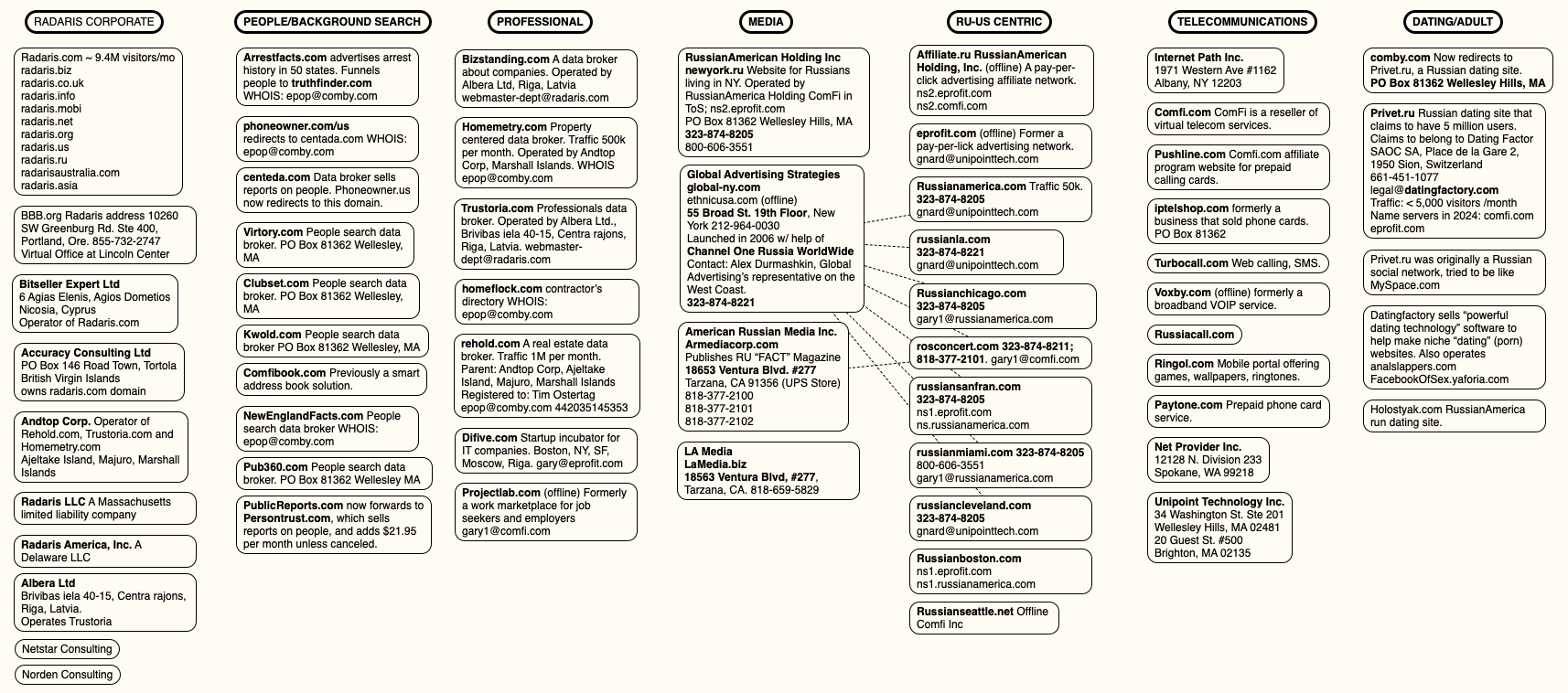
The company’s survival strategy relied on a tactic described by legal observers as "island-hopping." Whenever a lawsuit gained traction, the operators would shift the registration of their domains to offshore entities in tax havens such as the Marshall Islands, the Seychelles, or the British Virgin Islands. By creating a revolving door of corporate shells—ranging from Bitseller Expert Limited to Andtop Company—the Lubarsky brothers successfully delayed legal proceedings, forcing plaintiffs into a cycle of repetitive service of process and jurisdictional disputes.
The 2017 case served as a trial run for this strategy. After failing to appear in court, the operators faced a $7.5 million default judgment. Yet, through the intervention of counsel, they successfully appealed the decision by arguing that the court had targeted the wrong corporate entity. By the time the dust settled, the operators had simply migrated the domain to a new entity, rendering the previous judgment effectively unenforceable.
By June 2025, when Atlas refiled its lawsuit with a significantly broader scope, it was clear that the industry’s "attrition-based" defense was being met with a counter-strategy: persistent, resource-intensive forensic litigation.
Forensic Evidence and the Illusion of Separation
Central to the success of the current litigation was the discovery of over 10,000 internal emails and corporate documents. These records provided a rare, behind-the-curtain look at the financial and operational mechanics of the data broker ecosystem. The findings dismantled the long-standing pretense that Radaris and its dozens of sister sites—including Veripages and various other data-scraping fronts—were independent operations.
The documentation revealed a centralized hub of administrative, financial, and technical operations. These sites shared identical payment processing infrastructure, hosting configurations, and a singular virtual office address. Furthermore, the analysis of these documents indicated that the Radaris network was generating substantial monthly revenue—estimated at approximately $42,000 per month for Radaris.com alone, with Veripages generating roughly $45,000. These revenue streams were heavily bolstered by partnerships with marketing firms and, paradoxically, by affiliations with companies claiming to offer data removal services, such as Onerep.
The revelation that these entities were, in fact, a unified operation run by a small Boston-area group using a fictitious CEO named "Gary Norden" highlighted the deceptive marketing practices that have become rampant in the people-search industry. When questioned during the legal proceedings, counsel for the defendants admitted that the "Gary Norden" persona was an invention, used to provide a face for press releases and investor solicitations.

The Constitutional Battleground: Daniel’s Law
The enforcement of Daniel’s Law represents the most significant challenge to the data broker industry in recent history. Named after the late son of a New Jersey judge, the law provides a clear, statutory path for specific public officials to request the removal of their personal data. With fines set at $1,000 per violation for non-compliance, the law transforms privacy requests from a polite suggestion into a high-stakes financial liability.
However, the industry has pushed back with significant constitutional arguments. Across the country, roughly 150 lawsuits initiated by Atlas are currently being contested. The core of the data broker defense is that such laws violate the First Amendment, arguing that the aggregation and publication of "public record" information is protected speech.
This constitutional challenge is not isolated to New Jersey. In August 2025, a federal district court in West Virginia ruled that a similar state privacy law was facially unconstitutional. This creates a fragmented regulatory environment where privacy rights are increasingly dependent on geography. With the Third Circuit currently deliberating the constitutionality of Daniel’s Law, it is widely anticipated that the conflict will eventually reach the U.S. Supreme Court, setting a precedent that could define the boundaries of the First Amendment in the digital age.
The Broader Implications for Digital Privacy
The seizure of Radaris.com serves as a sobering reminder of the gaps in current federal privacy legislation. As privacy expert Justin Sherman notes, the primary weakness in modern data protection efforts is the persistent exemption of "public records" from privacy regulations. While citizens are increasingly sensitive to how their data is tracked by advertisers, the "public" nature of voter registries, property filings, and court documents allows data brokers to bypass most existing consumer protection laws.
The vulnerability of this system was starkly illustrated by the recent breach at IDScan.net, where 153 million driver’s license records were compromised and effectively weaponized for identity theft on the dark web. The absence of federal laws governing how companies store, use, and share sensitive government-issued identification data creates an environment where personal information is always just one security failure away from becoming a commodity for cybercriminals.
A New Precedent for Enforcement
The outcome of the Radaris litigation demonstrates that the era of "winning by attrition" may be coming to a close for some data brokers. By committing the necessary resources to conduct deep forensic audits of the defendants’ corporate structures, Atlas Data Privacy Corp has established a roadmap for how future litigation might overcome the jurisdictional games that have historically protected these companies.
While the domain Radaris.com now stands as a redirect page—a monument to the court’s intervention—the broader industry remains largely intact. The transition of the domain is a tactical victory, but the strategic war for comprehensive privacy legislation continues. As more states adopt versions of Daniel’s Law, the pressure on Congress to harmonize these protections into a federal framework will only intensify.
For the average consumer, the Radaris case is a rare moment of accountability in an industry that has long operated in the shadows. Yet, until comprehensive federal privacy laws address the fundamental issue of data scraping and the commercialization of public records, the "wake-up calls" will likely continue, punctuated by the next breach, the next lawsuit, and the next discovery of yet another, as-yet-unnamed, offshore data broker. The Radaris domain transfer proves that while the law may be slow to adapt, it can, with sufficient persistence, reach even the most entrenched of digital operators.