Amazon ECS Gateway Simplifies Ingress Networking and Containerized Application Management at Scale

Managing containerized applications at scale on modern cloud infrastructure has long presented platform teams with complex operational bottlenecks, particularly when configuring ingress networking. For years, organizations utilizing Amazon Elastic Container Service (Amazon ECS) have faced tedious, repetitive overhead whenever a new microservice or containerized application is deployed. Traditionally, for every individual service introduced into a production environment, platform engineers were required to manually provision, configure, and meticulously maintain a web of dependent resources. This included Application Load Balancers (ALBs), AWS Certificate Manager (ACM) certificates, AWS WAF web access control lists (ACLs), and intricate security groups.
As applications scaled, updated, or shifted operational states, keeping these disparate resources synchronized introduced a high risk of configuration drift, human error, and sluggish deployment velocities. To alleviate this burden, Amazon Web Services (AWS) has announced the official launch of Amazon ECS Gateway, a powerful new account-level resource engineered to streamline and automate ingress networking for containerized workloads directly within the user’s AWS account.
The introduction of Amazon ECS Gateway marks a significant evolution in how cloud architects approach multi-tenant container management. By automating the heavy lifting of load balancing, DNS routing, and security policy enforcement, the feature redefines the boundary lines between platform engineering teams and application development units, paving the way for streamlined enterprise workflows.
Main Facts and Core Functionality of Amazon ECS Gateway
At its core, Amazon ECS Gateway acts as an intelligent orchestration layer that dynamically provisions and manages necessary networking infrastructure on behalf of the user. Operating at the account level, the gateway establishes a clear separation of responsibilities. Platform teams define global networking guardrails, security policies, and gateway architectures, while application teams simply connect their services to the designated gateway without needing deep expertise in low-level load-balancer tuning or certificate issuance.

One of the most impactful features of the ECS Gateway is its support for host-based routing using Application Load Balancers. To optimize infrastructure expenditures—which can balloon quickly in microservices environments—ECS Gateway allows up to 25 distinct containerized services to share a single ALB. Amazon ECS takes charge of the entire lifecycle of the underlying infrastructure. The system automatically provisions the initial ALB the moment a first service connects, scales out by adding additional ALBs as capacity thresholds are reached, and safely deprecates and removes load balancers when workloads scale down or decommission.
Furthermore, upon successful provisioning, every integrated service is automatically assigned a unique DNS hostname. This grants development teams an immediate, ready-to-use endpoint the moment their deployment pipeline concludes.
The architecture is built to support robust scale and flexibility. A single Amazon ECS Gateway can be associated with up to 10,000 distinct ECS clusters, while an individual cluster can support up to as many as five separate gateway associations. This many-to-many relationship mapping empowers platform engineers to easily construct multi-tiered networking topologies—such as sharing a centralized gateway across multiple staging environments, or enforcing strict separation by assigning dedicated public-facing and VPC-internal gateways to the exact same cluster.
Step-by-Step Implementation and Configuration
Getting started with Amazon ECS Gateway can be achieved through either the AWS Management Console or programmatically via the AWS Command Line Interface (AWS CLI).
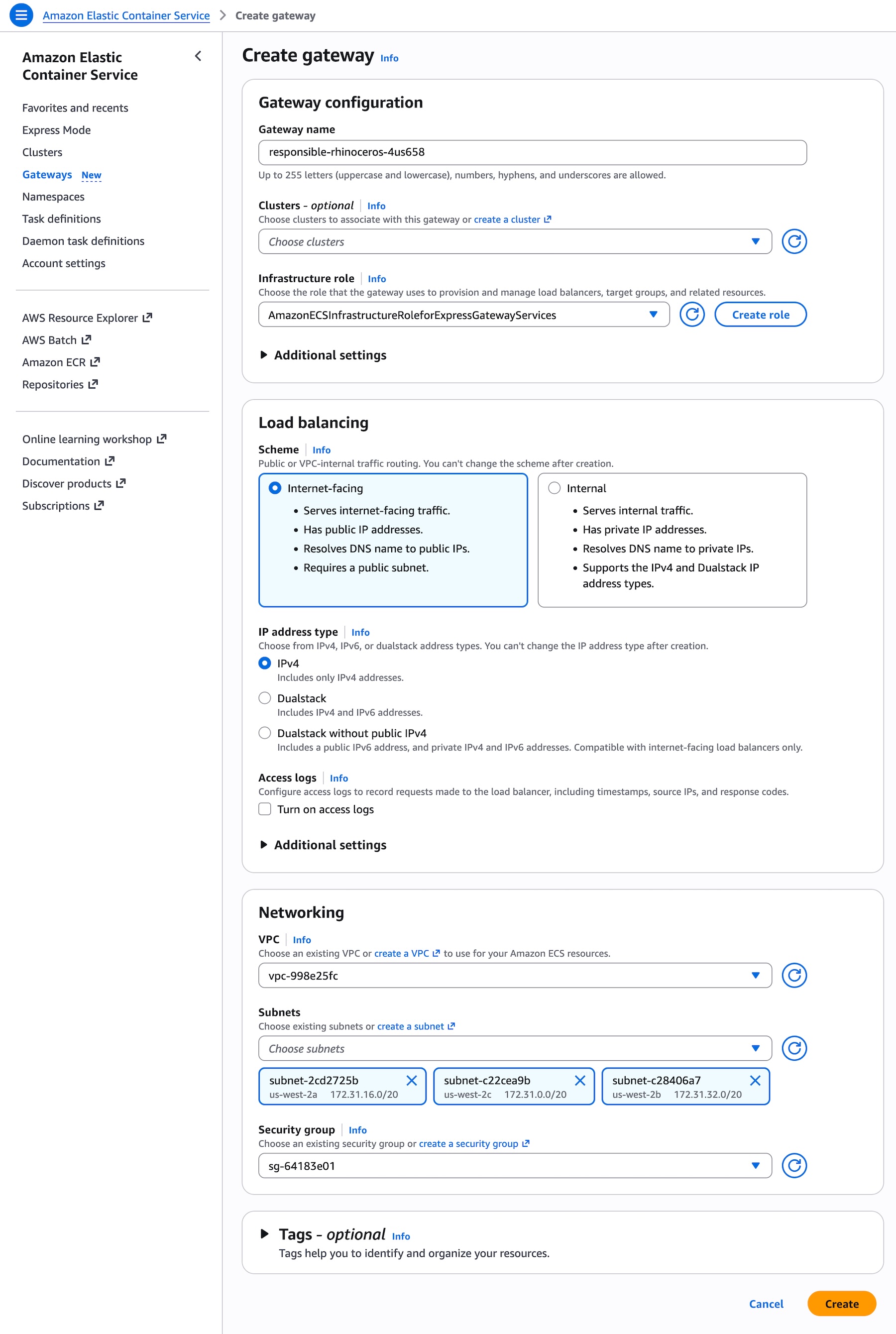
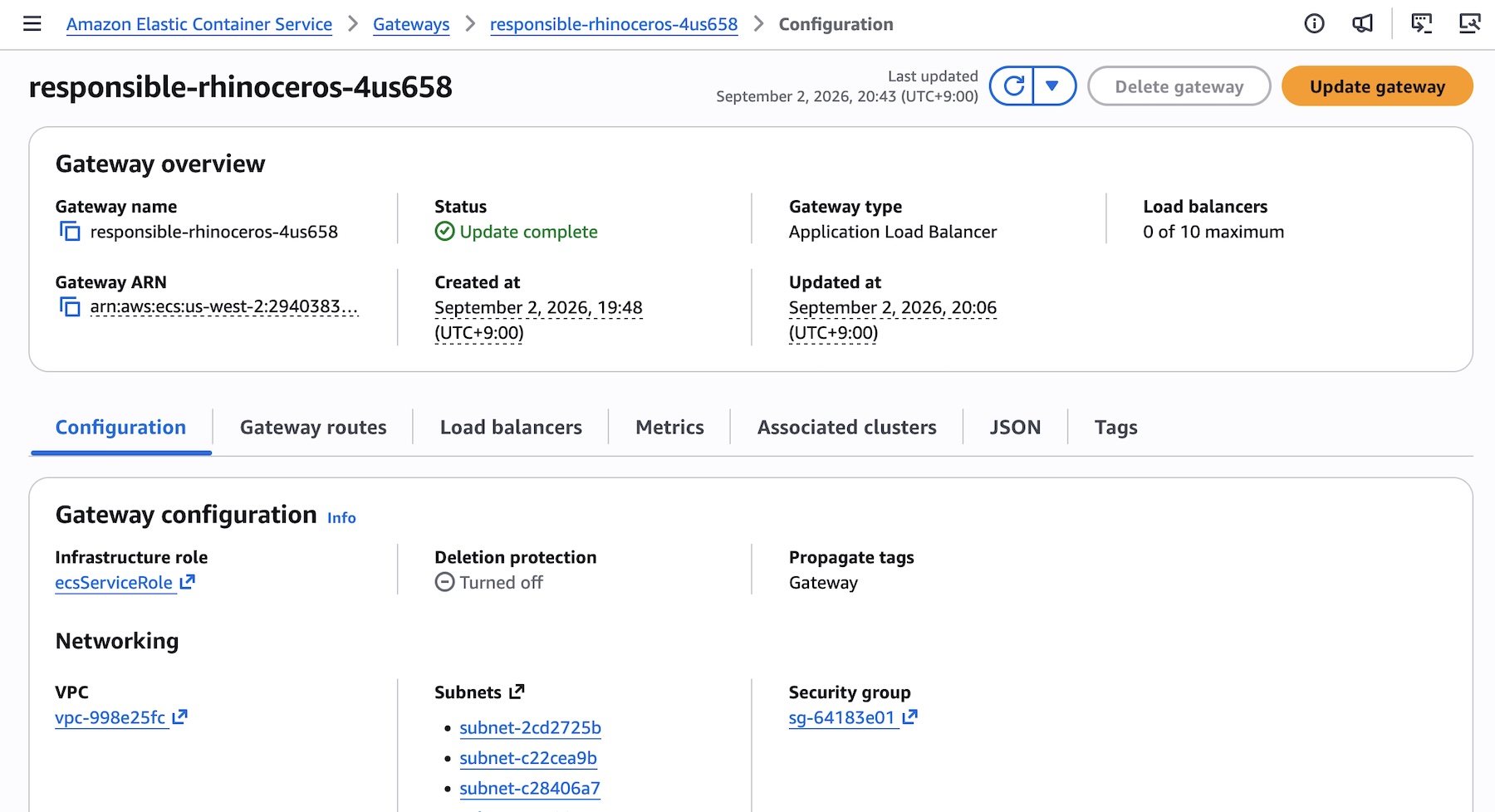
To configure a gateway within the console, platform administrators begin by creating a new gateway resource and designating an infrastructure role. This specialized AWS Identity and Access Management (IAM) role grants Amazon ECS the permissions required to provision, manage, and tear down networking infrastructure—such as ALBs, security groups, and SSL/TLS certificates—within the account. Administrators provide a unique gateway name, select the pre-configured infrastructure role, and optionally associate the gateway with target ECS clusters immediately or at a later stage.

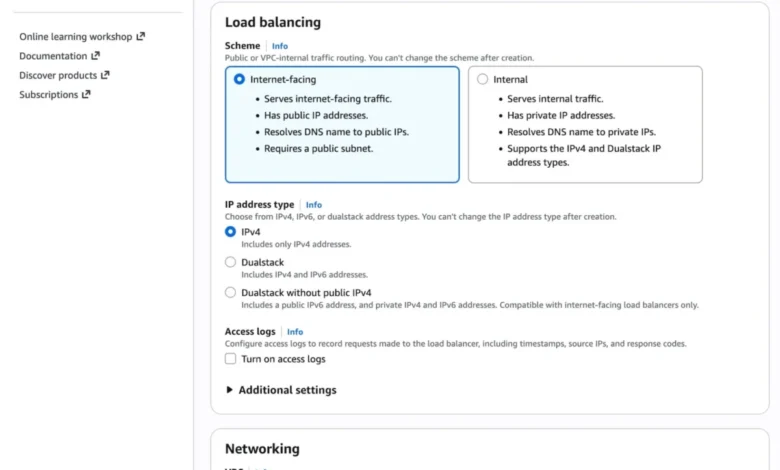
During the initial setup, users must choose a load balancing scheme, designating whether the traffic routing should be public (internet-facing) or entirely VPC-internal. Under advanced settings, administrators can define listeners, ports, maximum load balancer scaling thresholds, and associate AWS WAF web ACLs to shield web applications from malicious traffic. It is important to note that certain foundational parameters—such as the gateway name, traffic scheme, underlying Virtual Private Cloud (VPC), subnets, IP address types, listener protocols, and ports—are immutable and cannot be altered after the gateway has been instantiated.
Alternatively, automation-focused teams can utilize the AWS CLI by executing the CreateGateway command:
aws ecs create-gateway
  --name my-team-gateway
  --infrastructure-role-arn arn:aws:iam::123456789012:role/ECSGatewayRole
  --configuration '
    "HostSharedAlb":
      "networkConfiguration":
        "subnets": [
          "subnet-080779f9bd887757a",
          "subnet-03d5b2fead6bc6258",
          "subnet-0861210a397d31252",
          "subnet-06539e194023cb77a"
        ],
        "ipAddressType": "ipv4"
      ,
      "scheme": "internet-facing"

  '
Once the gateway resource exists, it must be linked to specific container clusters using the AssociateGatewayWithCluster API call, rendering its ingress capabilities accessible to services deployed within those environments. For developers leveraging modern AI-assisted coding frameworks, Amazon ECS Gateway can also be managed programmatically via the AWS MCP Server and associated plugins.
Adopting and Integrating Services Incrementally
For organizations with extensive, pre-existing container deployments, migrating to new architectural paradigms can often introduce operational friction. Recognizing this, AWS designed ECS Gateway to support smooth, incremental adoption paths.
Application teams integrate the gateway into their workflows by appending a gateway connector parameter directly into their service definitions, typically handled via the CreateService or UpdateService API operations. For legacy ECS services already operating with dedicated, traditional load balancers, engineers do not need to perform a risky "rip-and-replace" migration. Instead, teams can call UpdateService to introduce a gateway connector alongside their existing configuration. Because both ingress paths remain fully operational simultaneously, organizations can thoroughly validate the new gateway routing and DNS resolution before safely decommissioning legacy load balancer configurations.
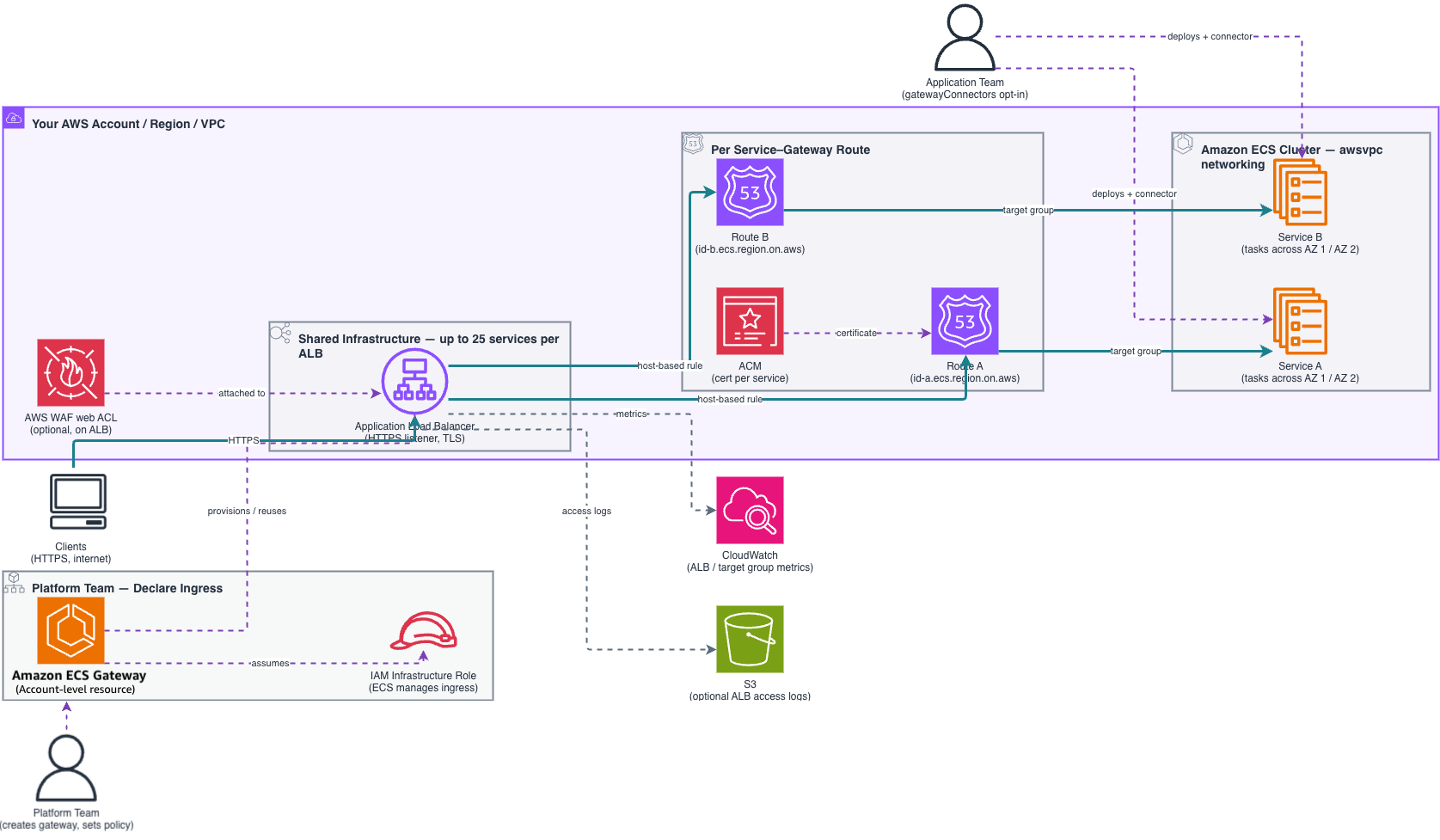
When an updated service is deployed, Amazon ECS evaluates all gateways linked to the cluster, automatically identifying compatible endpoints based on access-type filters, VPC boundaries, and Availability Zone coverage. Behind the scenes, the service orchestrator instantiates all required sub-resources: generating ACM certificates, binding unique DNS hostnames, configuring listener rules to direct traffic cleanly to the correct target group, and establishing security groups that restrict inbound traffic exclusively to the associated ALB.
Chronology and Background Context
The launch of Amazon ECS Gateway arrives at a critical juncture in the maturation of cloud-native computing. Over the past decade, containerization via Docker and orchestration platforms like Kubernetes and Amazon ECS have transitioned from cutting-edge experimentation to foundational enterprise infrastructure. However, as enterprise microservice architectures expanded from dozens of containers to thousands, networking configuration emerged as a chronic administrative drag.
Industry analysts and cloud architecture surveys consistently highlight ingress management, certificate rotation, and load balancer sprawl as leading sources of operational overhead and security misconfigurations. While service meshes and advanced API gateways sought to address service-to-service communication, east-west traffic, and north-south ingress routing, they frequently introduced steep learning curves and heavy resource footprints.
AWS engineering teams developed Amazon ECS Gateway to bridge this exact gap—delivering a native, tightly integrated solution that eliminates the need for complex, third-party ingress controllers while abstracting away the tedious lower-level mechanics of AWS Elastic Load Balancing. The rollout follows a series of incremental updates by AWS aimed at simplifying multi-tenant container operations, positioning ECS as a more agile, cost-effective alternative for businesses seeking robust container orchestration without the operational overhead often associated with complex Kubernetes environments.
Official Responses and Industry Implications
While formal customer case studies and enterprise testimonials will take time to materialize following the general availability announcement, early reactions from cloud architects and platform engineering communities point toward overwhelmingly positive sentiment.
Industry experts emphasize that the financial implications of the feature could be substantial. By allowing up to 25 services to share a single Application Load Balancer under a managed model, mid-sized and large enterprises stand to realize immediate cost reductions by eliminating the idle resource charges associated with provisioning dedicated ALBs for minor microservices. Furthermore, the decoupling of infrastructure provisioning from application deployment pipelines is expected to drastically improve developer productivity metrics, enabling continuous delivery pipelines to execute without administrative bottlenecks.
From a security perspective, analysts note that automated lifecycle management significantly reduces the window of exposure for configuration drift. When ACM certificates, WAF rules, and security group rules are provisioned and synchronized programmatically through a centralized gateway architecture, the likelihood of orphan resources, expired certificates, or overly permissive network ingress rules drops considerably.
Pricing, Availability, and Getting Started
Amazon ECS Gateway is available starting today across all commercial AWS Regions where Amazon Elastic Container Service is supported. In keeping with standard AWS resource-governance practices, the ECS Gateway control plane and orchestration features are provided at no additional upfront charge.
Organizations utilizing the service will incur costs solely for the underlying AWS infrastructure provisioned within their accounts as services bind to gateways. This includes standard hourly charges for active Application Load Balancers, Amazon CloudWatch logs and operational metrics, AWS Certificate Manager certificates, and standard data transfer fees as outlined on the official Amazon ECS Pricing documentation page.
Platform engineers and system administrators looking to modernize their container networking pipelines can begin exploring the feature immediately by navigating to the Amazon ECS console. Detailed technical documentation, API reference guides, and implementation best practices are currently live on the Amazon ECS Developer Guide portal, with technical support channels open via AWS re:Post and traditional enterprise support pathways.
Related posts: