Unlocking Enterprise Intelligence: Google Cloud Introduces Data Cloud Connectors in Gemini to Revolutionize Conversational Analytics

The landscape of enterprise data analytics has long been defined by structural friction. For decades, organizations have struggled with a persistent bottleneck: business questions multiply exponentially faster than data teams can write SQL queries, build dashboards, or clear ticket backlogs. This systemic delay forces executive leadership to rely on guesswork, while operational teams resort to unmanaged, error-prone spreadsheets scattered across isolated departments. Although early waves of generative artificial intelligence promised a conversational panacea—allowing users to simply chat with their data—they routinely stumbled over the complexities of enterprise schemas, hallucinated inaccurate database commands, and failed to respect rigorous security and governance frameworks.
Addressing these foundational challenges, Google Cloud has launched Data Cloud connectors for Gemini for business, currently available in preview. This strategic release introduces a direct, secure pathway for business users, analysts, and decision-makers to query live enterprise data using natural language directly within their everyday workspaces. By bridging the gap between natural language processing and complex data estates, the new capabilities aim to eliminate information siloes, accelerate decision-making cycles, and maintain strict adherence to enterprise compliance.
The Evolution of Conversational Analytics
To understand the significance of this development, it is necessary to examine the evolution of business intelligence (BI). Traditional BI tools required specialized knowledge of database languages like SQL, creating a dependency on central data engineering teams. While self-service analytics platforms sought to democratize data access, they often steepened the learning curve, resulting in shadow IT and conflicting versions of the truth. Generative AI initially offered hope through chatbots capable of translating text into database queries, but these early iterations lacked deep contextual awareness of business logic, table relationships, and fine-grained access controls.
Google Cloud’s latest offering addresses these shortcomings by dividing conversational workflows into two complementary paths: Data Cloud connectors and Conversational Analytics agents. Together, these tools integrate generative AI deeply into enterprise routines. Data Cloud connectors enable ad hoc, exploratory querying across live datasets, allowing users to interact directly with information sources. Meanwhile, Conversational Analytics agents provide pre-configured, highly governed pathways built and certified by central data teams for predictable, multi-step strategic reporting.
How Data Cloud Connectors Function
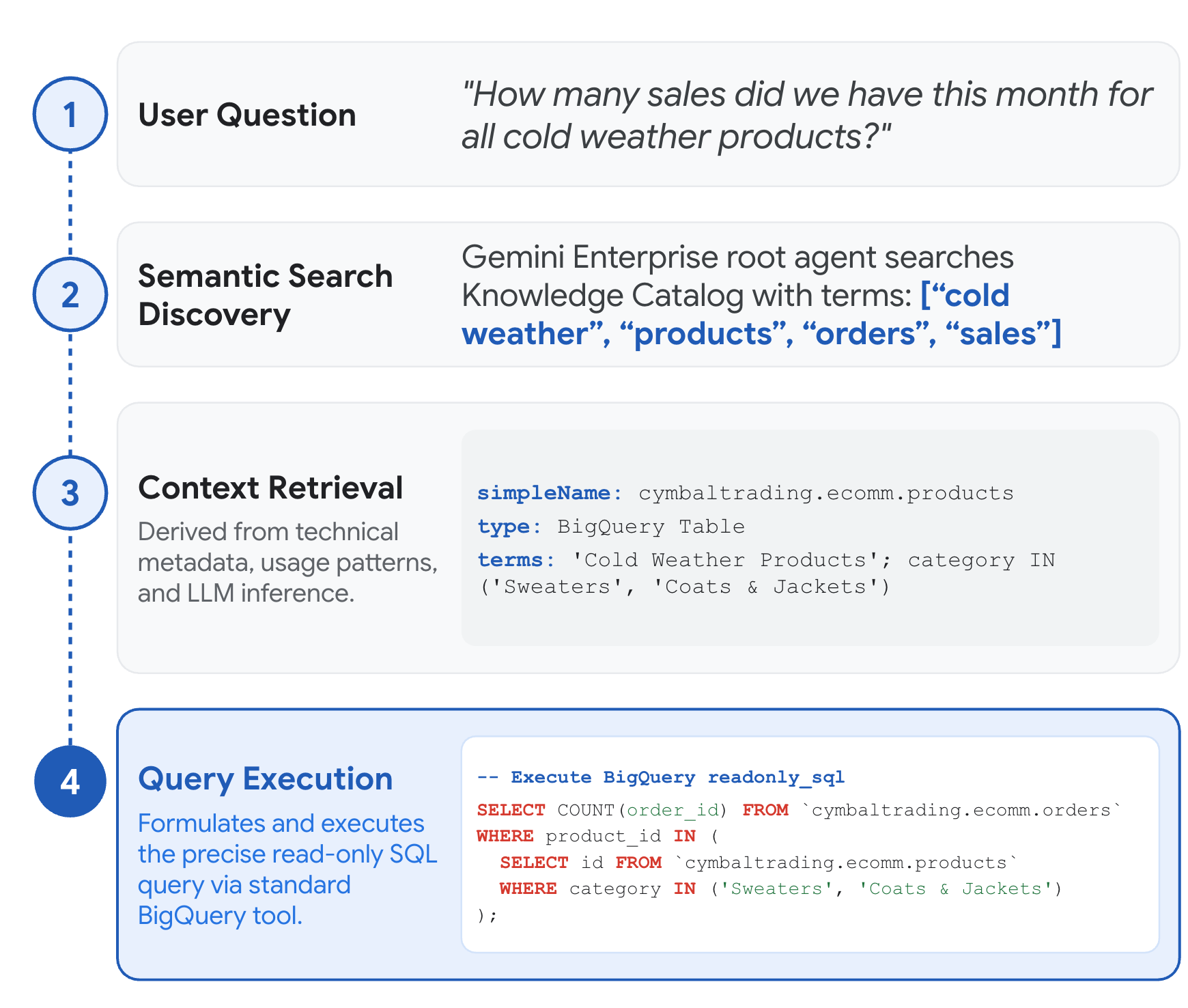
At the core of the Data Cloud connectors architecture is a sophisticated coordination framework that handles discovery, semantic interpretation, and secure query execution. When a user enters a prompt into Gemini, the system engages the Knowledge Catalog to locate relevant data sources, interpret the semantic intent of the question, and execute permission-scoped queries under the user’s exact enterprise identity.
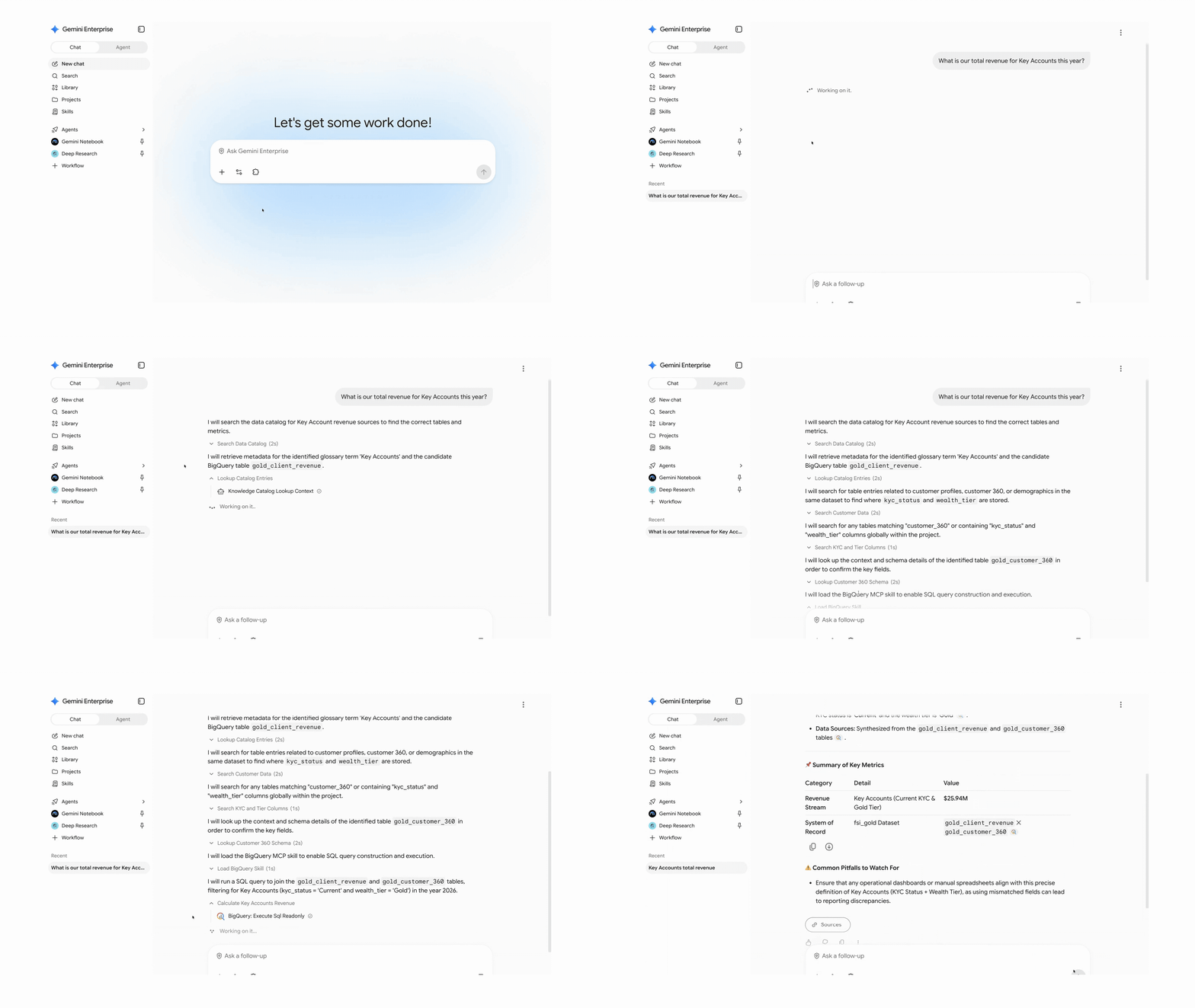
Crucially, the system utilizes a federated query model. Rather than ingesting, copying, or indexing corporate data into a separate Gemini data store—which introduces data staleness and compliance risks—Data Cloud connectors query the data directly in place. This ensures that insights are derived from the most current, up-to-date live records available across the organization.
The breadth of supported data sources is extensive. During the preview phase, users can pull live data natively from BigQuery, operational transactional databases such as Spanner, AlloyDB, and Cloud SQL, and governed semantic metrics from Looker. Once Gemini retrieves the requested information, users can seamlessly transition their findings into collaborative productivity tools, instantly transforming query results into formatted Google Docs, comprehensive draft emails in Gmail, or polished presentation decks in Google Slides.
The Role of Knowledge Catalog and Context Enrichment
A persistent hurdle for language models in enterprise environments is the absence of specialized business context. A raw database schema outlines table names and column headers, but it rarely captures the institutional knowledge required to interpret metrics accurately—such as what constitutes an "active customer" versus a "churned user," or how regional tax calculations are applied.
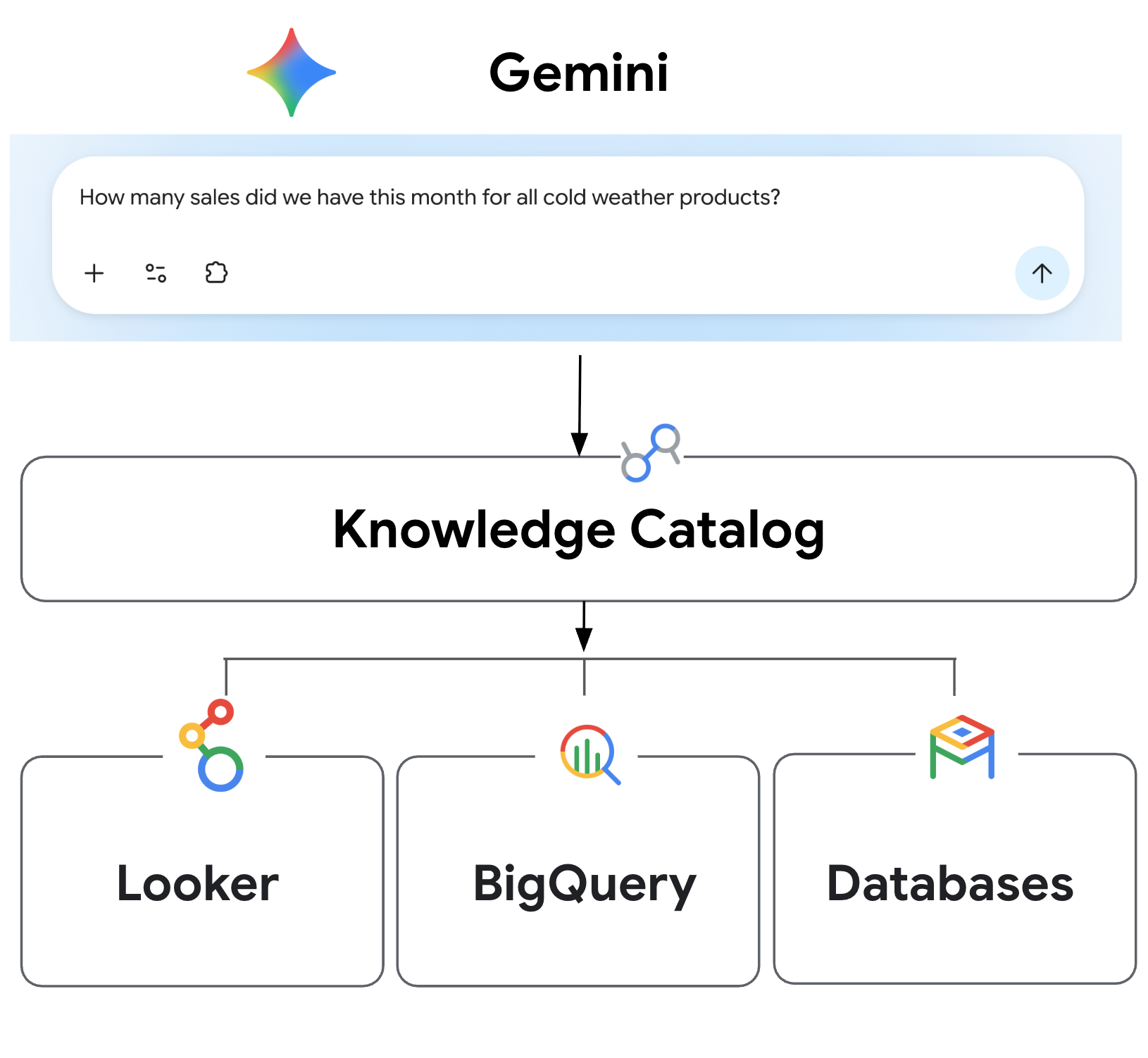
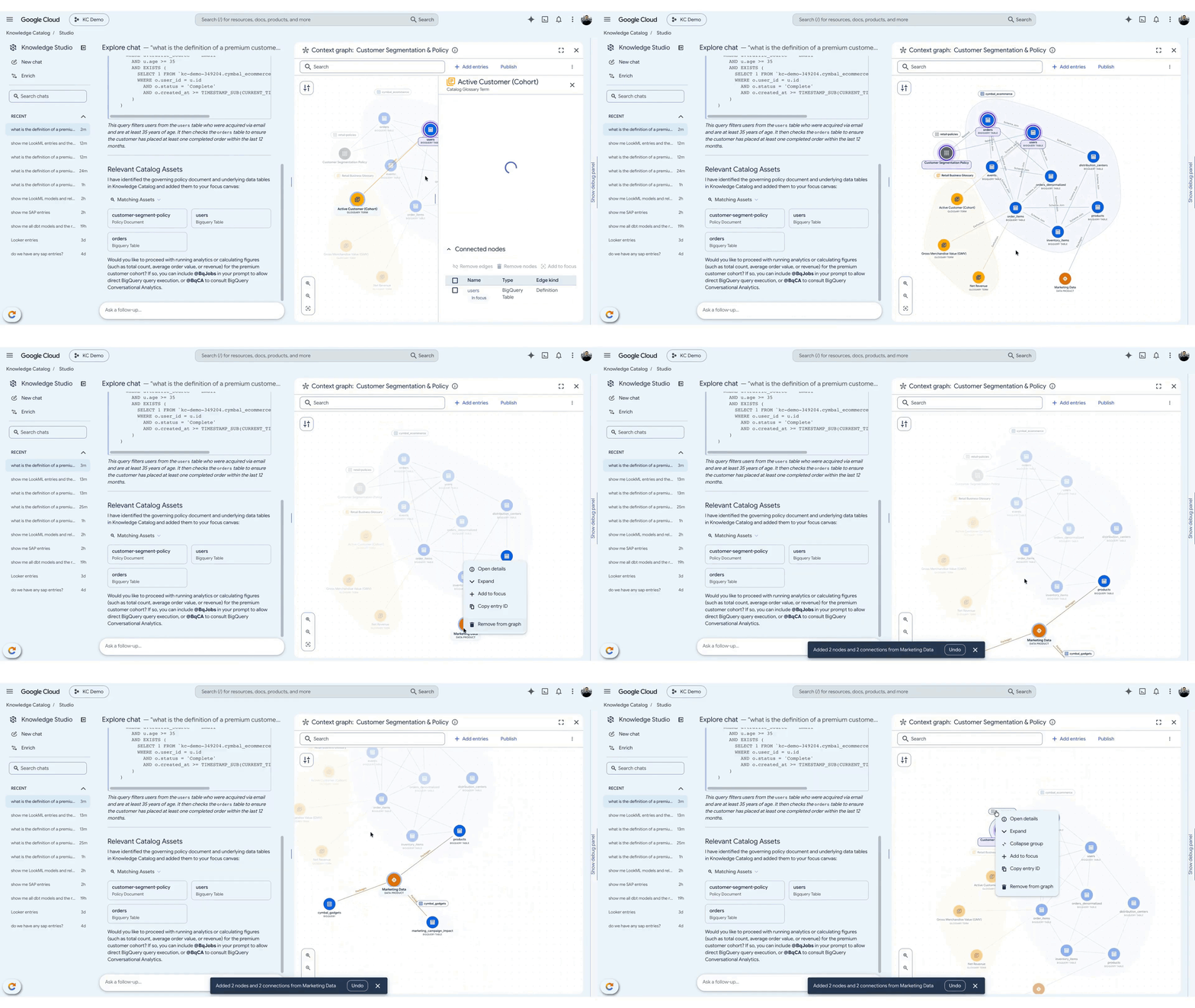
To bridge this gap, Data Cloud connectors integrate tightly with Knowledge Catalog. This component provides a curated context bundle that includes technical metadata, explicit business logic, underlying table relationships, and verified historical queries. By supplying this rich contextual graph to the language model, the system significantly improves query accuracy while simultaneously reducing computational latency and token consumption.
Furthermore, Knowledge Catalog empowers a borderless lakehouse architecture. Enterprise analytics has historically been fractured by physical boundaries, with data locked in proprietary silos, open lakehouse tables stored in cloud object storage, and datasets distributed across multi-cloud infrastructures. The BigQuery connector extends conversational analytics across this fragmented landscape, unifying native storage with open table formats—including Apache Iceberg, Delta Lake, and Parquet—as well as cross-cloud datasets residing in Amazon Web Services (AWS) S3 via the AWS Glue federated catalog.
Balancing Flexibility and Governance: Connectors vs. Data Agents
Organizations face a perpetual tension between data democratization and stringent data governance. Google’s dual-path approach acknowledges this dichotomy by offering both flexible, user-driven connectors and tightly controlled conversational agents.
Data Cloud connectors cater to exploratory, ad hoc analysis. They empower everyday users to investigate hypotheses on the fly without formal IT intervention. Conversely, Conversational Analytics agents are meticulously designed by data engineering and compliance teams. These scoped agents are restricted to specific subsets of data and are programmed to handle complex, recurring business questions that demand high regulatory compliance and absolute consistency in reporting.
These two modalities are not mutually exclusive; they operate symbiotically. When a user interacts with Gemini, the interface surfaces relevant published agents created by central data teams alongside direct connector options. This allows the user to make an informed choice: utilize a certified, highly structured data agent for standard reporting, or deploy a flexible Data Cloud connector for exploratory investigations. Both options publish their capabilities so they can be consumed directly within Gemini or integrated via API into custom enterprise conversational applications.
Security Architecture and Access Control
In an era defined by heightened regulatory scrutiny and data privacy mandates, enterprise AI tools must adhere to zero-trust principles. Data Cloud connectors are engineered with security embedded at the infrastructure level.

Queries executed via Gemini do not bypass standard organizational permissions. Instead, every natural-language prompt runs strictly under the end user’s verified enterprise identity. If an employee lacks the formal database permissions required to access executive salary data, proprietary financial models, or protected healthcare records, the Knowledge Catalog will not surface the underlying metadata, and the system will actively block the execution of unauthorized queries. This ensures that conversational AI cannot be exploited to circumvent established internal access policies.
Implementation and Administration
For IT administrators, deploying Data Cloud connectors is managed through a centralized Gemini admin console. Administrators can establish default, read-only connections to target datasets across BigQuery, operational databases, and Looker instances. Knowledge Catalog integration is enabled automatically during this provisioning phase.
Once administrators configure and authorize the connected data stores, end users can activate the connectors within their Gemini environment. Setup documentation and integration guides are readily available for BigQuery, Spanner, Cloud SQL, and AlloyDB for PostgreSQL, with Looker support currently rolling out in preview.

Industry Implications and Future Outlook
The introduction of Data Cloud connectors marks a maturation point for generative AI in the enterprise sector. By moving past the limitations of standalone chat interfaces and brittle custom integrations—such as public or self-managed Model Context Protocol (MCP) servers—Google Cloud is providing a standardized, secure, and context-aware bridge between artificial intelligence and foundational data infrastructure.
Industry analysts note that as organizations increasingly demand demonstrable return on investment from their generative AI initiatives, tools that solve systemic operational bottlenecks—such as data team backlogs and cross-silo fragmentation—will see rapid adoption. By uniting live database querying, multi-cloud lakehouse federation, contextual enrichment, and strict user-level access controls into a single conversational workflow, Data Cloud connectors represent a significant step toward frictionless, secure enterprise intelligence.