PacketStream Residential Proxy Network Review: Affordability Meets Limitations in the P2P Proxy Market

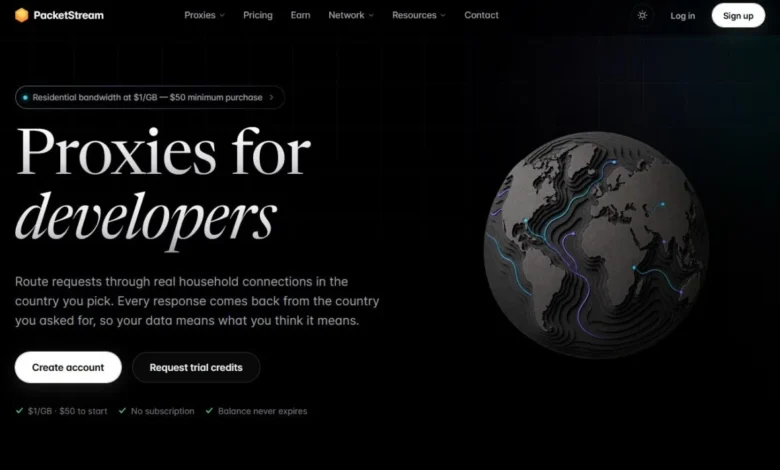
Founded in California in 2018, PacketStream entered the proxy service industry with a specific mission: to drastically lower the financial and operational barriers associated with residential proxies. By utilizing a peer-to-peer (P2P) bandwidth-sharing infrastructure, the company set out to provide businesses, developers, and individual researchers with affordable IP addresses sourced from real consumer devices across the globe. Over the years, this unique architectural model has positioned PacketStream as an accessible entry-level platform, distinguishing it from traditional enterprise-grade providers through a simplified, flat-rate pricing structure and crowdsourced resource pooling.
The Mechanics of the PacketStream P2P Ecosystem
At the core of PacketStream’s operational model is a symbiotic resource exchange between everyday internet users and data-driven entities. Individual device owners—often referred to within the platform’s ecosystem as "Packeters"—download a lightweight background application onto their desktop computers running Windows, macOS, or Linux (via Docker). By sharing their idle internet bandwidth, these participants earn financial compensation starting at $0.10 per gigabyte shared.
On the demand side of the network, businesses and developers purchase this pooled residential bandwidth for a flat rate of $1.00 per gigabyte. This architecture allows companies to bypass geographical restrictions, aggregate publicly available web data, and manage automated digital workflows without investing in expensive enterprise contracts. However, this crowdsourced approach introduces distinct operational realities. Unlike corporate data centers housing dedicated, highly stable server lines, P2P networks rely on consumer hardware and residential connections that fluctuate in availability, speed, and uptime. Consequently, while PacketStream ensures that all participating IPs are added consensually by their respective owners—thereby avoiding the legal and ethical grey areas surrounding illicitly acquired botnet traffic—the underlying network characteristics inherently prioritize cost-effectiveness over absolute performance consistency.
Pricing Structure, Financial Thresholds, and Competitive Landscape
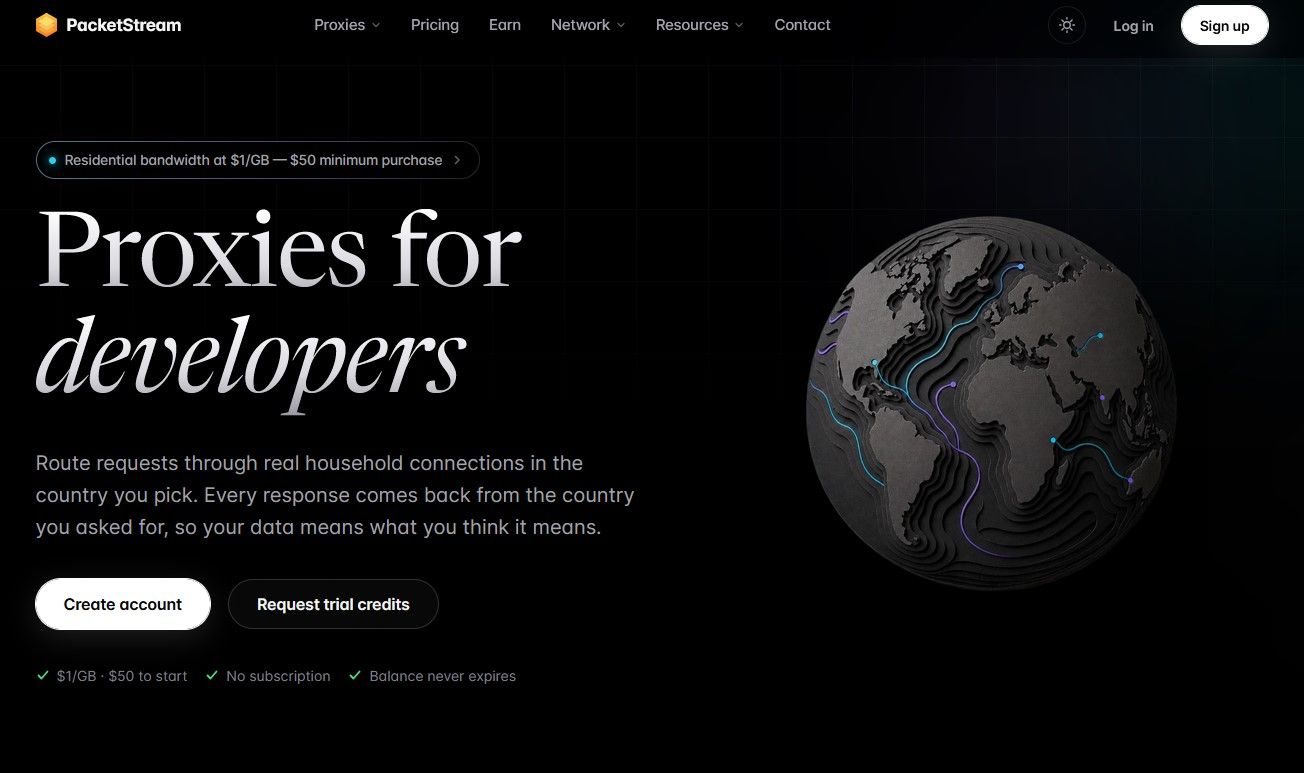
PacketStream maintains one of the most straightforward and aggressive pricing models in the proxy industry. Rejecting the convoluted subscription tiers, recurring monthly commitments, and tiered user minimums common among competitors, the provider charges a flat $1.00 per GB. Furthermore, purchased balances do not have an expiration date, granting users long-term flexibility.
Despite this low per-gigabyte cost, onboarding requires meeting specific financial entry points. Users must deposit a minimum of $50 to activate an account and begin utilizing the proxy network. This policy effectively prevents casual hobbyists from purchasing nominal amounts, such as a single dollar’s worth of bandwidth, to trial the service. For those strictly requiring hands-on evaluation before financial commitment, trial credits are not dispensed via an automated interface; instead, prospective clients must submit a formal request form or contact customer support for manual workload assessment and discretionary credit approval. Payments are accepted through major credit cards and PayPal, while enterprise and reseller tiers requiring orders of $500 or more can utilize bank transfers.
When benchmarked against established industry rivals, PacketStream’s economic advantage becomes starkly apparent. Premium enterprise competitors maintain significantly higher entry barriers. For instance, IPRoyal’s pay-as-to-go residential proxies begin at approximately $7.00 per gigabyte, while Bright Data’s standard pay-as-you-go offerings start at roughly $8.40 per gigabyte, scaling down closer to $3.00 per gigabyte only under substantial monthly commitments. Similarly, Webshare prices its residential bandwidth starting at $3.50 per gigabyte before scaling down to $1.40 per gigabyte. While PacketStream undercuts these competitors significantly on raw entry-level pricing, this cost reduction reflects a narrower feature set and a lack of advanced enterprise infrastructure.
Technical Capabilities and Protocol Support
PacketStream’s network spans more than 190 countries, offering broad international coverage driven by its millions of active peer connections. The platform supports standard web communication protocols, including HTTP, HTTPS, and SOCKS5. The inclusion of SOCKS5 is particularly vital for developers, as it operates at a lower network layer than standard HTTP/HTTPS protocols, making it indispensable for complex scraping architectures and general-purpose network tasks.
Session management on the platform is handled via rotating and sticky session configurations. Rotating proxies automatically alter the exit IP address with every new connection request, maximizing anonymity and reducing the likelihood of rate-limiting or blocks during large-scale data extraction. Alternatively, sticky sessions allow users to maintain the same residential IP address for up to 60 minutes. This persistence is crucial for workflows requiring continuous authentication states, multi-step form submissions, or persistent e-commerce interactions.
However, technical limitations remain apparent when examining geographic targeting granularity. PacketStream enables users to select proxy locations by country, but it does not support precise filtering by state, city, or ZIP code, nor does it offer Autonomous System Number (ASN) targeting. Many competing enterprise platforms allow users to isolate proxy nodes down to specific metropolitan areas, a feature essential for localized ad verification and localized market research. Additionally, PacketStream does not provide static ISP proxies (dedicated residential IPs) or native datacenter IPs, restricting its utility for operations demanding uninterrupted, high-speed data throughput.
Primary Use Cases: Data Scraping and E-Commerce Automation
Businesses frequently deploy residential proxy networks for two primary functions: large-scale web scraping and digital retail operations.
In the context of data extraction—such as monitoring commodity pricing, aggregating travel fares, or gathering market intelligence—target websites often deploy aggressive anti-scraping defenses. These mechanisms utilize IP rate-limiting, geographic barriers, and algorithmic behavioral analysis to identify and ban automated scraping bots. By routing requests through PacketStream’s vast network of residential IP addresses, automated scripts mimic organic consumer traffic. If a specific IP address is flagged and blocked by a target server, subsequent requests automatically route through an alternate peer connection, ensuring data collection continuity.
Similarly, in the realm of e-commerce, automated applications and collectors rely on residential proxies to navigate inventory constraints and purchase high-demand retail items. Because residential IPs are tied to real consumer households, e-commerce platforms cannot easily block them without risking high false-positive rates that would inadvertently lock out legitimate shoppers. When blocks do occur, PacketStream’s sticky sessions can be refreshed to assign a new peer identity, allowing operations to proceed uninterrupted.
Security Software Detection and Endpoint Compliance
An important technical hurdle documented during platform evaluations involves endpoint security interaction. When attempting to download and install the PacketStream client software on Windows environments, Microsoft Defender occasionally flags the application as a program that "displays deceptive product messages." This classification typically describes software categorized as potentially unwanted programs (PUPs) or scareware.
Security analysts emphasize that this designation does not indicate inherent malware or malicious code designed to compromise user data. Instead, the antivirus heuristic likely interprets the application’s core functionality—which involves routing third-party web traffic through the host machine’s hardware during bandwidth-sharing operations—as anomalous or high-risk behavior. Users experiencing installation roadblocks must often manually adjust local antivirus exclusions to permit the software’s execution.
Reseller Infrastructure and API Integration
Beyond direct end-user access, PacketStream accommodates digital entrepreneurs and enterprise clients through a dedicated Reseller API. This white-label infrastructure enables businesses to construct and market their own proprietary proxy brands utilizing PacketStream’s underlying residential network, completely devoid of PacketStream branding or attribution.
Through the API interface, administrators can programmatically provision subaccounts, establish bandwidth limits, audit real-time usage metrics, and monitor credit balances. Wholesale bandwidth for resellers is priced at the standard rate of $1.00 per gigabyte, subject to a minimum wholesale purchase threshold of $500. Resellers retain full autonomy over setting their own retail margins, though they assume sole responsibility for providing front-line customer service and technical support to their respective end-users.
Evaluation of User Experience and Customer Support
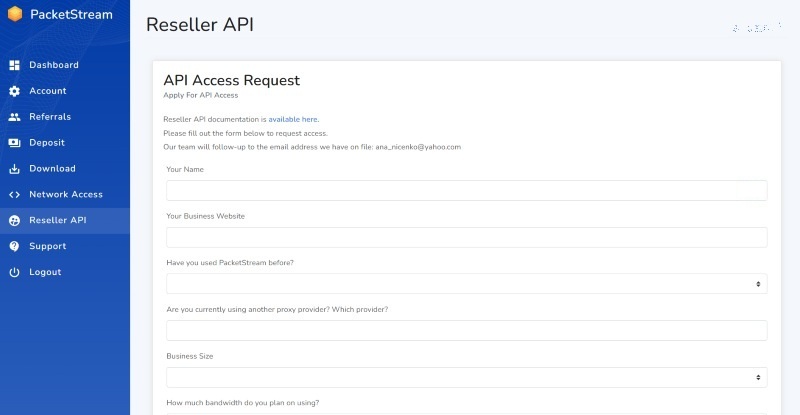
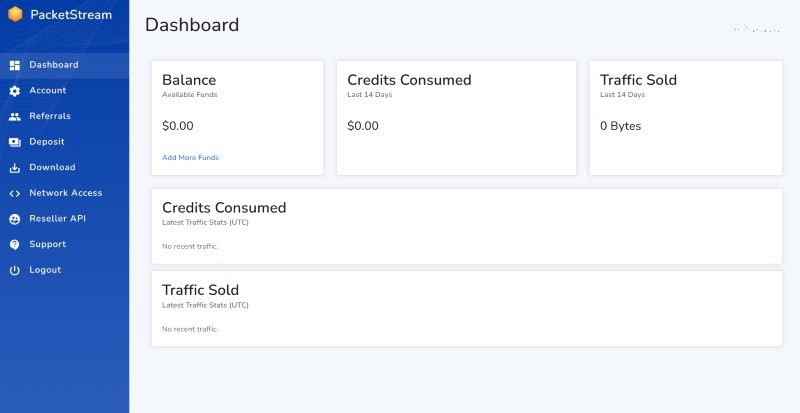
PacketStream scores high marks for interface simplicity and dashboard design. The web-based user panel features a minimalist layout with a clean white background and intuitive left-hand navigation, allowing individuals with minimal technical backgrounds to configure proxy authentication strings swiftly. Unlike competitors that offer browser extensions for instantaneous proxy toggling, PacketStream requires users to manually copy endpoint credentials into their respective scripts or third-party applications.
Conversely, customer support represents a notable operational bottleneck. PacketStream does not offer telephone support or real-time live chat functionality. Client inquiries must be submitted exclusively via email or web-based contact forms. While support tickets are monitored continuously, response times can extend up to 48 hours, lacking the guaranteed Service Level Agreements (SLAs) expected by high-volume corporate clients. For self-guided troubleshooting, the platform provides a centralized Resources page containing quickstart guides, gateway reference materials, and runnable code examples hosted on GitHub, catering effectively to software developers.
Implications and Market Verdict
PacketStream occupies a distinct, highly utilitarian niche within the global proxy market. By leveraging a decentralized peer-to-peer network, the company successfully delivers functional residential proxies at an aggressive price point of $1.00 per gigabyte. This economic model democratizes access to residential IP infrastructure for budget-conscious developers, independent researchers, and small-scale businesses.
At the same time, the platform’s architectural compromises—including the absence of granular city-level geographic targeting, a lack of datacenter or static ISP proxy options, reactive-only customer support, and a mandatory $50 minimum deposit—clearly delineate its boundaries. Enterprise organizations requiring dedicated infrastructure, instantaneous support SLAs, and high-speed data throughput will likely find the platform inadequate for massive, mission-critical scraping operations. Nevertheless, for individuals and small teams seeking cost-effective rotating residential IPs for everyday data collection, PacketStream remains a uniquely viable, highly accessible entry-level solution.