HighScalability Hot Links: The Evolution of Computing Hardware and the Quantum Frontier

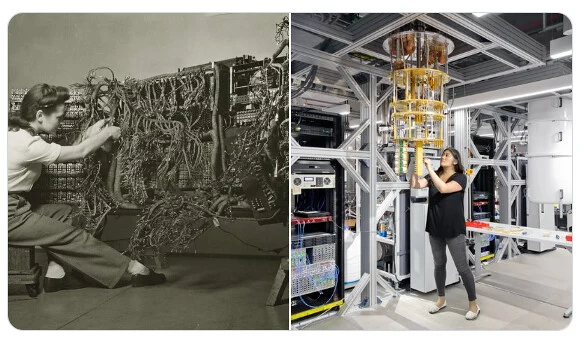
The history of computing is often told through the lens of software innovation, but the physical reality of the machines themselves—the intricate, tactile process of engineering—reveals a more profound story of human persistence. Recent archival imagery comparing an IBM engineer in 1958 to a contemporary specialist working on an IBM quantum computer in 2021 highlights a striking continuity in the discipline of hardware development. While the substrates have shifted from vacuum tubes and copper wiring to superconducting qubits and cryogenic dilution refrigerators, the fundamental requirement for precision manual labor in experimental computing remains remarkably unchanged. This comparison serves as a focal point for understanding the current state of high-performance computing, where the transition from classical silicon architectures to quantum systems necessitates a radical rethinking of physical infrastructure.
The Chronology of Physical Computing Infrastructure
To understand the current state of high-performance computing (HPC), one must examine the progression of hardware architecture over the last seven decades. The late 1950s represented the era of the mainframe, dominated by companies like IBM. During this period, the physical footprint of a computer was massive, requiring custom-built facilities to manage heat dissipation and power consumption. Engineers of that time were essentially circuit designers who physically mapped logic onto boards by hand.
By the 1980s and 1990s, the focus shifted to the miniaturization of transistors, leading to the rise of the microprocessor. This era was characterized by the "scaling" of silicon—the ability to fit more computational power into smaller spaces. However, we have now reached the physical limits of Moore’s Law, where transistor density cannot be increased indefinitely without encountering quantum tunneling effects and excessive thermal output.
As we moved into the 2010s and 2020s, the industry began a pivot toward specialized hardware. This included the widespread adoption of Graphics Processing Units (GPUs) for parallel computing and the emergence of field-programmable gate arrays (FPGAs) and Application-Specific Integrated Circuits (ASICs). Today, the frontier has moved toward quantum computing, which requires not only new logic gates but entirely new environments—specifically, temperatures near absolute zero to maintain qubit coherence.
Supporting Data: The Shift in Computing Architectures
The evolution of these systems is reflected in the technical requirements of modern data centers. According to recent industry benchmarks, the power density in high-performance computing facilities has increased by an order of magnitude over the last decade. While a standard data center rack might have operated at 5 to 10 kilowatts in the early 2000s, modern AI and HPC clusters often require 50 to 100 kilowatts per rack to support high-end GPU arrays.
Furthermore, the complexity of system integration has grown exponentially. The transition from classical binary logic (0s and 1s) to quantum superposition and entanglement involves significant overhead. A quantum computer, such as those developed by IBM or Google, requires a dilution refrigerator—a massive, gold-plated structure that acts as a thermal anchor, keeping the quantum processor at approximately 15 millikelvins. This infrastructure is a far cry from the air-cooled rooms of 1958, yet the imagery of an engineer painstakingly connecting wires to the "chandelier" of a quantum processor echoes the meticulous manual assembly of early IBM mainframes.
Technical Implications and Challenges
The physical engineering required for quantum systems introduces new variables that were non-existent in the classical era. One of the primary hurdles is the "cabling problem." Because quantum chips are incredibly sensitive to thermal and electromagnetic noise, the wires carrying control signals to the qubits must be engineered with extreme precision to prevent heat leakage from the outside environment into the cold stage.
Moreover, the software-hardware interface is becoming increasingly blurred. In classical computing, the instruction set architecture (ISA) provides a clear abstraction layer. In quantum computing, the control software must directly manage the timing and pulse shapes of microwave signals sent to the qubits. This requires a feedback loop that integrates traditional high-speed electronics with the quantum state, necessitating a "hybrid" computational model where classical supercomputers act as the controllers for quantum processors.
Official Perspectives and Industry Reactions
Leading research institutions and technology corporations have acknowledged that we are in a transitional phase of computing history. IBM’s roadmap for quantum development emphasizes the need for "quantum-centric supercomputing," where the integration of classical and quantum processors is treated as a single unified architecture.
Dr. Jay Gambetta, Vice President of IBM Quantum, has frequently noted that the goal is not to replace classical computers with quantum systems, but to build a modular architecture that allows for the orchestration of both. This viewpoint is supported by the broader scientific community, which sees the next decade as a period of "quantum utility"—a phase where quantum computers begin to provide verifiable results on problems that are intractable for classical machines, such as molecular simulation, materials science, and optimization problems.
The Broader Impact on Global Technology
The implications of these physical hardware advancements are far-reaching. As hardware becomes more specialized, the cost of entry for building and maintaining these systems has skyrocketed. This has led to a concentration of high-end computational power within a few massive cloud providers and national laboratories. The "democratization" of computing that occurred with the personal computer revolution is being challenged by the sheer physical requirements of modern HPC and quantum infrastructure.
However, the ripple effects of these developments are already being felt across various sectors:
- Materials Science: The ability to simulate chemical reactions at the quantum level is expected to revolutionize battery design and carbon capture technologies.
- Cybersecurity: The development of Shor’s algorithm and the threat it poses to existing RSA encryption has accelerated the global transition toward post-quantum cryptography.
- Logistics and Finance: Quantum-inspired algorithms are currently being tested for complex optimization problems, such as global supply chain management and portfolio balancing, even before full-scale quantum supremacy is achieved.
Conclusion: Bridging the Gap
The visual comparison of the 1958 IBM engineer and the 2021 quantum technician is not merely a nostalgic exercise; it is a testament to the fact that the computer, regardless of its underlying physics, is a human-made tool that requires human mastery. While we are currently witnessing a shift toward automation in software development—with artificial intelligence increasingly writing code—the physical layer of computing remains a manual, hands-on discipline.
As we look toward the future of high-performance computing, the focus will likely remain on the interplay between physical constraints and logical possibilities. The lessons learned during the era of vacuum tubes and early transistors are directly applicable to the challenges of superconducting circuits and trapped-ion systems. The history of computing is cyclical in its physical demands: as soon as we master one level of abstraction, we move to a new, lower-level substrate that demands a fresh generation of engineers to wire it by hand, ensuring the machine functions as intended.
In summary, while the technology has evolved from simple mechanical switches to complex quantum interference, the core mission of the computing industry remains constant: to expand the boundaries of what is calculable. Whether in the form of a 1950s mainframe or a modern quantum processor, the hardware remains the foundation upon which our digital world is built. As we transition deeper into the quantum era, the dedication of the engineers working in the "cold rooms" of today will prove just as pivotal as those who labored over the vacuum tubes of the past. The infrastructure may change, but the spirit of technical inquiry—the "hot links" connecting human ingenuity to machine performance—remains the driving force of the industry.