AWS Glue 6.0 Officially Launches With 30 Percent Price Reduction and Full Apache Iceberg v3 Support

Amazon Web Services (AWS) has officially announced the general availability of AWS Glue 6.0, marking a significant milestone in serverless data integration and extract, transform, and load (ETL) operations. The latest iteration of the fully managed data preparation service introduces a powerful combination of enhanced runtime capabilities, native support for advanced open-table formats, and a substantial 30 percent reduction in pricing compared to previous versions. Built on a completely modernized engine that incorporates Apache Spark 4.1, Python 3.13, and Scala 2.13, AWS Glue 6.0 is designed to help organizations handle massive workloads faster, more efficiently, and at a significantly lower operational cost.
The release arrives at a time when enterprise data architectures are increasingly shifting toward open-table formats like Apache Iceberg to maintain data lakes with database-like reliability. By delivering the most complete Iceberg v3 implementation available on any fully serverless managed Spark service, AWS aims to solidify its position as a central pillar in modern data lakehouse ecosystems.
Main Facts and Technical Enhancements
At the core of AWS Glue 6.0 is its updated runtime architecture, powered by Apache Spark 4.1. This foundation brings numerous performance optimizations, enhanced PySpark capabilities, and support for real-time streaming data ingestion operating at single-digit millisecond latencies.
Perhaps the most notable feature of the AWS Glue 6.0 release is its comprehensive integration of the Apache Iceberg v3 specification, built specifically on Iceberg 1.11.0. This integration introduces the innovative VARIANT data type equipped with advanced shredding support. In traditional data architectures, semi-structured data such as complex JSON logs, system event streams, and nested application payloads are often ingested as string data types. This approach requires downstream engineering teams to write custom parsing code, flatten complex schemas, and duplicate data storage just to make the information queryable—a process that frequently results in fragile data pipelines that break whenever upstream schemas evolve.
With the new VARIANT data type and shredding capabilities in AWS Glue 6.0, organizations can ingest, store, and query semi-structured data natively. The engine automatically handles complex and nested structures without requiring schema flattening. Consequently, enterprises avoid duplicate data copies, eliminate the overhead of maintaining custom parsing logic, and maintain pipeline resilience even when data structures change dynamically. According to preliminary performance benchmarks, this capability yields dramatically faster query read performance relative to legacy string-column approaches for semi-structured datasets.
In addition to the VARIANT data type, AWS Glue 6.0 delivers a robust set of Iceberg v3 features designed to streamline transactional data lake maintenance, optimize storage layouts, and enhance security governance across distributed datasets.
Background Context and Chronology of AWS Glue

To understand the significance of the AWS Glue 6.0 release, it is helpful to examine the evolution of the service within the broader cloud computing landscape. Launched initially in 2017, AWS Glue was created to solve a pervasive pain point for data engineers: the operational overhead of provisioning, configuring, and scaling clusters just to clean, transform, and catalog data scattered across disparate storage repositories.
Over the years, AWS iteratively modernized the service. Major milestones included the introduction of serverless Spark job execution, continuous integration with AWS Lake Formation for fine-grained security, and native support for various open table formats including Delta Lake, Apache Hudi, and Apache Iceberg. As organizations migrated from monolithic data warehouses to decoupled, cloud-based data lakes, AWS Glue evolved from a basic metadata catalog and simple ETL script runner into a comprehensive data integration platform capable of handling petabyte-scale workloads.
The transition from Glue 5.0 to Glue 6.0 represents one of the most substantial architectural leaps in the product’s history. By embracing the latest stable releases of foundational open-source technologies—specifically Apache Spark 4.1, Python 3.13, and Scala 2.13—AWS has ensured that data engineering teams can leverage cutting-edge language features and performance enhancements without needing to build or manage underlying infrastructure.
Financial Implications and Pricing Structure
One of the most heavily anticipated aspects of the AWS Glue 6.0 announcement is the accompanying 30 percent price reduction across the board. In an economic climate where corporate technology budgets face intense scrutiny, cloud providers are under continuous pressure to deliver better price-performance ratios.
Under the updated pricing model, customers continue to pay an hourly rate billed by the second for crawlers—which automatically discover and catalog data—and for ETL jobs that process, transform, and load information into data stores. For the AWS Glue Data Catalog, AWS maintains a simplified monthly pricing structure designed to be cost-effective for organizations of all sizes. Notably, the first million objects stored in the catalog remain entirely free, and the first million data accesses incur no charge.
Industry analysts note that this aggressive price cut, combined with the efficiency gains of the Spark 4.1 runtime and Iceberg v3 optimizations, could substantially lower the total cost of ownership (TCO) for enterprise data lakes. Organizations running continuous streaming pipelines and heavy batch ETL workloads stand to realize immediate cost savings, freeing up capital for other strategic data initiatives.
Migration Pathways and Getting Started
AWS has designed the transition to Glue 6.0 to be as frictionless as possible for existing users. The service requires no API changes to adopt the new version. Development teams can provision or update jobs by modifying the existing --glue-version parameter through the AWS Command Line Interface (AWS SDK), AWS Glue Studio, Amazon SageMaker Unified Studio, or any standard integrated development environment (IDE).

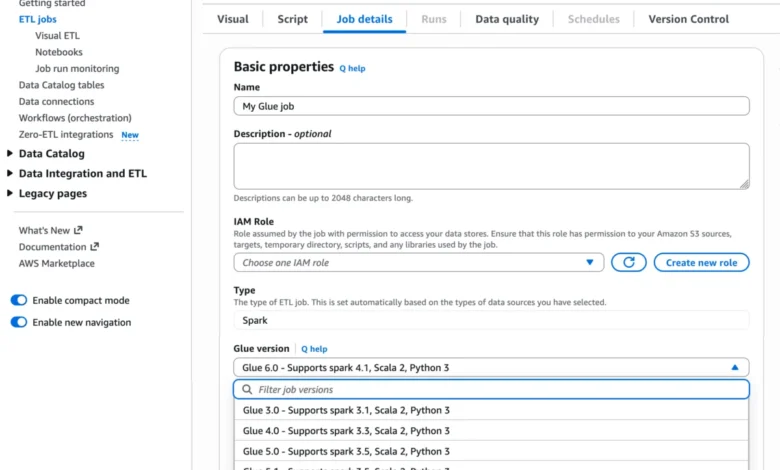
For users operating within the visual interface, navigating to the AWS Glue Studio console allows engineers to open an existing job, go to the Job Details tab, and select the newly designated "Glue 6.0 – Supports Spark 4.1, Scala 2, Python 3" configuration. For interactive development and exploratory data analysis using notebooks in AWS Glue Studio or Jupyter environments, data scientists and engineers can simply specify version 6.0 using the %glue_version magic command.
Recognizing that upgrading large fleets of production ETL jobs can be a complex undertaking, AWS has also introduced automated migration tools. Teams can utilize the Spark upgrade agent directly within AWS Glue Studio to analyze legacy codebases, identify potential compatibility issues between older Spark runtimes and Spark 4.1, and suggest or apply necessary refactoring steps. Alternatively, organizations can leverage the built-in auto-upgrade feature within their existing Glue configurations to seamlessly transition eligible jobs to the new runtime.
Global Availability and Ecosystem Integration
AWS Glue 6.0 is generally available immediately across all global AWS Regions where the service currently operates. Enterprises seeking specific Regional compliance, data residency adherence, or localized feature availability can consult the official AWS Capabilities by Region documentation.
Furthermore, to assist developers in adopting the new version, AWS has integrated support for the AWS Model Context Protocol (MCP) Server and associated plugins. This allows development teams to query documentation, verify Regional availability, call APIs, and troubleshoot deployment errors directly within their preferred AI-assisted coding tools and environments.
Broader Impact and Market Implications
The launch of AWS Glue 6.0 carries broad implications for the broader data management and analytics ecosystem. As data lakes mature into modern data lakehouses, the ability to process semi-structured data efficiently without cumbersome ETL pipelines becomes a critical competitive differentiator for enterprises striving to derive real-time insights from operational telemetry, clickstreams, and application logs.
By tightly coupling a 30 percent cost reduction with native Apache Iceberg v3 support and the modernized Spark 4.1 runtime, AWS has lowered the barrier to entry for advanced data architectures. Smaller organizations that previously found enterprise-grade data lake maintenance cost-prohibitive can now leverage serverless infrastructure to manage complex analytical pipelines economically. Meanwhile, large enterprises gain the performance headroom needed to process expanding data volumes while simultaneously driving down cloud infrastructure expenditures.
As organizations begin rolling out AWS Glue 6.0 into production environments, industry observers will be closely monitoring migration success rates, actual performance benchmarks on semi-structured workloads, and the broader adoption velocity of Iceberg v3 across cloud data platforms. For now, AWS Glue 6.0 represents a comprehensive, cost-effective, and technically advanced leap forward for cloud-native data integration.
Related posts: